







I never really thought about Pelican Shoal until three or so months ago. I’m not sure I’d even heard of it. I’d certainly never been there.
What got me thinking about it was a conversation with Chris Bergh. He’d mentioned that terns had nested out there in the past, particularly roseate terns, and it’s possible they were nesting out there still.
Once that seed was planted, I couldn’t stop thinking about the place.
Pelican Shoal is about 8 miles southeast of Key West and, like any shoal, the only way to get there is by boat.
The proåblem was that ridiculous real-world responsibilities kept popping up – work, home repair, poker games, feeding and occasionally walking the dog. And on days I was finally clear to head out there, it was windy or rainy or both.
Bergh is the Florida field program director for the Nature Conservancy, where he has been working since 1999. He also grew up here and has the most broad, grounded and versatile knowledge of the Keys ecosystems of anyone I know. He’s also great company.
I texted him in late July, asking something about sand fleas. He was out of town, but answered in his usually low-key, learned way. I mentioned something about still wanting to get out to Pelican Shoal.
“I’ll be home a week from today. Love to visit Pelican Shoal with you!” he texted back.
Three weeks later we actually managed to leave the dock. Along with us was Jana Mott, who used to live in the Keys, but now works for TNC out of Tallahassee.
Roseate terns have an odd distribution map, preferring to breed on small, coastal islands, largely in the warmer climes of the world – in the Caribbean, as well as off the coasts of Africa and China. But they also have small breeding colonies on islands from Long Island to Nova Scotia, as well as climatically similar habitats off of England and France.
Roseate terns, like least terns, evolved to nest on places like the sand, rock and coral beaches of the Keys. And like least terns, they have largely been supplanted from those habitats by human activity, but have adapted to nest on the gravel rooftops of commercial, and sometimes military, buildings in the mainline Keys. (The most reliable place to see roseates is the Marathon Government Center, but I have also seen them splash diving off of Fort Zachary Taylor, meaning they are probably nesting somewhere over on the Navy part of Truman Annex.)
One of the last places where they bred in their natural habitat was Pelican Shoal. And since they are a threatened species, Pelican Shoal has been a no-access zone since the creation of the Florida Keys National Marine Sanctuary in 1990.
The Florida Keys are a shifty place, though. Islands appear, disappear and reappear on a geologically regular basis.
While we were talking about the island on the boat, Chris gave a little of the shoal’s recent history.
“The birds pick these places because there are no predators. They like nice open, sandy, shelly, rocky places to nest with no trees around. So the predator birds can’t perch on them and prey on the young ones, or prey on the eggs. And so this was the spot. There were lots of roseate terns nesting here, fledging here, coming back year after year,” he said.
“The island was just sort of a low-lying sand and shell and coral rubble. Sediment could get washed away, but it could get washed in as well. And it built up big enough that a little bit of grassy, weedy vegetation grew on it. The birds were using it, and it was protected,” he said.
“People weren’t allowed to go on there, because it was the only place for the birds to nest. So you could come up close to it, but not go on it. There’s good diving right around it. So people are always around. But as long as they didn’t go on the island, the birds were fine,” he said.
“And then Hurricane Wilma in 2005 wiped the island off the map,” Bergh said.
Chris was on the Key West National Marine Sanctuary Advisory Council at the time, and there was some discussion in the years after about whether the no-access zone should be removed since it was no longer serving its purpose.
“But as soon as that got close to being proposed formally, another hurricane, Hurricane Irma in 2017, happened. And the storm came in and scooped up a bunch of sediment from the bottom, and redeposited it on the old spot, creating nesting-type conditions again. And within a short time, the birds started nesting again,” he said. Chris had been out there about two years ago, but not since.
It was an amazingly nice day on the water, easy running the whole way out. As we ran, the water was so clear you thought it was shallower than it was.
After about a half-hour I eased up on the throttle. As we got close to the island, the only other boat around was someone fishing way on the south side.
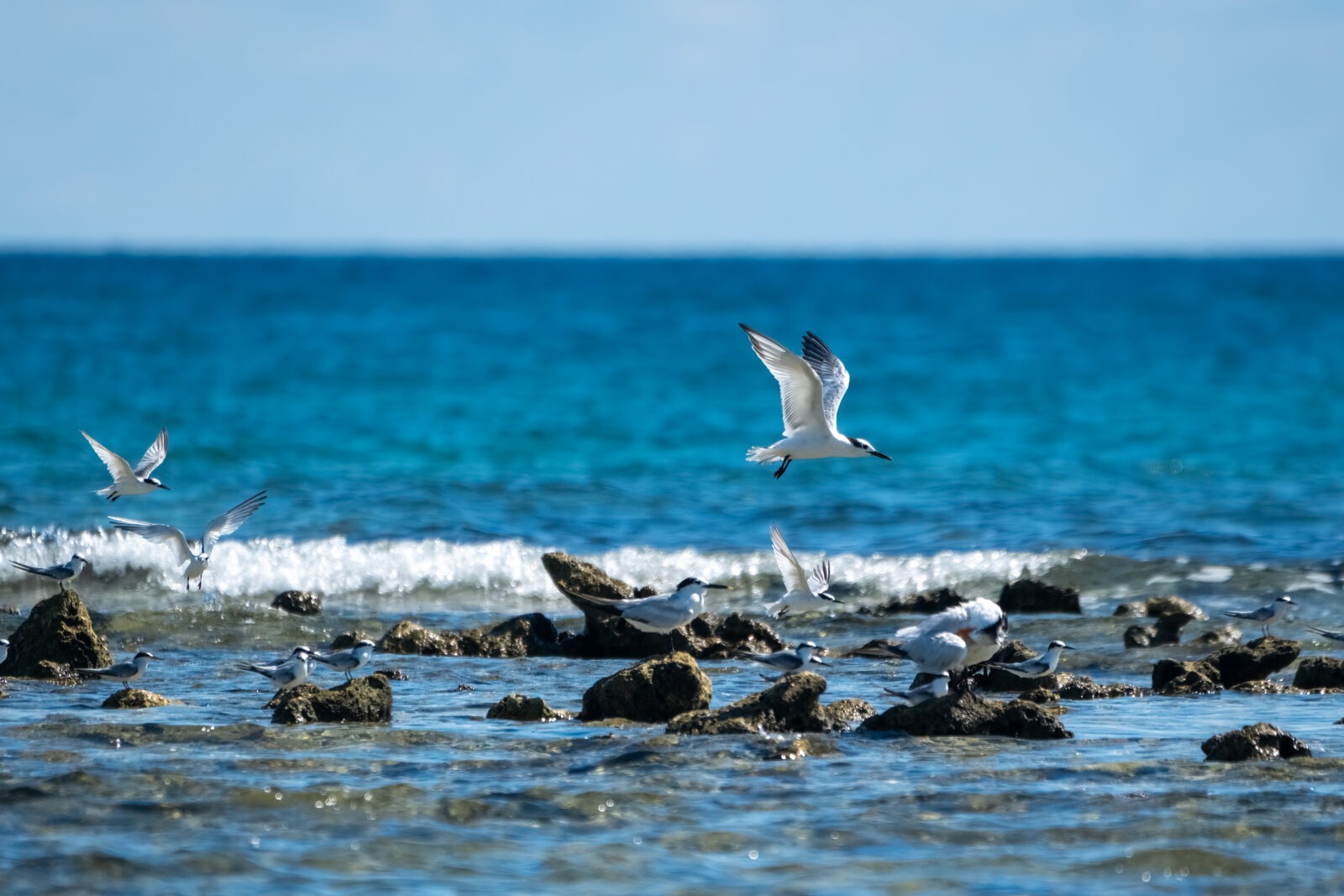
The first thing we could see was a long, narrow strip of brown rocks. Then, among the rocks, a lot of white spots, which were terns.
While there were a lot of rocks, most of them were only a few inches out of the water. And there was no dry substrate below. It seemed unlikely that any tern would risk nesting in any spot so vulnerable to wind and tides.
It looked to be a great place to roost unharassed, though. I lifted my binoculars and began to scan. It took a while. I scanned around a few more times, then decided to count. I tallied 360 least terns, 21 royal terns, nine Sandwich terns, six common terns, one spotted sandpiper and a pair of female magnificent frigatebirds that came in and made a half-hearted swoop at the flock – kleptoparasitic schoolyard bullies, trying to make sure they still got it.
There were no roseate terns, though. Maybe if we’d gone out earlier in the season we might have seen some.
“If we got a hurricane again this year, it could rework the sediments and put them back up on top of the shoal again. And it could be a nesting site again,” Chris said.