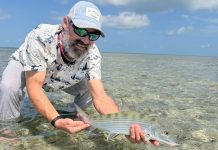
The mangrove snapper spawn is on.
Every summer, between the July and August full moons, our mangroves pull out of the backcountry, the bridges and the harbor pilings and slide out to the ocean side to spawn on the reef. They do it on the calendar. If you fish down here for a few seasons, you figure that out. So does every other captain with a chart plotter.
I took a family out last week during the July full moon window. The plan was to hit a spot another captain had put me on the day before. When we came off plane, there was already a boat sitting on it. That is the deal in July. If the fish are stacked, so are the boats. We slid a quarter mile over to one of our regular yellowtail holes, dropped the hook and got the chum bag over the side.
The bite came right up. A few solid yellowtails on light tackle, kids bent over the gunnel, everybody yelling. Then the current switched on us and started pulling the chum slick back under the hull instead of trailing off the stern. When the slick goes under the boat, the fish go with it, and the bite dies right there under your feet. It happens all the time in the summer down here.
I looked back at the mangrove spot. The other boat was pulling his hook and heading home with his fish. We picked up, eased over, dropped in 25 feet of water and it was on. Mangroves stacked in the slick. Bent rods, screaming drag and kids having a field day. That is the whole reason you take a family out in July.
We ended up with plenty for lunch and a couple of sandwiches for the next day, wound in the lines, and ran back to the dock.
Why they show up on the reef
The fish you catch inshore all year, off a bridge or a mangrove root, are the same fish that stack up on the reef right now. Biologists call them gray snapper, Lutjanus griseus. They start life in the seagrass and mangrove shorelines as juveniles, then move onto patch reefs and structure as they grow. They are slow. A mangrove pushing 4 or 5 pounds might be 15 or 20 years old. That is not a joke. That is a fish that was swimming when a lot of the kids on my boat were still in diapers.
Once a year, on the summer full moons, the mature ones stack up on the same reef spots and spawn. Same lunar window, same fish, year after year. That is a gift for anyone with a rod. It is also a trap.
The trap part
Spawning aggregations are the easiest fish in the ocean to overfish. Everybody knows when and where. Nassau grouper are the cautionary tale nobody in this town wants to become. Those aggregations got hammered for decades and they still have not come back. Our mangrove population is in better shape than that, and I would like to keep it that way. Same for you.
So here is how we fish this stuff on DirtyBoat when the spawn is on. Nothing complicated.
Keep what you are actually going to eat. Not a limit for the picture. Not five per person because the state says you can. Enough for tonight’s dinner and maybe tomorrow’s sandwich, then wind in.
Release the giants. The biggest fish in the pile is almost always a mature female, and a big female carries more eggs than a small one. Killing her for a Facebook photo is a bad trade. Let her go and she makes more mangroves for the next fifteen years.
Do not grind the same spot every trip. If you hit a spawn pile hard on Monday, go somewhere else Tuesday. Give the pile a breath. It will still be there next full moon if you let it.
Handle released fish right. Wet hands, quick unhook, straight back in the water. If a fish came up from real depth and is bloated, vent it or send it back down with a descender. A released fish that floats off and dies is worse than a kept fish that fed a family.
A quick word on the rules, because they change on you as you run offshore. In Florida state waters, mangroves are a 10-inch minimum, five per person daily, inside the aggregate 10 snapper limit. The second you cross into federal waters, which is most of the reef out from the Keys, the minimum size jumps to 12 inches and the bag opens up to 10 per person, still inside that 10 snapper aggregate. So if every fish in your box is over 12 inches and you are outside three miles, on paper you can keep twice as many.
The catch is, if you have anything under 12 inches in the box, that fish had to come from state waters, and state rules apply to what you are holding. You cannot mix a state-water fish with a federal-water pile and keep the bigger bag. Something to keep in mind before you count to 10 on the reef.
That is the ceiling. It is not a goal. On a spawn pile, the goal ought to be lower than the ceiling.
The bottom line
The mangrove spawn is a summer gift down here. Light seas, close water and fish that want to eat. It does not take a hero run offshore to find them. It takes a chum bag, a bag of oats, a spot 20 to 30 feet on the reef line and a little patience when the first spot is already taken.
Just remember what you are fishing on. That pile of fish is not a coincidence. It is a spawn. Take what you are going to eat, let the big ones go, and give the spot a rest between trips. The reef gives back to the people who do not take everything.
The August full moon lands in a couple weeks. The bite is not done yet.