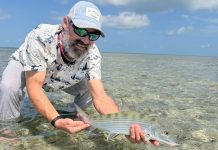
We started before sunrise working sabiki rigs in the back of the bay. First thing in the morning before most people’s alarms go off.
We got the pilchards loaded in the livewell and ran offshore. FishIntel had us looking at the Islamorada Hump. Chlorophyll was stacked on the deep water break southeast of Alligator. The Gulf Stream was sitting 4 to 8 miles off the beach in 84-degree water. It looked like a deep-drop day.
We set up on the hump and started working the thermocline with dual electric reels. Thick bands of bait on the sonar, sardines and squid stacked in the column. First mate Thomas set the drops and within minutes we were into vermillion snapper and yelloweye. Nice fish. Not dinks. The kind that make the cooler look good. We stayed on it, working both reels, swapping baits. The hump was doing what the Hump does.
Then things changed fast.
Our customers spotted it first — bait on the surface, maybe 200 yards off the stern. Not a few fish flipping. A wall of sardines getting run over by everything in the ocean. Blackfin tuna on top. Wahoo slashing the edges. Bonito and barracuda running through the middle like they had somewhere to be. Every boat in the area noticed it the same second I did. VHF went quiet. Everyone started moving.
Thomas grabbed a pilchard out of the livewell before we’d even stowed the electric reels. Pitched it underhanded, soft toss right into the middle of that mess. The bait sat there maybe half a second.
Sailfish.
“Got ’em on!”
The fish lit up, went deep, came back, burned line. Matt locked in on the rod. I was on the wheel trying to work the boat with half the fleet packed into the same patch of water. Every boat around us was hooked up. Lines crossing. People yelling. Engines everywhere.
Then the second one showed up.
She came up right behind the first fish, pectoral fins fanned out, bill slashing. Just appeared out of nowhere the way sailfish do. Matt still grinding on the first one, me on the bridge staring at this second fish circling thirty feet off the stern, screaming down at Thomas: “Second one! Right there!”
He pitched another pilchard one-handed. She ate it. We were doubled up.
With boats packed in on all sides there was nowhere to go. Right means crossing lines. Left means the same. The second fish made a run for the props. We had two seconds. Didn’t get there. She threw the hook in the turbulence off the stern.
We kept working the first fish. Matt had been on her 15 minutes, gaining leader, losing it, gaining it back. You don’t rush it. Back down when she gives you the angle, keep pressure when she doesn’t.
Eventually she came close enough. Thomas reached over the gunwale and got a hand on the leader. Caught fish. Leader touch counts on a billfish — tournament rules. She went back into the blue and swam off like nothing happened.
I stood there for a minute just looking at the water. Eleven years running charters out of Islamorada. I’ve had good days. Great days. This was a different category altogether. It was a National Geographic show out there. Matt had the look on his face you only get a few times in a career. I’ve seen that look before and I never get tired of it.
The bite is still going.
The conditions
Water temperatures are 83 to 85 degrees, Gulf Stream close — 4 to 8 miles off Alligator Light. That’s tight for June. Mahi should be right on that color change where the green water meets blue, stacked up on whatever weed and debris is floating the edge. FishIntel has a convergence zone about ten to fifteen miles southeast of the reef, which is where I’d start. Look for birds.
Deep-drop bite on the Hump has been steady all week. Vermillion, yelloweye, some misty grouper. Dual electric reels, fresh-cut bait, work the thermocline. Not glamorous but the cooler doesn’t know that.
Mutton snapper are on the deep reef right now, staging ahead of the spawn. Work the current edges in 90 to 120 feet. Pilchards, free-lined live grunt, keep it simple. Winds have been southeast five to ten all week, seas one to two feet. There’s no reason to stay at the dock.
As for where the sailfish were — find your own bait balls.
July is filling up. Get on a captain’s calendar.
Tight lines.