










By Liah Continentino
Have you ever noticed the fronds on your palms looking dry and brown, with accumulations of crumbly brown pellets stuck to them? If so, you may have palm leaf skeletonizers.
The palm leaf skeletonizer, Homaledra sabalella, is a small moth native to Florida and the Caribbean. The moth itself is inconspicuous, but the feeding damage caused by its larvae can alarm homeowners and landscapers. While the adult moths feed on nectar, their larval, or caterpillar, stage feeds exclusively on palms.
Researchers have recorded these caterpillars feeding on 78 palm species, including many popular landscape plants such as coconut, cabbage, fan and thatch palms. The species earns its name from its feeding pattern, referred to as “skeletonization.”
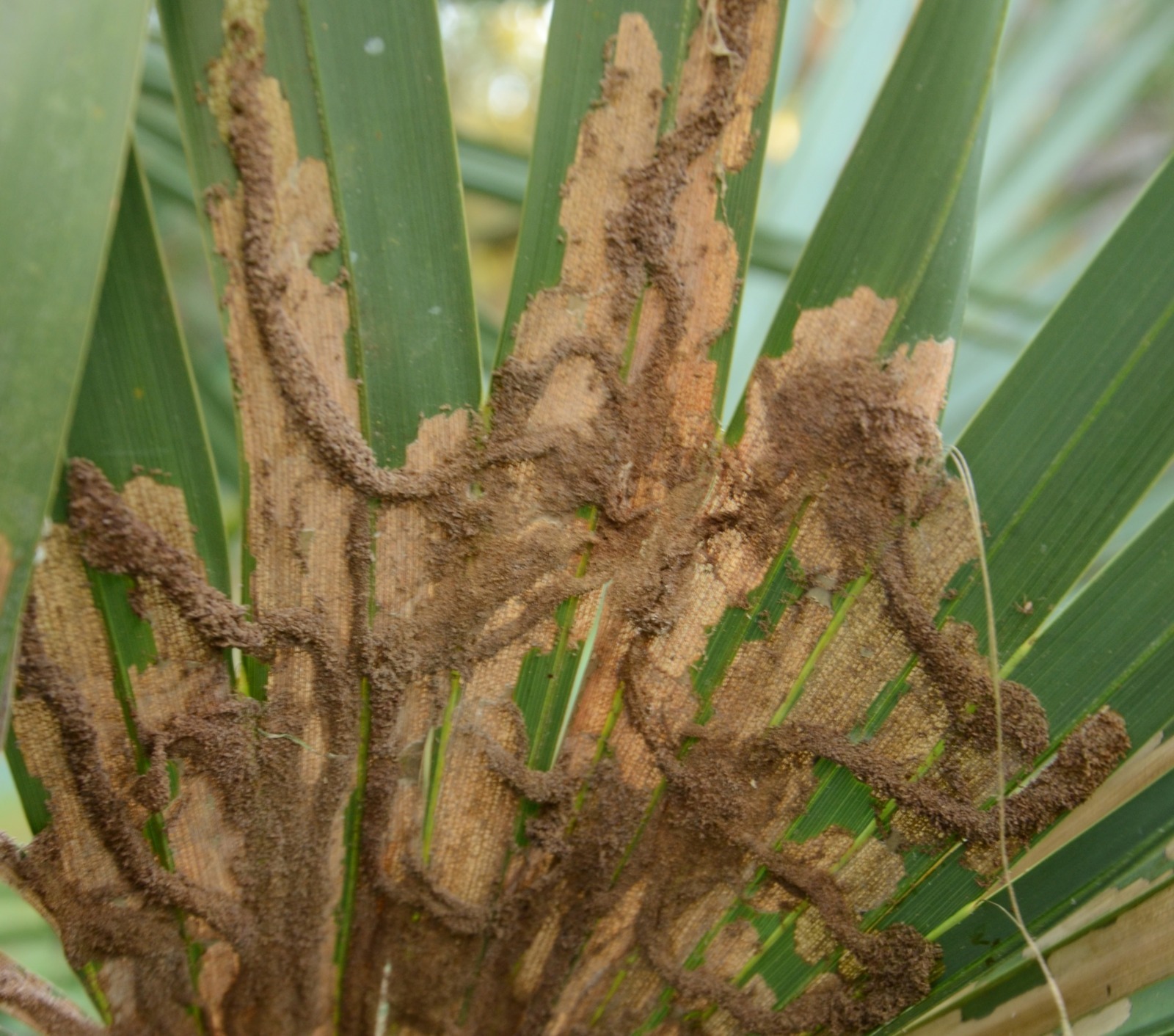
Skeletonization occurs when the soft tissue of a leaf is eaten away, leaving behind thicker veins and giving the leaf a lace-like skeletal appearance. This pattern is shared by many moth species, but if you see this feeding damage on a palm, you are likely observing the palm leaf skeletonizer.
Unlike many seasonal pests, palm leaf skeletonizers are active year-round. They feed gregariously, gathering in groups on both the upper and lower surfaces of fronds and forming tubes from their droppings, referred to as frass.
Identifying a palm leaf skeletonizer can be easy if you know what to look for. You may never see the adult moths or even the caterpillars, as they are well hidden under their frass. What you will likely notice is the skeletonized leaves. This, in combination with an accumulation of frass, which looks like small brown pellets, is a strong sign that you have palm leaf skeletonizers.
The good news is that despite their dramatic feeding patterns, palm leaf skeletonizers rarely cause serious harm to palms. Their damage is primarily cosmetic. For homeowners who want to minimize their presence, early detection is key. Regular inspection of palms can help you spot the frass tubes and skeletonized patches before damage becomes widespread.
Fortunately, managing them doesn’t require harsh chemicals or even a trip to the hardware store. In fact, horticultural soaps and oils, and other insecticides, have little effect on the caterpillars, as the frass tubes provide them with protection from these products. Instead, the best methods for lowering palm leaf skeletonizer populations are mechanical. You can easily control caterpillar populations by washing them off of the leaves with a strong hose or a wet sponge; this is best if the leaf is still mostly green, as the damage left by the caterpillar will not heal. Another option is to prune the infested leaves and dispose of them by securely sealing them in plastic bags.
If you suspect palm leaf skeletonizers on your property or want guidance creating a management plan, the UF/IFAS Monroe County Extension Service can help. Contact Liah Continentino for more information: Continentino-liah@monroecounty-fl.gov or 305 998-9580.