












Once you place your trash, recycling and yard waste at the curb, your job may feel complete, but the journey of your waste is just beginning.
Monroe County does not process any waste locally in the Keys. Instead, all collected materials are transported to Monroe County transfer stations, where they are stored separately to prevent contamination. From there, each waste stream — yard waste, recyclable materials and municipal solid waste — is loaded into semi-trucks and hauled to specialized processing facilities on the mainland.
Recycling: What happens after the blue bin
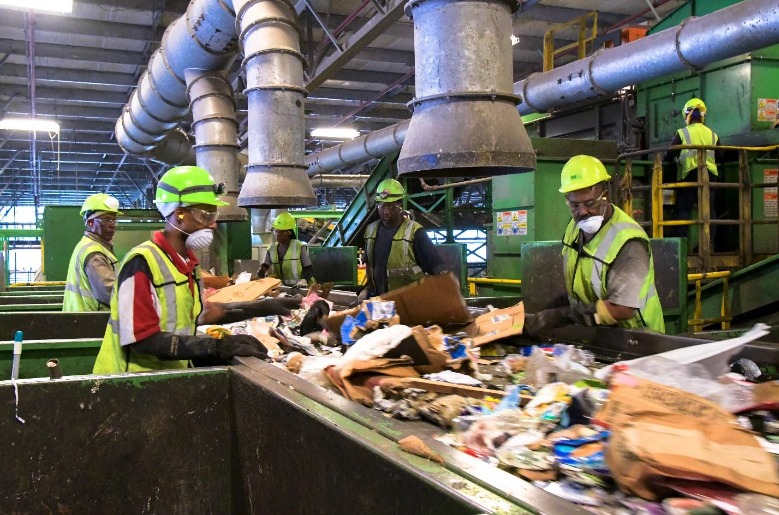
Recyclables such as paper, cardboard, aluminum and steel food cans, glass bottles, and plastics Nos. 1, 2 and 5 are taken to Reuter Recycling Facility in Pembroke Pines. There, they are carefully sorted, cleaned and baled together with like materials. These bales are then sold to manufacturers to create new products — keeping valuable resources in circulation and reducing the demand for virgin materials.
Yard waste: Turning green waste into garden gold
Grass clippings, palm fronds, leaves and other landscape debris are hauled to an organics processing facility, where they are composted into nutrient-rich soil amendments. This process not only diverts bulky material from landfills but also supports soil health and reduces the need for chemical fertilizers.
Trash: The long road to a landfill
Municipal solid waste — the everyday trash that cannot be recycled — has the longest journey. Monroe County hauls trash to the Medley Landfill, about 150 miles from Key Largo, or to the Lake Okeechobee Landfill, about 200 miles away. These facilities are projected to reach capacity within this decade.
Transporting waste this far incurs significant financial and environmental costs. Hauling trucks emit carbon dioxide, carbon monoxide and nitrous oxides, and generate brake and tire debris, which can wash into waterways. Once buried, the food waste within trash produces methane, a potent greenhouse gas that accelerates climate change. Notably, food is the heaviest component of the trash stream, making municipal waste more expensive to transport and more harmful to the environment.
Choose reuse: Small habits, big impact
This holiday season — and every day — simple choices can significantly reduce waste:
- Use refillable beverage bottles.
- Set your table with reusable plates, napkins and utensils.
- Give gifts in reusable bags.
- When dining out, choose to refuse single-use utensils, napkins, condiment packets, straws and plastic bags.
- Avoid food waste: let your compost worms have a taste.
A single take-out meal with disposable packaging can fill an entire kitchen trash bag. Reusables prevent additional waste, conserve resources and reduce the impacts of long-distance hauling.
Compost or drop it off
Food scraps don’t belong in the landfill — they belong in compost. Composting at home reduces methane emissions and produces a nutrient-dense soil amendment for gardens.
Don’t have time to compost or don’t live here full-time? Monroe County offers five local food scrap dropoff sites, all listed at makesoil.org.
Upper Keys residents can also participate in the free food waste collection pilot program in Key Largo and Tavernier, thanks to a partnership with SoilMate Compost Farm and Baptist Health. Register and access three convenient dropoff locations. Visit your-soilmate.com/pages/monroe.
A delicate community
Monroe County is a unique island chain with a fragile environment that we all cherish. As we move into 2026, let’s commit to small, meaningful changes that protect our islands for future generations.
Little steps make a big difference. Be responsible in your choices, take advantage of available waste-diversion opportunities, and help reduce what we send to landfills.
Together, we can keep the Keys clean, resilient, and sustainable.Email tuschel-melody@monroecounty-fl.gov with questions.