


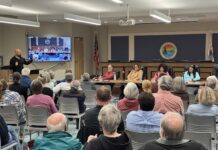






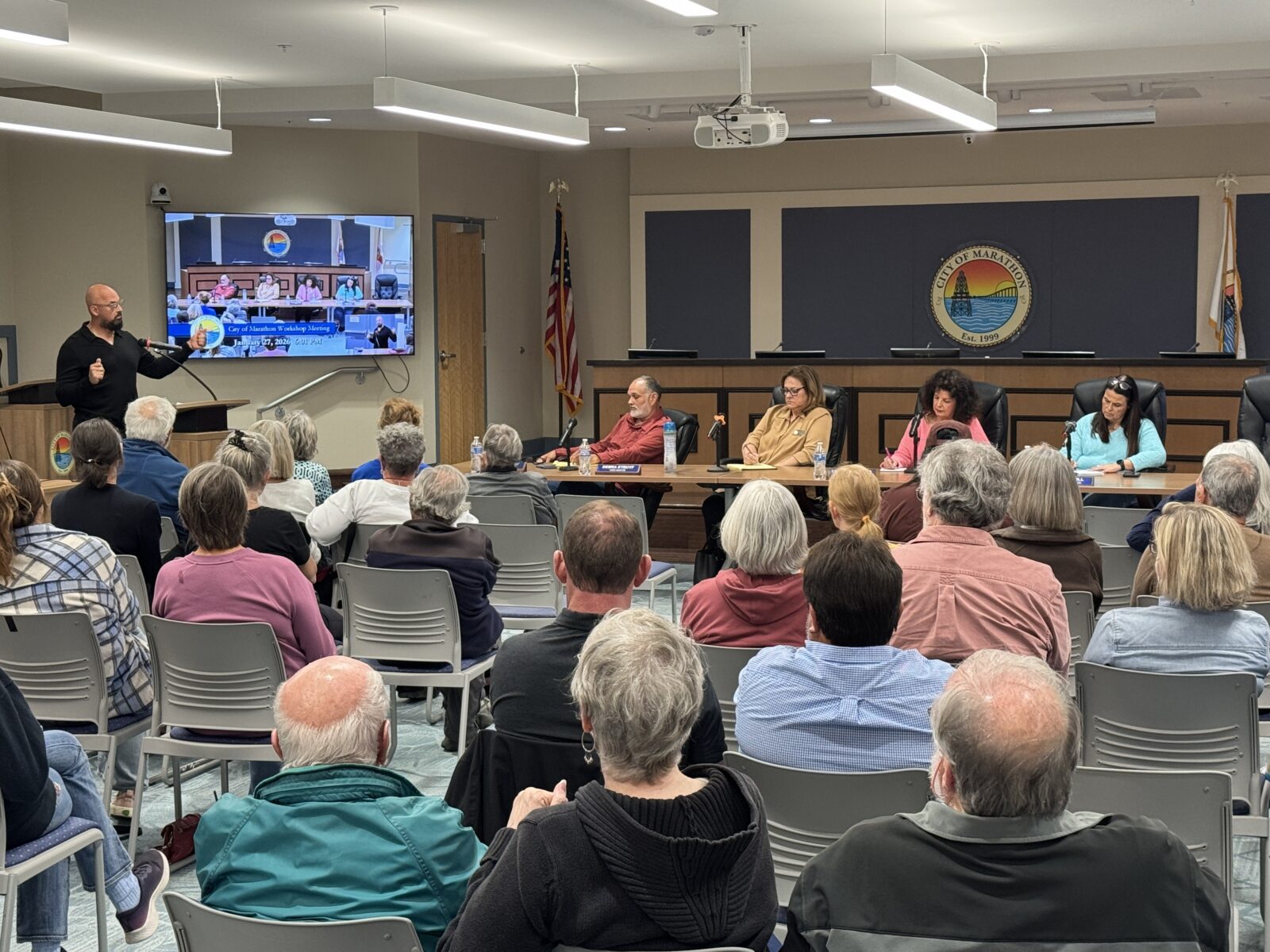
The Marathon City Council’s Jan. 27 workshop was the first in months to feature open-format discussion between residents and council members on issues affecting the Middle Keys. Instead, it was national headlines on the minds of more than half the speakers from a crowded room.
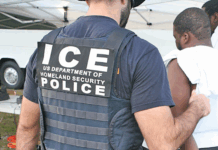
Public commenters spoke of widespread concern for the actions of Immigrations and Customs Enforcement, both locally and across the United States.
Thirty-four-year Marathon resident Mary Akroyd told the council that while Marathon’s student body is an inclusive mix of races and cultures, recent enforcement tells another story.
“These kids are a beautiful blend of every race, color and most likely creed. Homecoming and prom kings and queens reflect our community’s inclusive identity,” she said. “The policing forces in this town are already too many to count … during Irma, COVID, these forces kept us safe. Not so much now. Our nasty, and now deadly, national narrative has turned this peaceful town into a place unsafe for our immigrants, brown people, and recently, legal white citizens.”
Key Colony Beach resident Laurie Swanson described being handcuffed by a Florida Highway Patrol trooper after filming an immigrant being detained.
“Is that what we want in Marathon? Law enforcement by intimidation?” she asked. “The detainment for me exercising my First Amendment rights in a public space is illegal. … I was and continue to be shocked that this happened to me, an elderly, light white American woman who was not breaking any law. If it happened to me, it can happen to you.”
Acknowledging that the council lacks jurisdiction over federal agents, a number of speakers asked the council to consider resolutions in support of Marathon’s immigrant community and proper due process for the detained.
“What is happening right now is creating fear in our community. Families are afraid to go to work. Children are afraid their parents won’t come home. Businesses are struggling because workers are not showing up for fear,” said Shark Drive resident Isaac Valdez.
“These individuals are not statistics. They are our neighbors. I am not here to debate federal law. I am here to ask for local compassion. I ask the city of Marathon to take a public stance that reflects the values of this community. … Silence during times like this feel like agreement, and many of our community are watching and hoping that the local leaders will acknowledge what is happening and stand for the people who help make the city what it is. We can be a city that follows the law while still advocating for humane treatment.”
Council members said that while they were unprepared to discuss the issue immediately, expecting other local topics from the workshop session, they were open to other meetings set to discuss the issue of ICE exclusively.
“I think we all care more than you guys realize, but we have our hands tied to a point, and this is not something the Marathon City Council can just change,” said Vice Mayor Debbie Struyf. “It’s not a topic about who we voted for, it’s a topic about what’s happening in our community. We don’t like it.”
“My family won’t come down here to visit me, because my mom’s husband is from Spain,” said Mayor Lynny Del Gaizo. “So it hits us all, and this is personal.”
Another commenter asked the council to renew its architectural review committee, taking exception with the appearance of new buildings along U.S. 1.
Marathon Bike Works owner Brandon Manzer and resident Riet Steinmetz both asked the council to ramp up safety measures in town as Marathon experiences an explosion in e-bike use.
Manzer said he’s experienced a severe uptick in tire repairs caused by debris left on bike paths – three times as many as his shop in a “bikeable community” in Michigan. As more residents use bikes for their commutes, he also asked for refreshed markings on bike paths to avoid collisions.
City Manager George Garrett said the majority of the paths along U.S. 1 are maintained by the Florida Department of Transportation (FDOT) or the Department of Environmental Protection as the Overseas Heritage Trail.
“Could (these things) be done? Absolutely, but it would take some coordination to do it,” he said.
Gulfwinds Lane resident Riet Steinmetz said she has nearly collided with high-speed e-bikes riding on sidewalks against the flow of traffic as she pulls from side streets onto U.S. 1. She asked the city to require bikes to follow car traffic, allowing motorists to monitor both the flow of traffic and oncoming bicycles from a single direction.
“Education is the biggest key to all this,” said councilman Lynn Landry. “There was a time when (DOT) put little stop signs on U.S. 1 through every intersection. Why they disappeared, I don’t know. On the south end of town, we do have bicycle lanes and you ride with traffic. There was a point when the sheriff’s office was writing tickets to people riding against traffic. So it has been done, and we can do it.”
Garrett said some signs could be installed by city workers, pending permission from FDOT.