





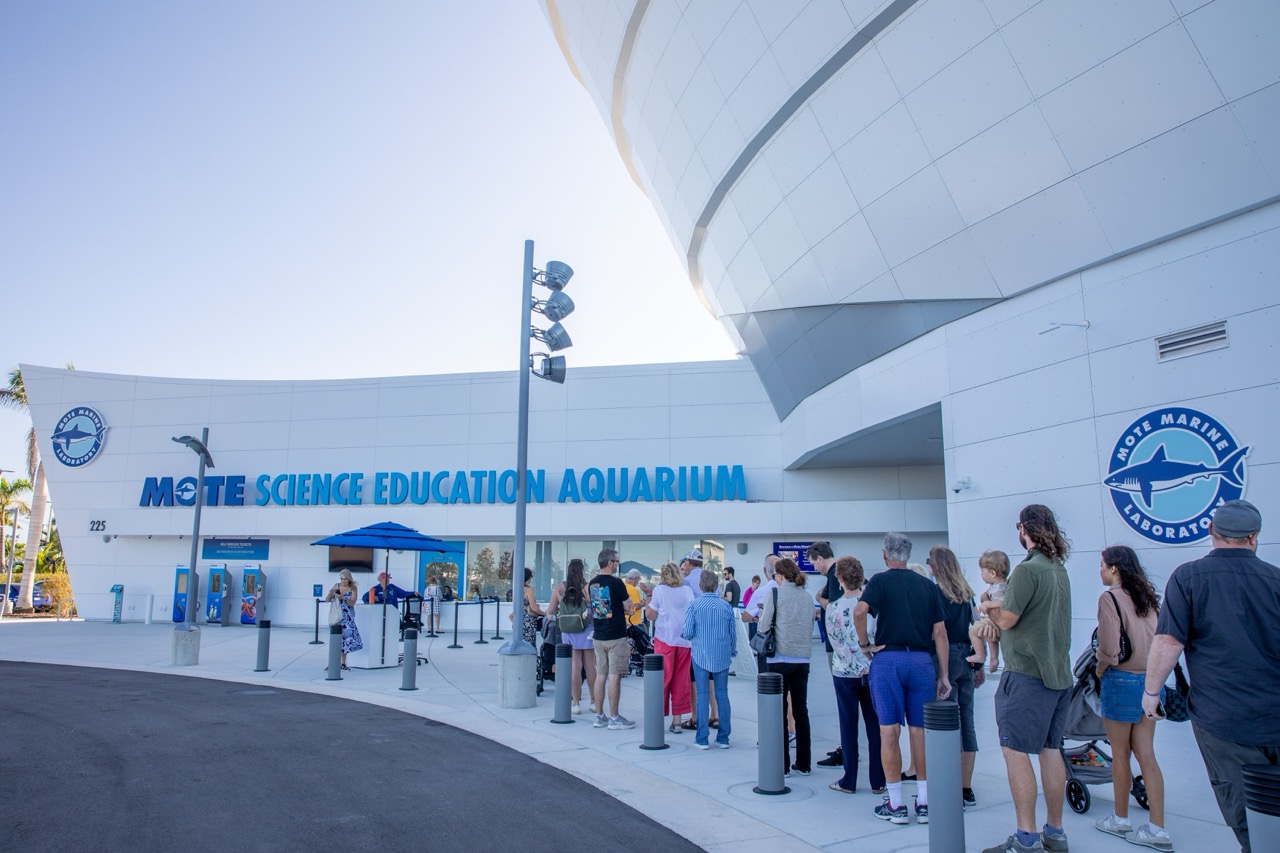
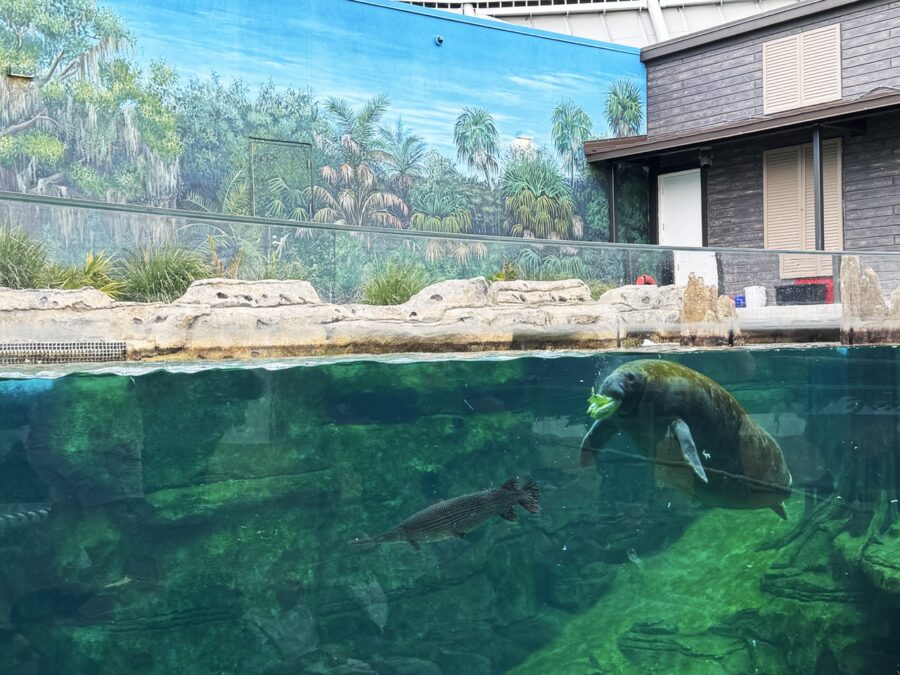
The agenda included close encounters with sharks, rays, manatees, penguins, sea otters, octopuses, coral reef and more as a group of public officials, community members and Mote Marine Laboratory staff from the Florida Keys traveled to Sarasota to tour the new attraction and research facility, Mote Science Education Aquarium, or Mote SEA.
Officially opened on Oct. 8, 2025, Mote SEA is a 12-acre campus offering engaging science education while enhancing ocean literacy in a 146,000-square-foot facility. It replaced Mote City Island, the home of the Mote Aquarium since 1980. This new addition is the 10th campus for Mote, with six in the Keys, including two more in the planning and building stages.
The Keys locations include Mote’s Elizabeth Moore International Center for Coral Reef Research & Restoration, Summerland Key; coral nurseries at Bud N’ Mary’s, Islamorada and at Reefhouse Resort, Key Largo; coral reef exploration exhibit at Keys History & Discovery Center, Islamorada; mangrove to reef exhibit at Crane Point Museum, Marathon; and coral research exhibit at Eco-Discovery Center, Key West.
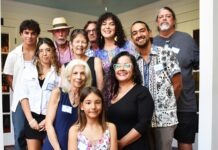
Mote’s Keys advisory committee members making the trek included chairman Peter Rosasco, George Garrett, Margie Smith and this writer. Other attendees include Monroe County Mayor Michelle Lincoln and commissioner Holly Raschein, Charlotte Quinn, Julie Cheon and Kate DeLoach.
“Shortly after I became chair of the Keys advisory council in 2003, I was lucky enough to attend a Mote trustees annual meeting where Dr. Eugenie Clark (Mote’s founding director, who died in 2015) was the keynote speaker,” Rosasco said. “She delivered a powerful and beautiful message that resonated with me: ‘Mote is a unique organization in the world of marine science. Since we are primarily funded through philanthropy, and not through a university or other public program, we are not constrained by political concerns.’
“‘As such, we are able to be totally focused on applied science — we attract the best and brightest marine scientists and allow them the freedom to not only do cutting edge research, but just as importantly to study how to use the results of that research to implement real world solutions to the many challenges that our marine ecosystems are facing in today’s world.’ This is the mission of Mote,” Rosasco continued.
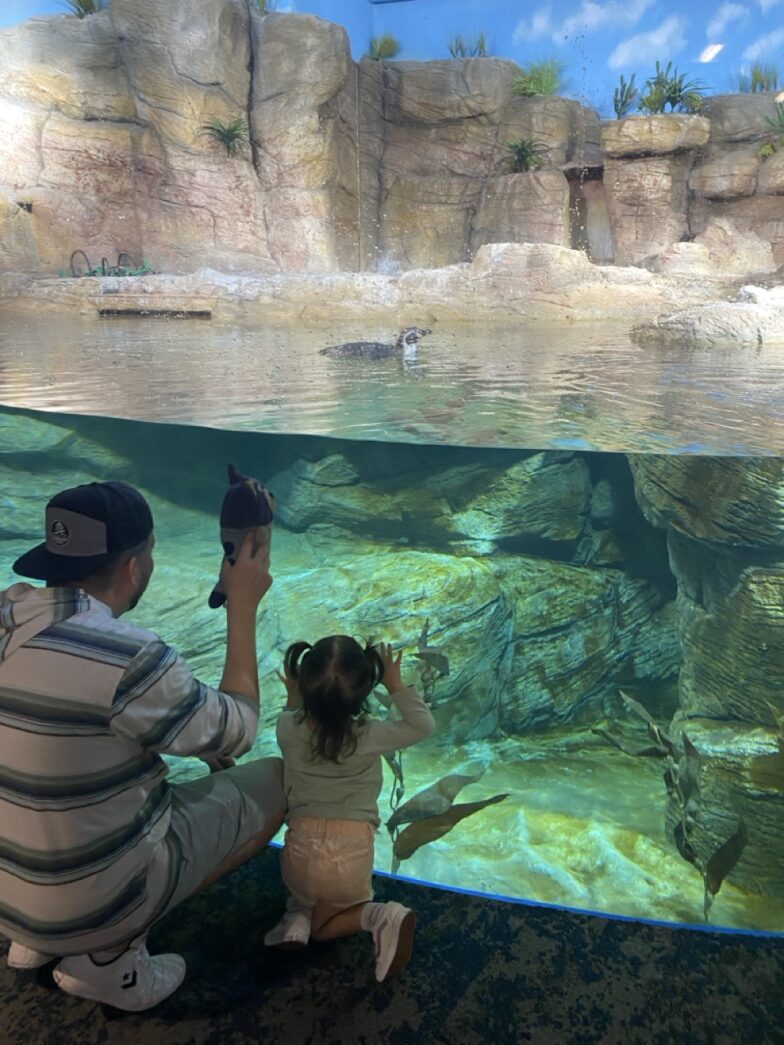
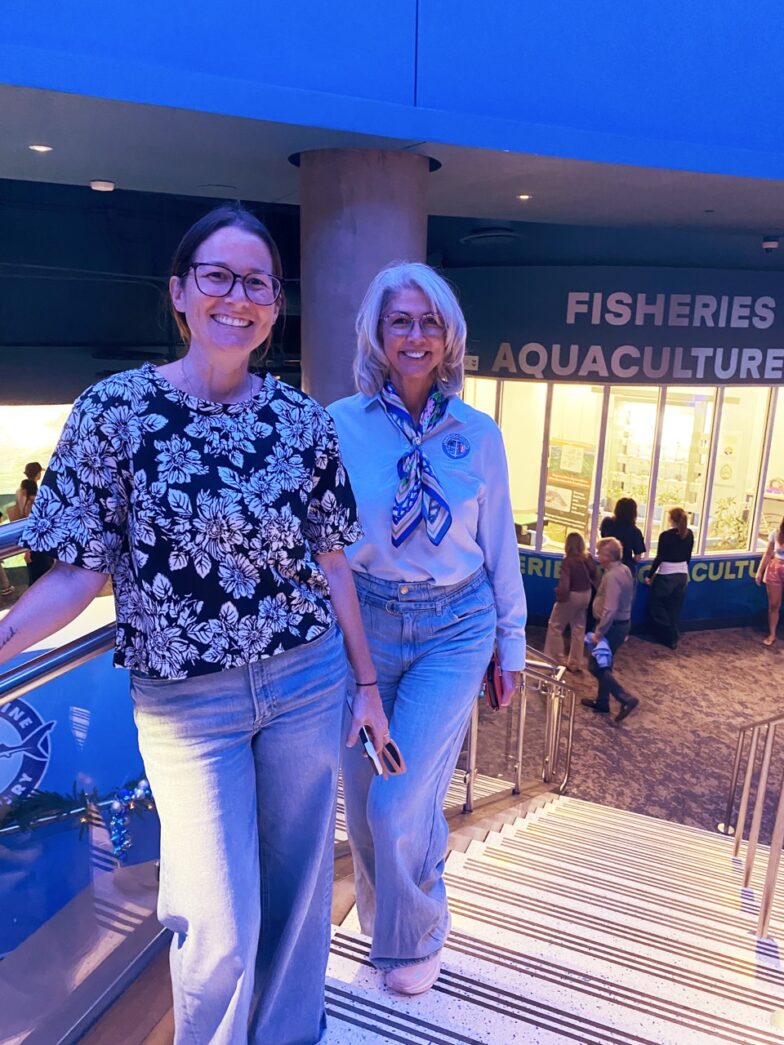
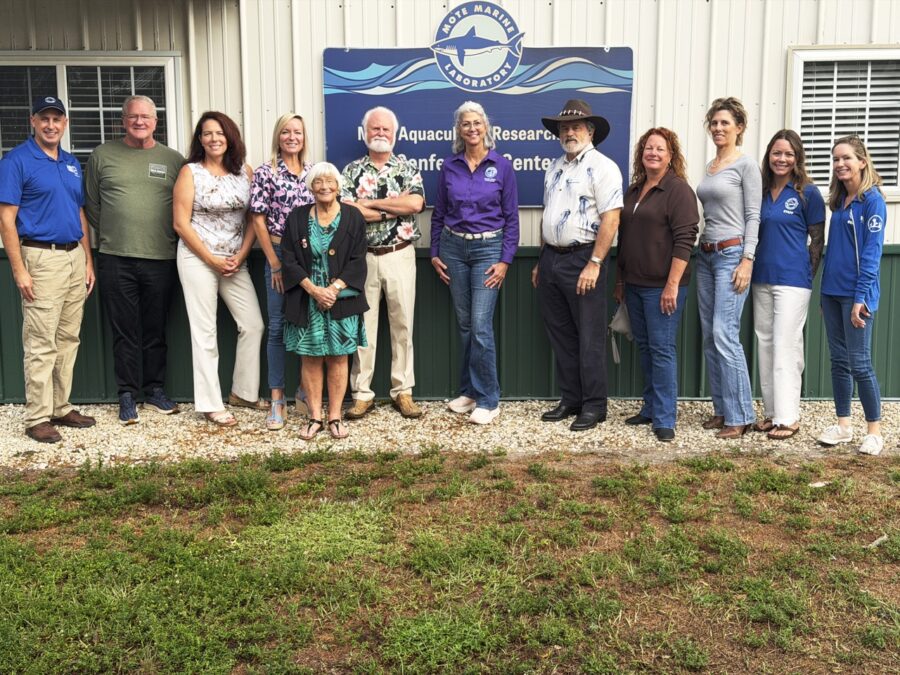
After a greeting session with Mote CEO and president Michael Crosby, and Kevin Claridge, Mote’s vice president for sponsored research and coastal policy programs, the group set out to explore the three floors.
On this recent Sunday, the attraction was bustling with hundreds of visitors of all ages who were delighted by the sea creature encounters, learning and engaging with marine life and Mote staff in ways many people never get to see. Each of the three galleries had a unique focus area — Florida’s Gulf Coast, Florida Waters and Indo-Pacific — with marine creatures from each area.
“In the first two months, we have welcomed more than 200,000 visitors,” Crosby said. “In the City Island location, we attracted 350,000 annually.”
With more than 320 employees, including 45 Ph.D.-level scientists and 1,400 volunteers, Mote anticipates an estimated 700,000 visitors in the first year.
In addition to the many aquarium exhibits, Mote SEA features three state-of-the-art STEM teaching labs geared to K-12 students and five STEM workforce training labs for professional education for high school and college students. The labs all include wall-to-wall glass windows, so guests can observe and enjoy scientists and students learning and conducting research in real time. Also readily available are a gift shop, retail kiosks and food and drink offerings.
The $167 million facility was 10 years in the making with the building, construction and infrastructure financed by philanthropy, partners and public support.
“As a completely independent nonprofit marine research and science education institution,” Crosby said, “Mote is unlike any university or agency in having an entrepreneurial culture for advancing innovative research and technology development built on passion for our mission, partnerships around the world, and philanthropic support that allows us to challenge existing paradigms of science.”
The group later toured the Mote Aquaculture Research Park, also in Sarasota, which was built in 2001 to pioneer the development of sustainable aquaculture technology to help feed the world, restock depleted species and address the need to develop a viable, domestic aquaculture industry in the U.S.
Today, the research park continues to advance this effort while hosting additional components of Mote Marine Laboratory’s mission including a red tide initiative, an international coral gene bank and a crab hatchery.
Scan the QR code to plan a visit to Mote SEA or to any of the Keys locations.