










We were moments away from several thousand bike-riding zombies rolling past us and swarming across the island when my friend Rob asked, “Hey, is it true all the turkey vultures we see here are from Ohio?”
For some reason the question threw me. Possibly because I was focused on taking photos of the rolling zombies as they pedaled by, and partly because I wasn’t totally sure of the answer.
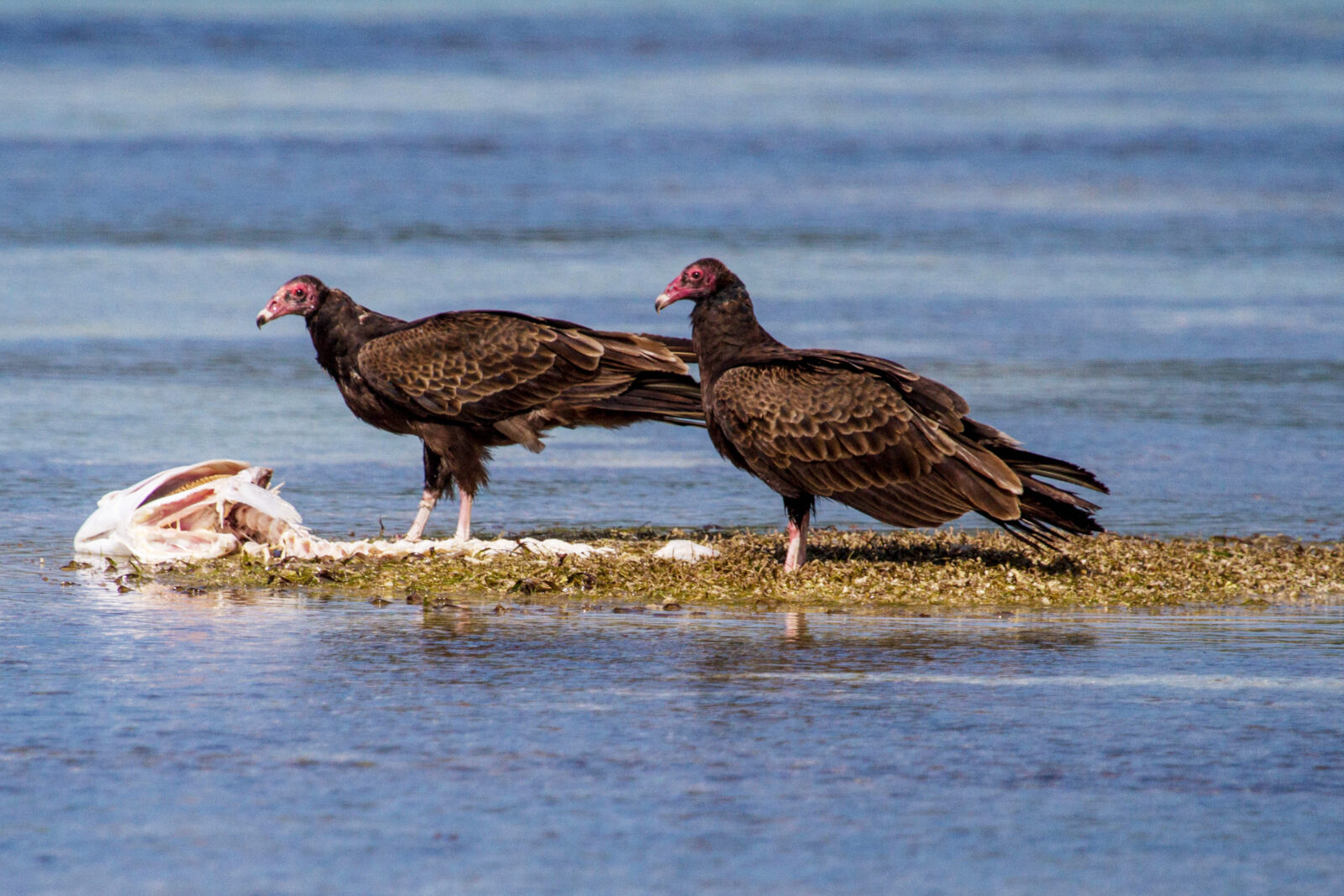
I mean, all the turkey vultures we see in the Keys are definitely not from Ohio. But some could be. And I remember hearing something about them being from Ohio when I first moved to the Keys in the early 1990s, before I was into the whole birdwatching thing. Was there any basis to the notion?
Geoff Tomb lives in Key West, but spent many years on the mainland working for the Miami Herald. I seemed to recall him occasionally working the “Oh my God, the turkey vultures are back” beat. So I texted and asked him.
Turns out Geoff did cover the story several times, referring to the yearly story as “an annual winter bright.”
“Something about Cuyahoga,” he texted.
Then he sent me a link from a website called Ohio Traveler about the town of Hinckley, where the turkey vultures are said to return every March 15, and where thousands of people show up to welcome them as harbingers of spring.
It should be noted that a lot of writing about turkey vultures refers to them as buzzards, which, in a taxonomic sense, is wrong. Buzzard is an Old World term for several species of soaring hawks. It was bastardized in North America as a term for vultures, a bastardization enhanced by the character Beaky Buzzard in the old Warner Brothers cartoons.
Rather than getting into a pedantic snit about people using inaccurate terms to describe wildlife, I’m going to take a few breaths, recite my secret mantra, and try to accept the term buzzard as fun slang for vulture, if not an accurate scientific term.
Anyhow, the story from Ohio Traveler states that, “Every March 15, like clockwork, the buzzards return to Hinckley after their winter vacations.”
It attributes this to the Great Hinckley Hunt of 1818, when, on one December day, the locals, deciding the wildlife was the enemy of agriculture, surrounded a 25-acre plot of woods, drove all the wildlife to the middle, and shot everything they could. According to one historical account, “21 bears, 17 wolves, 300 deer and untold numbers of turkeys, foxes and raccoons” were shot.
What people didn’t bring home for food was left to freeze, then thaw in the spring.
“When the buzzards arrived in the spring, the feast apparently was so overwhelming that the event was imprinted on the inherent part of their brains because they’ve come back every year since,” the website states.
Which is all a bit of homespun hooey. It’s doubtful a species of birds would return to the same site every year for close to two centuries because their ancestors once had a good meal. Also, modern research shows that turkey vultures won’t eat anything that’s been dead longer than four days. Most likely they come because the rocky bluffs above the nearby lake are perfect nesting sites.
An annual Hinckley Buzzard Day has honored their return on March 15 every year since 1957, drawing up to 5,000 people. There’s a pancake breakfast, people in vulture costumes and an official counter to point out the first returning vulture of the year. The fact that turkey vultures are regularly reported in the park weeks before March 15 shouldn’t get in the way of a good time.
While they arrive in the north every spring, the turkey vultures arrive in Florida every autumn. The Florida Keys Hawkwatch has counted a little over 1,500 so far this year. I’ve also seen a couple posts on Facebook of the “They’re ba-aack” variety with photos of kettles of them in the blue sky. One post said it was now okay to take down your hurricane shutters. (The same lore applies to the klee klee call of the American kestrel. Though in 2005, I both heard the klee klee and saw turkey vultures before Hurricane Wilma hit, so maybe wait until they burn the hurricane flag to take down the shutters.)
They get far more TVs in downtown Miami, where many of them famously perch on the roof of the courthouse.
On Oct. 23, 1979, an Associated Press story contrasted the attitudes of the folks in Hinckley about their return in the spring, which were mostly pro-vulture, with the attitudes of Miamians in the fall, which were mostly anti-vulture.
They quote Sam Griffith, the building superintendent of the Dade County Courthouse, saying, “To my knowledge, no one ever gave a whoop about them,” and, “They’re an awfully rotten-looking piece of equipment when you view them up close.”
A misunderstood narrative seems to have formed, because after that you see several newspaper columnists writing with solid authority that the turkey vultures in Miami all come from Hinckley, Ohio, although I’m not entirely sure how the linkage between Hinckley’s turkey vultures and Miami’s developed.
A correction came in late January 1980, in a story from United Press International under the no-subtext headline “Dade’s Turkey Vultures Aren’t From Hinckley.” Another headline over the same story was, “Hinckley, Ohio cleared in Miami buzzard woes.”
The story was based on the work of Sheila Gaby, a Miami-based biologist who was researching and writing a doctoral dissertation entitled “Urban Research Utilization by Migrant Turkey Vultures in South Florida.”
Gaby told the wire service that she had tagged about 300 TVs over three years, and “I have never had any evidence that they are from Hinckley.”
“I have received reports of my tagged birds being spotted in southern Ohio, West Virginia, New York, New Jersey and Ontario, but never Hinckley,” she said.
After that there’s something of a fork in the turkey vulture road, with some reporters repeating the Hinckley angle, and some noting Gaby’s research.
So the short answer is, it’s theoretically possible that an individual turkey vulture flew down from Ohio, but it’s definitely not all of them.
Also, maybe be wary about getting your information about wildlife from people who write for newspapers.