








It is important, I believe, to allow yourself to be dumb about certain things, to permit yourself to wallow in the hazy comfort of not always knowing, and possibly not ever knowing, what is what.
I feel this way about complimentary color schemes, most professional sports, music notation, anything to do with the Real Housewives of anywhere, the albums of Steely Dan and, as I was reminded recently, sparrows.
I believe the dumbness is usually the result of a lack of interest, but not always. I have actually made efforts to do things like understand color schemes and sheet music, to no significant result.
I’ve also tried really hard to be able to identify sparrows in the field. I think I have sparrow aphasia.
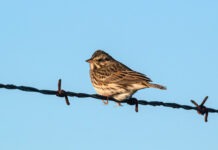
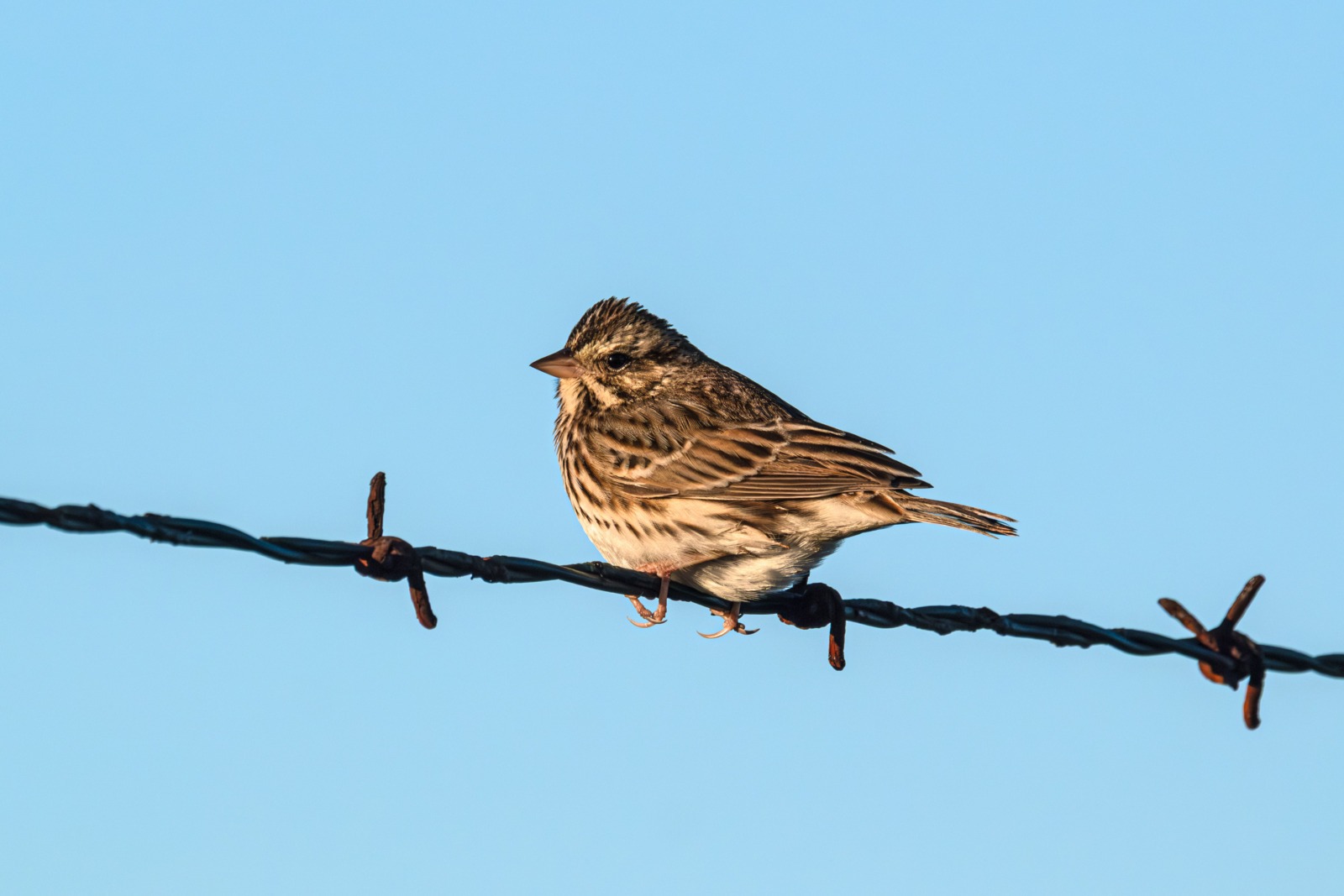
I was reminded of this a week or so ago when I was walking on Boca Chica Beach and a bird hopped up from the beach and landed on the barbed wire over the chain link fence. It did me the favor of not moving, of just sitting there, toes gripping the wire, looking around at the world. I was expecting a palm warbler, but it was bulkier, and wasn’t bopping its tail. It also had a broader, more wedge-shaped bill, built to crack seeds, and yeah, was a sparrow. The question then was, what kind of sparrow?
I would like to say my earliest concept of what a sparrow was came from one of the multiple times it is mentioned in the Bible, generally as an example of how God loves even the most insignificant of creatures. “Are not five sparrows sold for two pennies? Yet not one of them is forgotten by God,” Jesus is quoted as saying in Luke 12:6-7. Matthew reports him saying something similar, though the rate he quotes is two for a penny. (Maybe Luke knew to ask for the bulk discount.)
My earliest conception of the sparrow, though, came from the theme song for the TV detective show “Baretta,” which gives out such directives as “Don’t do the crime if you can’t do the time,” and “Don’t do me dirt or you’re gonna get hurt,” all leading to the repeated chorus of “Keep your eye on the sparrow / When the going gets narrow.” It never elucidated what it means to keep your eye on the sparrow, but it is no doubt derived from one of those biblical references.
I remember the song being something of a banger, more interesting at the time than the show, which starred Robert Blake, who started his career as one of the characters on “The Little Rascals/Our Gang,” and who may or may not have murdered his wife. The song had killer rhythm and horns, and some severely up-tempo, disco-era violins. But also, it turns out it was sung by Sammy Davis Jr. (It’s the third most popular song on his greatest hits album, after “Mr. Bojangles” and “The Candy Man.”)
The first sparrow I saw out in the world was most likely a house sparrow, a European species introduced to North America in the 1850s, either to help eradicate a moth that was damaging oak trees or to provide a familiar species in the landscape for European immigrants, or possibly both. And, of course, the population exploded across the continent due to the species’ preference for nesting in manmade spaces like houses, barns, shopping centers and airport terminals, over more natural spaces. I can’t remember exactly when I saw my first one, but they are rather hard to avoid.
In terms of North American sparrows, house sparrows don’t really count. Not so much because they are an invasive exotic species, but because European sparrows are not closely related to North American sparrow species. They share a name but not a taxonomic family.
Of the 44 species of New World sparrows, aka members of the passerellidae family – 30 of which have been recorded in Florida – I can comfortably identify about six species. The rest just cause me consternation.
I think I can explain why I am so bad at identifying sparrows. I didn’t take up this birding thing until after I’d lived in the Keys for a few years. And it’s possible we may get fewer sparrows here than other part of the country. None of those species breed here. Only about 16 have been recorded in the Keys and none of them are common.
As I get to see them so rarely, I’ve never been able to develop the visual grammar to distinguish them. If I can’t wrap my brain around how to identify a species by either repetition and proximity, I generally need them to have some type of distinctive quality. And sparrow species can be awfully similar looking to the untrained eye, a symphony of earth tones. I mean, if someone writes a new book about New World sparrow species, they should call it “Fifty Shades of Brown.”
I’ve given serious consideration to going up to a place like Paine’s Prairie, which is said to have quite a few species of sparrows in the winter, and spend a week taking myself to sparrow boot camp. But it’s hard to rationalize that kind of time.
The colors on the bird on the barbed wire ran from a peachy beige to a dull copper to a raw sienna to a deep oak. There were some darker streaks in the bill, and a series of alternating light and dark bands across the face.
The general theory in birding is that you shouldn’t pull your field guide out right away. You should try to really look at the bird, form sharp impressions about its field marks. In olden times you’d take some notes, make some rough sketches. In the more modern digital camera era, we take some shots. Which is what I did.
I’d like to say I pulled out a field guide and figured it out there, but it wasn’t until I got home and blew the photo up on the screen, and spent a while flipping through a couple field guides thinking no, no, no, maybe, no, maybe, that I narrowed it down to three or four species, and from there, one.
Savanna sparrow. At least I’m pretty sure. I’m hoping I recognize it right off the bat next time I see one.