








Do we have any crows or ravens down here in the Keys? How do I get them to follow me around en masse? — The Archivist
We don’t have ravens in the Keys. On the East Coast they don’t get much farther south than the Carolinas. We do get crows – fish crows to be precise – though not many.
There’s been a flock of about 15 of them roaming around the island since I moved here.
Fish crows look almost identical to the much more common American crow. The only way most people can tell the difference is by call, which the folks at the Cornell Lab of Ornithology describe in highly scientific terms as “like an American crow with a bad cold.”
Assuming the two have comparable predilections, I’d start by making friends with them. In a lot of online videos, people leave out piles of the food they like, then sit far away from the pile, moving closer and closer to it each day, until the crows get habituated and trust you. Eventually they might even feel safe enough to eat from your hand.
From there you probably have to get experimental. You could carry foods around that they liked, such as meal worms or peanuts. But you’ll have to wave it around so the crows can see it, as they don’t have a strong sense of smell. You could also consider attaching some suet to a hat, but that may get sticky.
Crows also like shiny things, so you could also think about braiding tinsel or scraps of aluminum foil into your hair. Also, maybe just use conjuring spells.
Does the Cuban finch sleep during flight, or is the voyage so short they just rest when they land? — Anonymous on Boca Chica.
Cut it out, Danette.
Bird-themed decor: How do you feel about it in general, and what about these plates specifically? — Old Town Arts Deputy
Different species of birds have different senses of decor. For instance, Antillean nighthawks like to nest in open areas on rough, scarified soil. American oystercatchers like to nest on beaches with high energy waves. Peregrine falcons are famed for their tendency toward high, rocky aeries, from which they can look down on the world, though they have also, in recent years, taken up nesting on tall manmade buildings in cities.
I guess if I was going to embrace one bird’s sense of style and design, it might be that of the crested oropendola. They build these long, woven nests that dangle from high tree branches like shoulder bags with really long straps. It would be really relaxing to sleep in one as it swings gently in the breeze.
Wait, re-reading your question, you asked about bird-themed decor, not bird decor.
Some I like, some is meh.
But the photo of those plates you sent me made me apoplectic. (Apoplatic?) It has the words “Wood Thrush” in this lovely, round, confident copperplate. And then it has a picture of a !@$#&% northern mockingbird.
I will be writing a very strongly worded letter to the manufacturer as soon as I am finished with this column. VERY strongly worded.
How come they were so go last year and this year they were in the cellar of the ALE?
— Bike Man
My friend, voice-to-text is not your friend.
If you could make everyone notice one bird, which would it be? — Stone House Hæddre
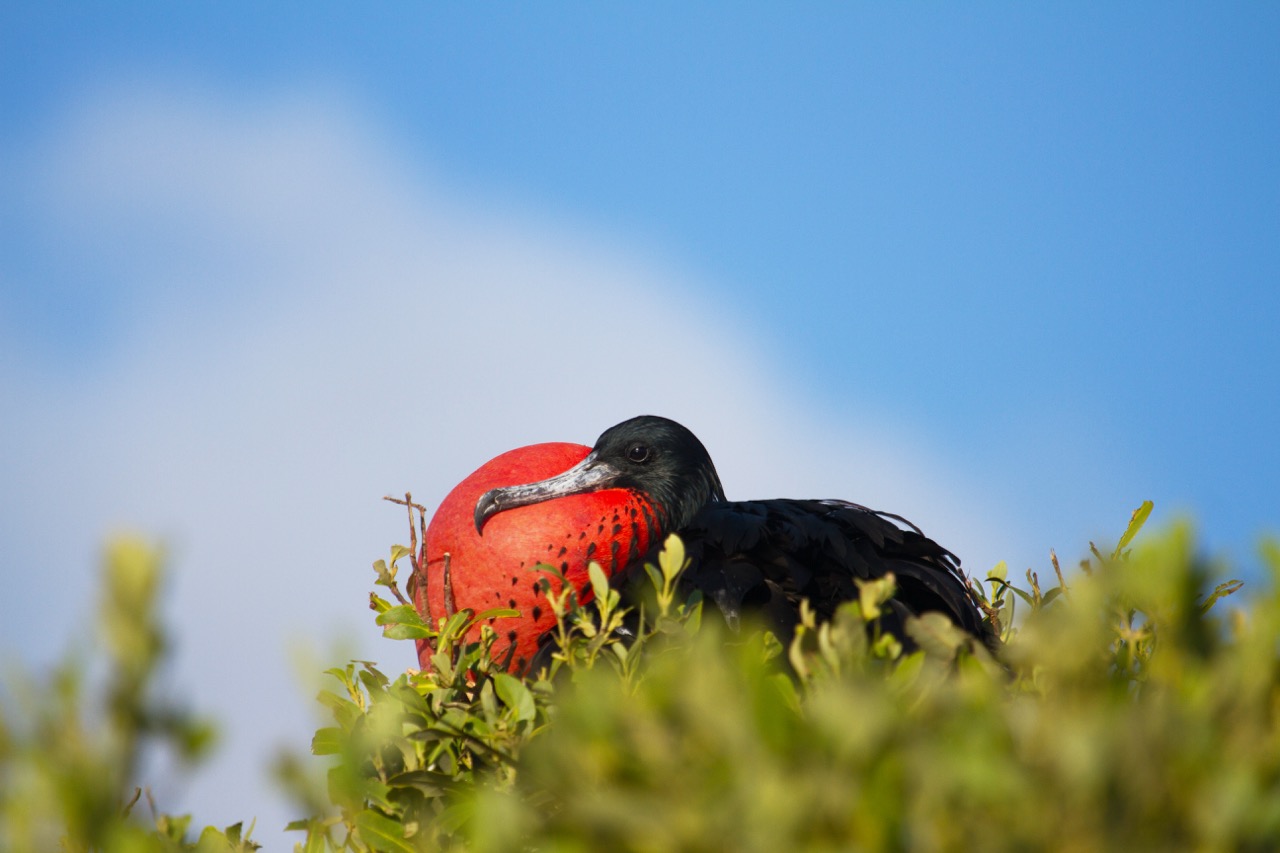
This is kind of a stumper. Because as soon as you name one bird, you think of five others you should have named. So I’m going to go with my gut, then stop thinking about it: magnificent frigatebird.
Magnificent frigatebirds are just such mysterious, unlikely, beautiful freaks. And living in the Keys, we get to see them every day. They’re primarily denizens of the warmer waters of the New World, and we live at the top of their breeding range. The only place they breed in North America is at the Dry Tortugas. (They used to breed at the Marquesas until the 1980s.)
To me, they are the most gothic-looking bird. It’s as if the cartoonist Edward Gorey thought them up. They have a skinny, 7-foot wingspan, a long hooked bill, and a tail that is basically two feathers that hang behind them like the ribbons on an old-school sailor’s cap, helping them control pitch and yaw. The males are all black, except for the red gular sac at their throat. The females have white breasts. When it’s breeding season, the males puff up their gular patches into ridiculous looking balloon-like shapes that somehow attract the ladies. (You have to go to a breeding colony at the right time of the year to see this.)
Magnificent frigatebirds spend their life at sea. They are amazingly light birds, built to cross large swaths of the ocean while expending minimal energy, so they don’t have oil in their feathers. Which means they can’t get wet. So they either have to catch fish in the top few inches of the ocean, or beat up other birds to steal their lunch in an act called kleptoparasitism, which on good days I can spell right the first time.
They are amazingly graceful fliers, turning slow circles in the air for hours on end. If you’ve somehow never seen one, just go to the beach and stand there for a little while. One will no doubt slide into view. Even if you have seen one before, you should probably go do that.
What do birds call giving someone the bird? — Hale Fellow, Well Met
We don’t know. And the birds won’t tell us. They just stare at us when we ask, then fly away with their smug little laughs. I heard that a joint team of scientists from the Cornell Lab of Ornithology, the Cape May Bird Observatory, Mass Audubon, and the American Bird Conservancy were working in a mountaintop laboratory in a kind of Manhattan Project to decode profane avian gestures, but they just had their federal funding pulled. It’s possible we’ll never find out.
What is the Florida Keys equivalent of a partridge in a pear tree? — Peak Piner
My friend Julie Zickefoose had the best suggestion, but I’m going to leave it at the bottom of this long, local version of the last verse of the song:
On the 12th day of Christmas / My cuzzy bubba love gave to me/
12 sapsuckers drumming,
11 plovers, piping,
10 egrets a-leaping,
Nine frigatebirds practicing kleptoparasitism,
Eight gulls a-laughing,
Seven birds a-mocking,
Six cuckoos a-lurking,
Five great white herons,
Four screaming chickens,
Three Antillean nighthawks,
Two roseate spoonbills,
And a white-crowned pigeon in a mango tree.
I believe the scansion totally holds up. Merry Christmas all.