






Some days you find yourself in the land of your youth, arguing with someone you’ve known more than 40 years about the quickest route to your destination. And after losing the argument because you “don’t live here anymore,” consoling yourself with coffee and a pork roll bagel from Wawa as you make your way to Exit 4 of the Jersey Turnpike, even though you could have been at Exit 7 by now, with a stop at a different Wawa, if he’d just listened to you and cut over on 206.
To be fair, it was Matt’s truck – one of those newfangled Ford electric ones with so much torque and pickup that when he floored it your head got thrown back into the seat rest and the skin on your face no doubt rippled like it did in those films of g-force tests from the 1950s.
In the backseat, Clark, who I’ve also known for more than 40 years, wanted to know if I was going to write a column about this, and whether they got pre-approval on content.
Probably not, I said, as an answer to both questions.
In our youth, in various configurations, we used to do a lot of road trips. Washington, D.C. on the spur of the moment to see the Lincoln Memorial in the rain at midnight. Chicago for the weekend to see a movie and ride our bikes around the Fermilab particle accelerator. Canada, to get a box of donuts, turn the car around and drive the entire length of I-95 as fast as possible. Vermont, just to goof around, more times than I can count.
But with life and family and various other aspects of adultness, it had been a long time – a decade or two – since we’d managed to pull off any kind of road trip together. And then it turned out I was up north, and we all had a free day, so we decided on some minor adventure.
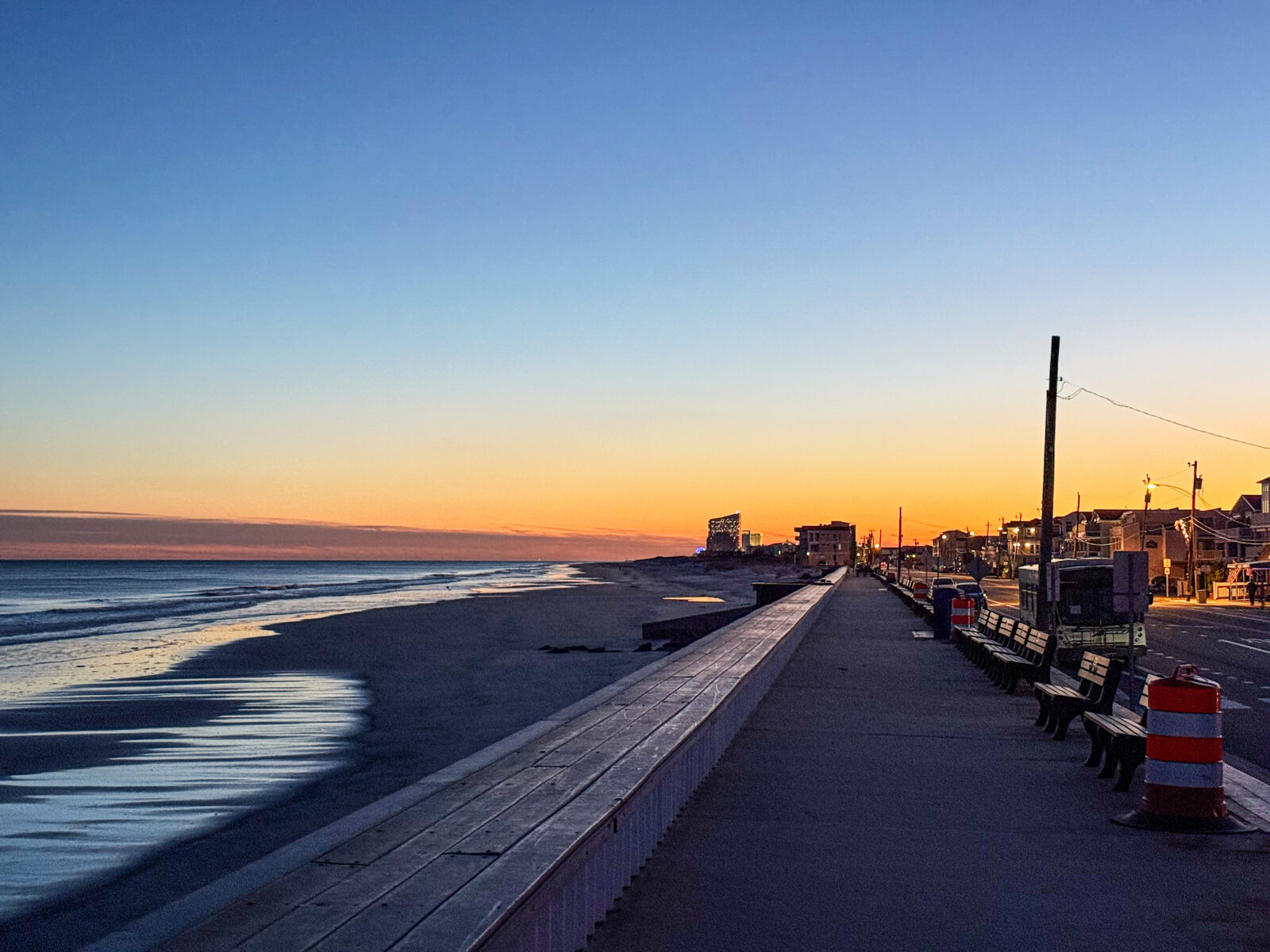
The agreed-upon mission was to drive the entire length of the Jersey Shore, as close to the ocean as the roads would allow. Which seemed manageable.
In the parking lot at the Sandy Hook National Recreation Area I realized while I’d brought three different film cameras, I’d forgotten my binoculars. But as we made our way along a narrow path to get a clear look at the Atlantic and the Manhattan skyline across the bay, I set myself a small challenge – to keep a list of birds I could ID naked-eyed.
While I grew up in New Jersey, I wasn’t a birder then, so it always seemed slightly exotic to me, birdwise.
The first birds were the northern cardinals I could hear chipping in the bushes. When we stopped to take a few photos at the base of the 250-year-old lighthouse, a small flock of Eurasian starlings pulled off an attempted murmuration overhead – a murmur of a murmuration, so to speak.
While Matt was in the public restroom a herring gull flew over.
“Look, a seagull,” Clark said.
I gave him the faux pedantic version of a lecture I’ve heard other birders give in earnest, about how there’s no such thing as a seagull, since gulls are seen in all sorts of habitats besides coastal ones. They are properly just gulls.
A few swallows flew overhead, and I decided the ones that gleamed a bit were barn swallows. The duller ones were giving me northern rough-winged swallow vibes.
On the drive out I also caught the briefest glimpse of an American kestrel hopping off a wire and thought, that bird should be down in the Keys, klee klee-ing its head off.
The next town was Sea Bright, which had a five-mile-long seawall that prevented us from seeing the ocean. It did open up on the bayside several times, and at one point I caught sight of a raft of ducks, all of which had heads that, from a distant moving truck, gave the impression of having big white dots on them. Which made them buffleheads, birds I only get to see every few years.
In Long Branch I noticed a row of rock pigeons on a power line, though it’s possible I’d been seeing them all day and tuning them out. The same with the V-shaped flock of Canada geese we saw a little while later. Because there are so many Canada geese in the north that it’s like noticing telephone poles.
Just south of the Stone Pony in Asbury Park, an immature ring-billed gull slowly walked across the street.
“Look, a seagull,” Clark said.
In Manasquan there was a flock of small birds in the grass on the side of the road, and at first I thought “more starlings.” But these birds were a mix of shiny ones and brown ones, which made me realize they were male and female brown-headed cowbirds.
A few miles later this inspired me to realize the swallows I was seeing were not barn swallows and northern rough-wings, but male and female tree swallows.
In Mantoloking, Matt, who was raised Catholic, and I, who was raised Episcopalian, were talking about having to go to church every Sunday when we were young, which led to a conversation about whether the Episcopal/Church of England folks were the first protestants. Because wasn’t there a thing with Martin Luther in Germany called the “Diet of Worms?” Which led to a conversation about whether or not Judy Blume wrote the book “How to Eat Fried Worms.” (She did not.) Which was when a double-crested cormorant flew across the road.
Long Beach Island was our first barrier island, with only one bridge on and off, so to do the whole thing we had to drive from the middle of the island to the north end, then 18 miles down to the south end, then back to the middle to get back across the bridge. We stopped only long enough for me to send a photo of myself on the front porch of Tony Falcone’s family’s beach house with a note that the railing needed fixing.
The sun set as we hit the northernmost part of Brigantine. In Atlantic City we were going to run in to one of the casinos and bet $10 on red, but they all wanted $15 to park.
We stopped to pay homage to Lucy the Elephant, the historic three-story-tall, elephant-shaped landmark (and one-time hotel) in Margate, and I heard a great blue heron kronk as it flew overhead.
It was dark when we rolled through Ocean City, which is probably why we missed the marker noting it as the homeland of Mandy Bolen Miles, the editor of this fine publication. Though, again, it didn’t help that Matt was unwilling to veer from the charted course, or even slow down a bit, to look for it.
We rolled in darkness through Avalon, Stone Harbor, North Wildwood and finally to Cape May, most of the stop lights switched off for the off-season. From one of the bridges I caught sight of a mixed flock of about 200 gulls, just sitting in the water, spectral looking as they were lit up by the lights of a trawler. No doubt they were waiting for bycatch.
We sneaked into the parking lot of the Cape May Lighthouse, even though it was officially closed, and took a few pictures. I pointed out the hawkwatching platform, where hundreds of people gather during the fall migration, which impressed neither Matt nor Clark.
As we got back into the car, a lone Canada goose honked out an erratic Morse code.
The Jersey Shore is officially 128 miles long. The odometer read 420 miles by the time we got back.