










The email came while I was out of town, midway through a long road trip. It was sent to the Florida Keys Audubon Society address, which I try to keep tabs on, and it was a long, detailed description from a visitor named Michael McHugh of a bird he’d seen in Key West that he thought might be a golden eagle.
I skimmed the email while I was standing at a gas pump in Delaware or Maryland.
Golden eagle sounds like a pretty fancy bird, like it’s covered in gilt or something, or maybe a prize given out by the Willie Wonka company. But they are mostly brown with some warm orangey highlights around the head, legs and a few other places that give them their name.
They mostly breed in the western half of the United States and above the Canadian border, and come down or across to winter in the eastern half of the U.S. (They also breed all across northern Eurasia.)
I’ve seen a golden eagle before – once, on a back road in south central Oregon. And I took some pretty solid pictures. But it wasn’t a bird I was comfortable trying to identify on the fly from a written description.
They’ve strayed into Florida a few dozen times, but a golden eagle in Key West would be a big deal as, according to eBird, there are no records of one occurring in the Keys before.
I put the phone back in my pocket, with every intention of sitting down and comparing McHugh’s notes with the images in my Sibley. But the road to hell is paved with good intentions, or at least the 2,000-mile-long road I had to drive to get back to Key West was, and I never got it together to suss it out.
I made it back to Key West around 7 p.m. Friday and my wife and I went straight over to a friend’s house to celebrate his recent good fortune. (Congrats on finally escaping the tyranny of the four-hour work week, BNT.)
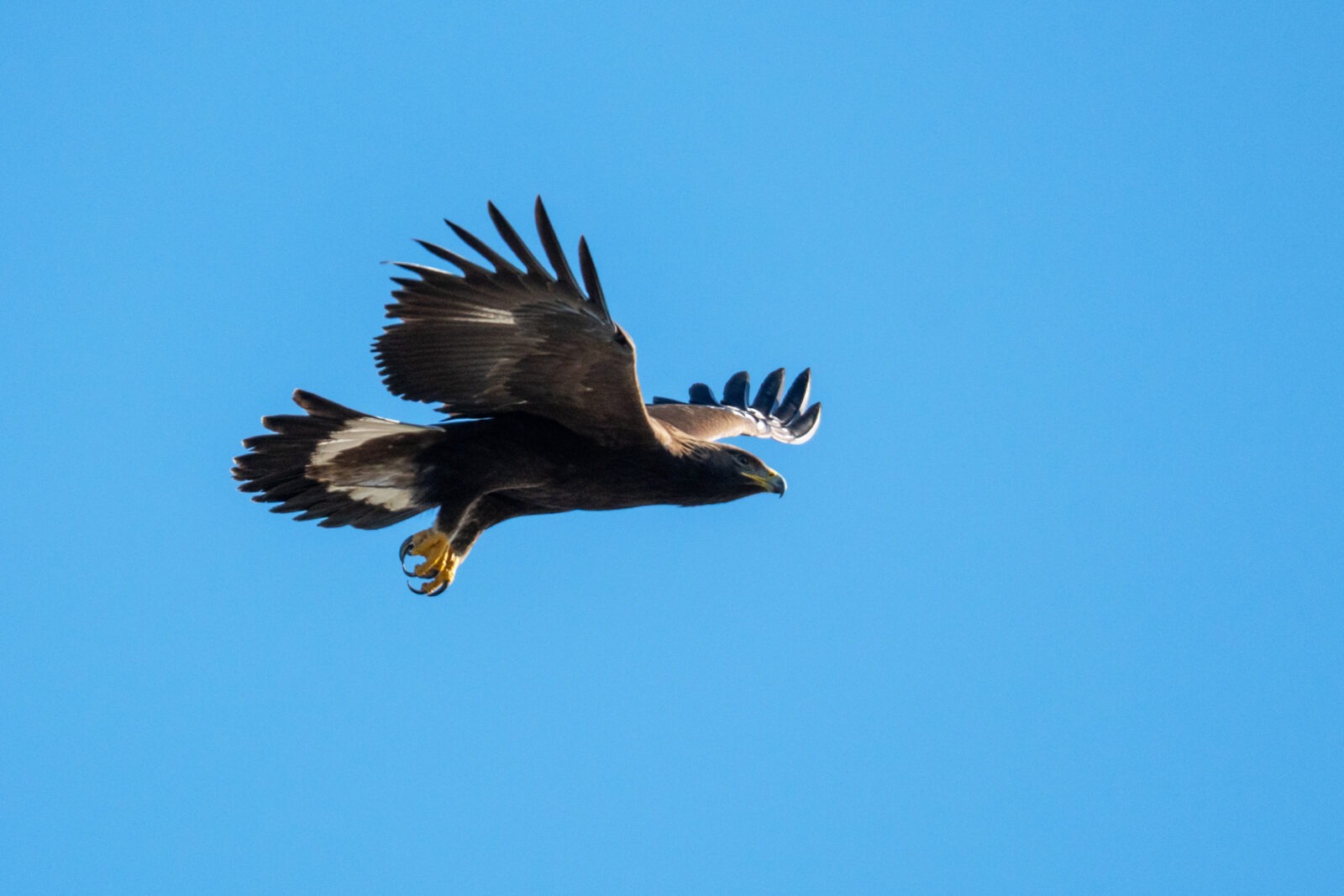
Saturday morning, a little after 9, at Fort Zachary Taylor, three Key Westers – Ben Edmonds, Bryan Edwards and Mary Houska – caught sight of an eagle soaring up with the turkey vultures. They also saw the eagle get into a small, midair tiff with a local osprey. They got pictures of the bird – good ones – and a little video.
There are really only two species of birds in North America that look remotely like a golden eagle. The first would be the bald eagle, which as an adult has the clean white head and tail that every ’merican is familiar with, but goes through several phases of general brownness in its first four years of life.
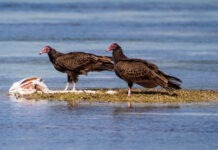
The other species it could possibly be confused with is the turkey vulture, if only for size and a tendency to ride thermals. It was pretty clear from the pictures that the bird didn’t have the dihedral that gives the characteristic V-shape to turkey vultures in flight. Also, the bird’s head wasn’t bald. (Bald as in unfeathered, not bald as in white feathered, which is where the bald eagle’s name comes from.)
Golden eagles also go through a couple years of brownness, but it’s a different brownness than the bald eagle’s, and the orangey patches are usually pretty obvious. The bird in the photo had two distinct white spots on the undersides of its wings, and the tail was clearly demarcated with a brown outer band and a white inner band, defining field marks for a juvenile golden eagle.
Word began to spread online and Mary, who has clued me in to a few other good birds, was nice enough to message me directly.
I made it over to Fort Zach in the late afternoon and parked in the far lot. The first bird I saw was a northern harrier that came across the open field known as the Back 40, slid through a 180-degree turn, and started back. A female American kestrel came out of nowhere and feinted toward the harrier, trying to declare the boundaries of some type of territory, though the harrier seemed non-plussed.
I met up with Ellen Westbrook and we stood out in the field, her dog Che standing patiently with us. (Two people riding by on bikes told us what a good looking boy he was.) The harrier made a few more passes and two kestrels called from opposite ends of the field.
I was out of town when the weather changed, and it was incredibly nice to be standing outdoors while the sun was up and have it be pleasant.
At some point we looked up and caught sight of a huge kettle of turkey vultures streaming in from over the water. How far they had ventured out over the water was hard to say, but they kept coming and coming. I’d guess there were 500 of them, all of which we scoured for eagle-ness, none of which looked like anything other than turkey vultures.
I wasn’t sure if I was going to go back on Sunday, but then Mariah Hryniewich and Luis Gles, friends who have both counted for the Florida Keys Hawkwatch, texted saying they were in Havana at the moment doing some bird work, but would be landing in Miami around 9 and then heading down to look for the eagle.
I met up with them around 1 p.m. and we stood out in the same part of the field. The same northern harrier cruised over the field and along the moat. The same two kestrels klee-kleed from the different ends of the park.
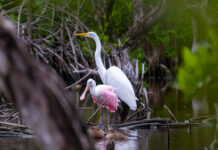
Things got somewhat lively when a great white heron picked a fight with a great egret, and the two swirled around each other in the sky for a few moments, but the heat soon went out of the dispute and they both settled back down into the trees.
The kettle of 500 turkey vultures drifted over the island like a plume of smoke over a moving fire. Vultures flew, joined and left the kettle from every different direction, leaving a lot of birds to keep track of, none of which looked to be golden eagles.
After an hour or so a bird with broad, flat wings came in off the water, flying low over the pines. An eagle. But as it got close, the bird’s white head and tail became obvious, making it one of the rare times a bald eagle was a disappointment.
We spent a few more hours looking, with no luck, and Mariah and Luis went back the next day and with a further lack of luck.
I have a little faith that the golden eagle, a bird this far out of its usual habitat, is going to be seen again. It just means that I’m going to have to pay attention to every turkey vulture I see, hoping it’s not a TV.
There are worse fates.