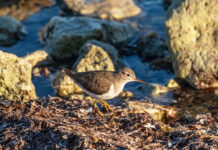












Up on Boca Chica Beach the other day, the sargassum was teeming with a diverse legion of shorebirds – sandpipers, dowitchers, willets, turnstones and plovers. Some were feeding, digging their bills down into the seaweed and coming up with gastronomical treasure. Some were loafing. Occasionally a bird would get annoyed with another member of its own species and run head down and head on at them, like a spatula after a pancake, to drive them off.
Once or twice a white ibis walked through the scene, out-sizing the other birds, a kid too big to be on the playground.
One of the wonders of Boca Chica Beach is you can get relatively close to shorebirds without scaring them off.
It had been a long time since I’d had such a good look at so many shorebirds. Partly because summer birding can be a little slow in the Keys, and partly because I’d shipped my damaged 20-year-old Swarovski binoculars off to be repaired two months before, and had just gotten them back. The repair folks realigned the barrels, fixed the focusing mechanism, replaced the rubber eyecups, tested things like resolution and focus uniformity and, if I’m reading the packing slip right, refilled the nitrogen. All at no charge. Thanks Swarovski Optik North America Limited if you are reading this (which you probably are not).
Looking through my rejuvenated binoculars felt like being gifted with a super power. My eyes had so much reach.
Almost all of the species on the beach could be seen here year-round, but not in such big numbers. Most breed far north of here – some as far away as the Arctic Circle. But it was close enough to the end of nesting season that some of the birds had yet to lose their breeding finery.
Not the black-bellied plovers, who either hadn’t migrated and molted, or had molted enough by the time they returned that they did not have their nominate black bellies. Which was a bit of a disappointment. (Do better, black-bellied plovers.)
There were a good number of peeps, nearly all least sandpipers, though I did manage to pick out a trio of western sandpipers, with their ruddy scapulars and black legs.
The short-billed dowitchers were the most glam of the shorebirds. Predominantly, when we see them in the Keys, they have a white belly and dull brown everything else. But most of the birds in front of me were flashier, with deep mahogany patches on their wings and a strong infusion of ochre, tiger orange and burnt sienna in their belly and throats.
Driving home, I started to think about what to call the group of shorebirds I’d seen. A riot seemed too dramatic. A scrum seemed too violent, which didn’t seem right, considering there wasn’t much argy-bargy going on. A pageant seemed too insubstantial. A mixed flock would work, but it sounded too much like an accountancy term.
A couple weeks ago I’d been talking with someone about nouns of aggregation, which some people call collective nouns, nouns of multitude or if you want to be olde about it, terms of venery. They are the codified terms for groups of critters, usually birds. (We’re going to just sail right past the fact that there is no standardized term to describe the standardized terms used to describe groups of animals.)
The most well known collective noun is a murder of crows. I suppose the second-most well known, at least in our era, is a murmuration of starlings.
The whole murmuration thing has something of a pop culture/product of the zeitgeist feel to me. I’m pretty sure its modern popularity traces back to a video posted in 2011 of two women canoeing across an autumnal lake in Ireland, when suddenly a huge flock of Eurasian starlings flies overhead, a cloud of thousands of birds moving under a graphite sky, constantly changing and undulating, reforming, then reforming again.
It is really mesmerizing to watch, and it has had over 11 million views on YouTube, and more on Vimeo. But I don’t think I’d heard the term murmuration applied to starlings before that.
Here in the Keys we have a small population of Eurasian starlings, but not enough for a noticeable murmuration. We hardly have enough to form a boy band. If they get together and fly around in a small cloud at dusk I have never noticed it.
I have seen the phenomenon a few times, though, most notably in Rome, overlooking the Forum, where hundreds of thousands of starlings gathered at dusk to swirl around in giant, nebulous flocks, looking alien and unreal. (While I was writing this, a song from Wilco’s “Sky Blue Sky” came onto my Spotify playlist. I don’t think I’d noticed before that the album cover is a grainy photo of a Peregrine falcon speeding toward a flock of starlings.)
I remember after the video came out, as the term murmuration came into vogue to describe a flock of starlings in flight, a birder friend – a man far more erudite than me, and also a bit crankier – got kind of annoyed about it, offended by what he called the term’s “preciosity.”
I’ve always felt two ways about it. I mean, I get the fear of preciousness when applied to the natural world, because it tends to frame nature as a crystallized idyll, as a gauzy ideal, something sentimental.
But alternately I’m a big fan of the more poetic aspects of the English language. And also, to my mind, anything that makes people feel connected to nature is a good thing.
Reading up on it, it turns out that murmuration isn’t some kind of newfangled term as a collective noun. Its first known usage as such was in “The Boke of St. Albans,” first published in 1496. I’m not sure how often it has been used in the intervening centuries, but it does have a solid historic basis.
“The Boke of St. Albans” actually has a list of 146 terms of venery, amongst them a parliament of owls, an exultation of larks and rout of wolves.
As of yet, I still haven’t come up with a satisfactory collective noun for the shorebirds I was seeing. I want to avoid the whiff of the twee. But I do want to come up with something.