


o throw the anchor first, and get a good look at whoever was doing the staring afterward.
We were at Destroyer Key, sometimes called Split Rock Key, on the far side of the Northwest Channel from Key West.
The lore is that a U.S. Navy destroyer once lost control and plowed into the tiny island, cleaving it, and that the deep water pool with the slow rip of current flowing through it, as well as the two 15-foot-high spoil piles on each side of the now bifurcated island, were created when the Navy dug the destroyer out. Which always seemed like bushwa hooey to me.
The waters surrounding the island are notoriously shallow. And the island is two miles from the near side of the Northwest Channel, the closest route a destroyer might have sailed. The idea that a 2,200-ton, 370-foot ship with a 15- to 18-foot draft would somehow have been able to wash up there, even at full steam in the highest of tides, just seemed unlikely. And if, by some defiance of nautical competence and gravity it did happen, the surrounding very shallow subaquatic topography would absolutely still be scarred and screwed up. Which it isn’t.
Also, cameras existed before destroyer class warships. Wouldn’t there be pictures? There were no images of such a mishap on the Monroe County Public Library’s Florida Keys History Center Flickr page, which has a pretty comprehensive collection of photos from most of the important and dramatic events in the Keys.
To be sure about this I spoke with Corey Malcom, the lead historian at the Florida Keys History Center.
Could it possibly be true that a destroyer accidentally plowed into Destroyer Key, and then was subsequently removed?
“I’ve never seen anything that indicates that in any way whatsoever. No news articles, no documentation,” Malcom said.
What do you think happened out there?
“I have no good answers. My guess is someone with a drag line or dredge was trying to dig a channel and it didn’t work,” Malcom said.
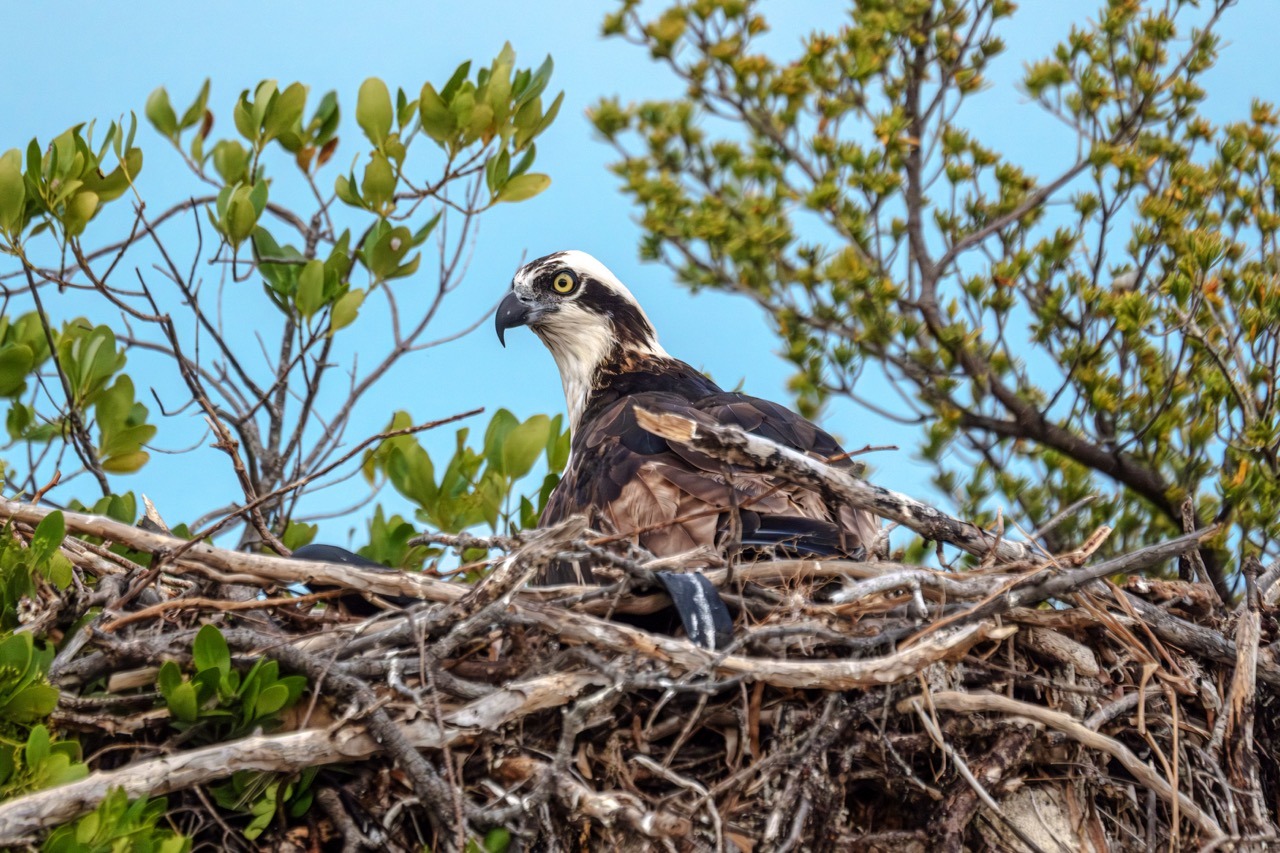
That conversation happened when we got back to civilization. While we were out there, once the anchor line went taut, I grabbed the binoculars and scanned around until I saw the nest high up on one of the plant-covered spoil piles. There was an adult osprey in there, most likely sitting on eggs, waiting for their partner to return and either spell her or feed her. (Females do about 70% of the incubating.)
I handed the binoculars to my friend Mad, who was on her first trip into the backcountry. She looked at the bird and seemed dutifully impressed.
Osprey are fierce looking. Possibly because they can be very fierce.
While osprey are found on every continent but Antarctica, their cosmopolitan ubiquity does not take away from the fact that they are such singular creatures, so unlike any other bird they are the sole occupant of their taxonomic family.
They are purpose-built to catch fish. They have long, lanky wings that, when they flap, often look rubbery to me, though they are not. They give the osprey the ability to circle around out over the water without expending a great deal of energy while they try to find food. They also allow them to hover in place when they do spot something.
When they dive, they do it from 30 to 120 feet up, feet first, wings up in a triangle, taking on an arrow shape that points the opposite direction of their motion. They are the only raptor that can swing their feet up in front of their face so they can keep their eyes on the prize when they hit. They will sink as much as a foot into the water before bobbing back up, and prefer hunting in shallower waters.
Their talons are incredibly sharp, their feet big with zygodactyl toes, meaning two facing forward and two facing backwards, all the better to pierce and grip their slippery, writhing prey.
The fish they catch are usually between 10% and 30% of their 3-1/2-pound body weight, though occasionally they catch fish up to half their body weight. It takes an incredible strength of wing to get themselves out of the water and airborne again, something they must do quickly.
In some places, up to 95% of osprey nests are built on artificial habitats. Osprey platforms yes, but also channel markers, radio towers, rooftops and such. Which seems about right for what you see in the mainline Keys. But in the backcountry, they tend to nest on more natural structures. And in a place without any mammalian predators, even on the ground, like this one.
Which gets me to the fierce part. They will defend their nest if you get too close. You hear stories. For instance, Tom Wilmers, a wildlife biologist who used to work in the Keys, had one come after him while he was in a bucket truck, banding some osprey chicks in the nest. The bird got close enough to him to steal his hat. After that he always brought someone else along with a trashcan lid to use as a shield.
Mad and I had both spent a good chunk of the last week at the San Carlos Institute for the Key West Literary Seminar, Mad working as assistant technical director, me mostly just listening to novelists like Jane Smiley, Rachel Kushner, Colm Tóibín, Richard Russo and Marlon James talk about their work. (Full disclosure: My wife is on the seminar board.)
After all that erudition and all that time indoors, it was nice to be out on the water, under all that sky, staring at a creature that holds its mysteries no matter how often you see one of its kind.
The one counterpoint to all that narrative prose was the poet Billy Collins, who comes to the seminar nearly every year. Is there such a thing as a visiting house poet? There aren’t many people who can hold a room the way Billy does when he reads – deadpan, wry, wily, able to flip your worldview on its side and make you laugh about it at the same time. (Good Lord, if you’ve never heard him read, Google him. Start with “The Lanyard.”)
He read a lot of poems over the weekend, some about not being a novelist, many of them about dogs, because he just published a book of poems about dogs called “Dog Show.”
One of the poems he did not read was about being on a rowboat on a lake and seeing an unfamiliar bird.
He starts, “Oh, large, brown, thickly feathered creature / with a distinctive white head,” then goes on to describe landing his boat after seeing the bird, and all the things he did immediately afterward, including contemplating what he wanted for his post-boating drink:
I’m thinking a vodka soda with lemon —
I will look you up in my
illustrated guide to North American birds
and I promise I will learn what you are called.
But you already knew. Because he titled the poem “Osprey.”


