


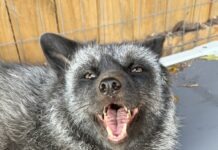
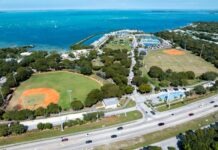



I was walking the dog down Reynolds Street, past the Casa Marina, when the dog started pulling for the pier. I try to give her her head as much as possible, to let her sniff whatever she wants, to lead the way on occasion. Though sometimes when I let her lead the way she starts trying to take us home, and I have to point out to her that we have further walking to do.
Last time we’d walked by the pier she’d pulled that way too, but after we’d walked about 20 yards out she realized she was walking on a grating that she could see through, and she freaked out, started pulling hard back toward the beach. I decided not to force it and let her lead the retreat.
I think it was the fact that she knew there was water under the pier. In the almost three years we’ve had her, June has done a pretty good job of acting as if large bodies of water, such as pools and oceans, don’t exist. You get to the beach and that’s it, you’ve reached the end of the world. A tennis ball falls into the pool and, sad to say, it is lost forever.
So when we started out on the pier this second time, I expected a repeat performance. But no, she wanted to keep going. She had her tail tucked under her, but she wanted to keep going. She gave hopeful looks to the people and ignored the pigeons.
Halfway through, a little girl out in the water smiled and waved at her, and suddenly June was wagging her tail, the happiest, bravest dog in the world. She seemed a little disappointed that the pier ended.
Sometimes I underestimate her ability to overcome her fears. I mean, she’s 65 pounds, and when lightning strikes, she no longer tries to wedge herself into the six-inch space between the couch and the floor. Instead she will sit on the couch in her circus bear pose and stare at us dolefully, as if we could do something about the weather if we really tried. If a storm is really loud and prolonged, she may sneak off and lie on the floor in our bunker of a bedroom. But she doesn’t panic so much anymore.
I was grooving on this sense of progress all the way back to the house, and really wasn’t paying much attention to the world. But as we were passing the No Trespassing at the entrance to the Jehovah’s Witnesses’ Kingdom Hall parking lot, I heard a yip. A telltale yip.
It came from a barn swallow that was zooming overhead in the last light of the day. I try to avoid anthropomorphism when I think about animals, because a human take on an animal’s mood – especially non-mammals – is rarely accurate. Still, I usually fail at this when it comes to barn swallows because they are the one species of birds that I’m pretty convinced are having fun as they rip around the sky, 40 times more agile than any Olympic snowboarder. And their yip always sounds like an expression of that joy.
Whatever the yip meant, it woke me up to something. It may seem like we’re waylaid in the doldrums of the Keys’ never-ending, very hot summer, but there is a little bit of change in the air. Bird migration is afoot.
It rained on and off overnight, and on and off through the next day – make up your mind, weather – but by late afternoon it was bright and overly sunny, so I decided to head over to Fort Zachary Taylor to see if there were any birds.
It’s not like I haven’t been out birding since the northbound migration trailed off in mid-May. But I haven’t gone out with that sense that anything could be anywhere. I’ve been kind of impatient and deliberate about looking for things, partly because it’s hotter than (fill in your favorite pithy metaphor for heat), and partly because there haven’t been that many species of birds around, and most of the species that are birds I could see any day of the year. Standing still and staring into the treetops is less fun when you’re unlikely to see anything, and the thought keeps creeping into your head that you have perfectly good central air conditioning at home, as well as a dog who would be happy for the rest of the day if you just played tug-o-war with her for five minutes.
I was worried I might be a little rusty, that I’d forgotten what warblers looked like. You generally find songbirds by watching for movement in the trees – the figures of birds themselves, but also the leaves and twigs moving more than, or out of sync with, the other surrounding leaves and twigs. (You might think it’s hard to confuse a bird with a three-foot iguana, but I did it several times before I convinced my brain to ignore anything that was disrupting the foliage too much.)
What I saw at first were summer residents like white-crowned pigeons, common grackles and gray kingbirds, most of which I ignored. Except for one gray kingbird who caught some kind of sizable buzzing insect in its bill, landed on a branch above me, then banged the insect onto the branch, trying to subdue it but only changed the pitch of the buzzing. Another gray kingbird came in, started fluttering its wings and yelling at the first bird, demanding the still buzzing insect. Learn to feed yourself, kid, the first bird essentially said when it flew off. All of which made me laugh a little.
Walking just below the blacksmith shop, I caught sight of a small bird making the leap from one bush to another, and even with such a fleeting glance in a terrible light and no articulable field marks, I knew it was a northern parula. I followed the bird as it moved through the landscape until I caught sight of its slaty blue head and lemon yellow throat, and then was sure.
After that, it was like I’d tapped into something slow and steady. First there was the black-and-white warbler, then a prothonotary, an immature hooded warbler and a female American redstart. Your basic early fall migration starter pack.
Migration had officially started. The warblers were back. And maybe I was, too.