


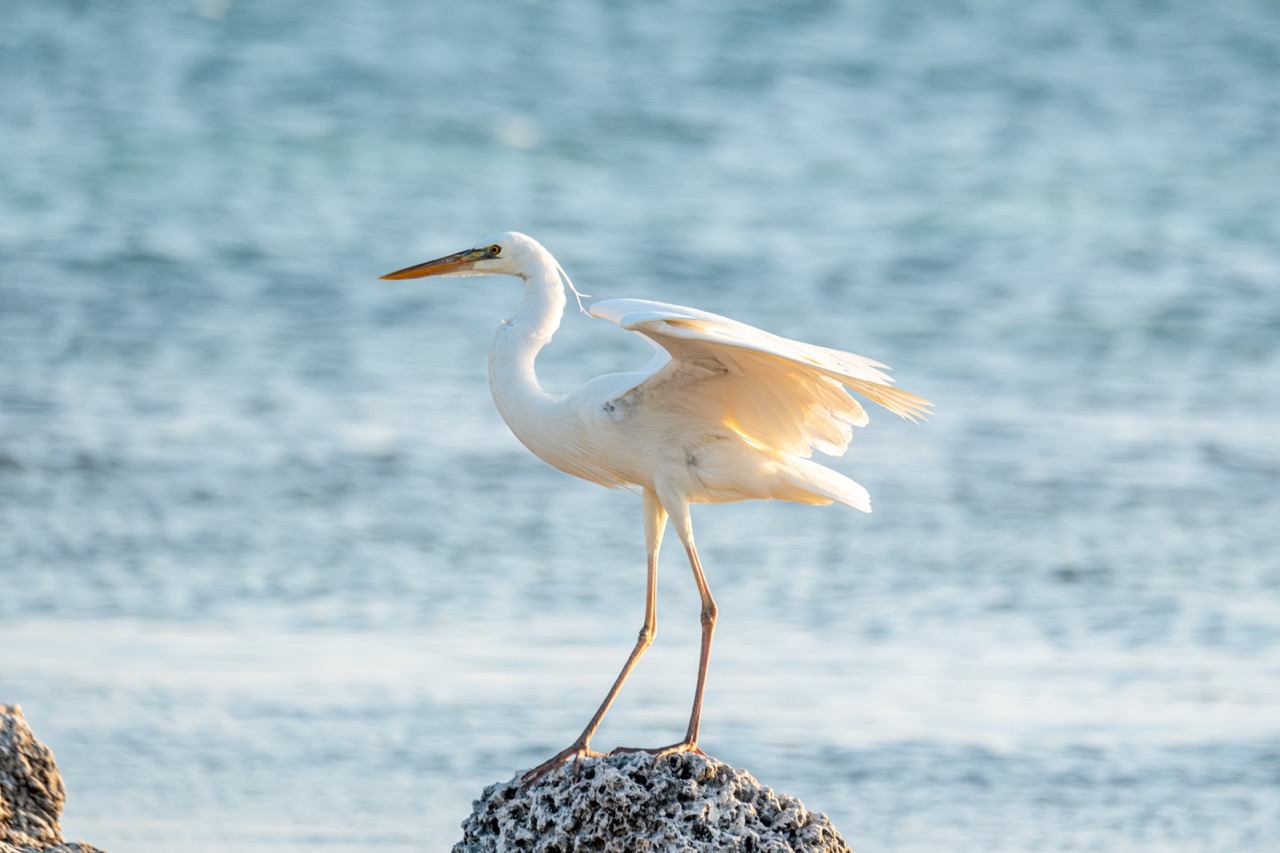
The great white heron came in fast and loud, wings half folded, pushed by a tailwind, letting out a raspy dysphonic squawk right before he pulled a half-corkscrew turn, dropped down, threw his wings out and landed soft as a pat of butter on the rocks.
He stood there for a long while, all 4 feet of him, facing upwind like some kind of heroic figure, the occipital plume waving off the back of his head in the breeze.
I’m always wary of the idea of someone discovering a species. I mean, the species was there all along, and no doubt the locals knew about it. Let’s just assume the great white heron was first described to the scientific/ornithological world by John James Audubon during his six-week visit to the Keys in 1832.
It’s impossible to say how many generations of great whites there have been since Audubon’s time, though it is possible to make a wild but semi-educated guess. If they live, on average, 15 years, and can breed at two years, an average generation is probably around eight years. Meaning there are probably about 25 generations between the birds he saw (and shot) and the bird I was looking at, which likely would not be distinguishable from one from the Audubon era. What’s changed, though, is how we think about the bird.
Scientific methods were different back in the day. It’s a pretty well-known fact that Audubon spent a lot of time observing birds in the wild, but he also spent a lot of time shooting them out of the sky. I’ve seen people get righteous about this, but I’m relatively ambivalent about it. At the time, people thought nature was infinite. There was really no other way, with the tools of the era, to study birds up close. And Audubon’s mission was to create a massive work, which was technologically revolutionary at the time, that would change the way people thought about bird life in America. Which he did.
Also, Audubon sometimes ate the birds he shot. (He wrote that he enjoyed the taste of great white heron.)
But reading about his efforts to acquire those specimens puts some strange images in your head. For instance, the first great whites Audubon saw were a pair of nestlings someone brought to him at Indian Key. They also brought him the nest, sawed out of the mangroves, with a long dead, and apparently very fragrant, chick in the bottom of it.
Audubon set his apparently well-trained dog, a Newfoundland named Plato, to watch over the heron chicks. And when he got too close to one of the chicks, it clamped its bill onto the dog’s nose and would not release it until Audubon came in and loosened it with his hands.
Audubon later came to Key West. He was so excited by this new species that he spent several days rowing and sailing around the islands west of here trying to track down great white heron specimens. Ultimately, he shot about 30 and brought about 15 skins north with him, delivering one to the Academy of Natural Sciences in Philadelphia. Which was generous, but also something of what the kids call a flex, as the academy had never accepted him as a member.
He shot down one bird, which he determined to be a female because of the unfeathered state of her brood patch.
Afterward he wrote, “We now rested awhile, and breakfasted on some biscuit soaked in molasses and water, reposing under the shade of the mangroves, where the mosquitoes had a good opportunity of breaking their fast also.”
Later he described pulling into the mangroves near a rookery in the dark.
“There we lay quietly until daybreak. But the mosquitoes and sandflies! Reader, if you have not been in such a place, you cannot easily conceive the torments we endured for a whole hour.” Reader, I believe him, as I have been to those islands. And I’m not particularly sad about him suffering.
But he also described seeing hundreds of great whites at a time, out feeding on the same flats, which I find amazing, considering I’ve seen maybe five or six. Also considering that after the plume-hunting era that came seven decades later, and the 1938 hurricane, only 146 great whites were counted in the Keys.
Audubon tried to paint the birds as large as he could get away with on the 39.5 x 26.5-inch pages of his double elephant folios. Being as the great white heron was the largest heron in North America, he had the bird’s bill break outside the confines of the scene into the margins on the page.
The great white heron is primarily considered a Florida Keys bird. They do stray up into the mainland, and there is a small population in Cuba. They also may be in parts of the Yucatan, Venezuela, Jamaica and the Virgin Islands. But it’s unclear if they breed in any of those places. It is very clear they breed in the Keys.
For close to a century-and-a-half after Audubon’s visit, nobody really questioned the viability of the great white heron as a species. But then a couple people did, specifically Ernst Mayr. Also, there was a paper by another man with the awesome name of Outram Bangs, a moniker that sounds like a proto-Wes Andersonian name. But Mayr was the star, a giant in multiple disciplines of biology – taxonomy and ornithology among them. He is credited with bringing about the modern interpretation of Charles Darwin’s theory of evolution.
In 1956 he wrote a paper entitled, “Is the Great White Heron a Good Species?” Not in a moral sense, of course, but questioning, and ultimately rejecting, the idea that the great white heron was a legitimate species, especially considering the fact that it was similar to the great blue heron in so many ways. He came to this opinion largely through studying stuffed specimens in museums and using second- and third-party accounts of the birds’ behaviors.
The change did not happen immediately, but in 1973 the American Ornithological Union reclassified (it’s tempting to say downgraded) the great white heron as a subspecies of the great blue heron. Later, it was reclassified further as a color morph.
The debate is not over. A paper published in 2019 with morphological studies as well as DNA analysis made a rather compelling argument that the great white heron is, in fact, a species, though it did not fully convince the AOU’s Committee on Classification and Nomenclature for North and Middle America, which voted 5-4 not to reclassify the bird. (BirdLife International and the International Union for Conservation of Nature, two other taxonomy powerhouses, do consider the great white to be a species.)
None of this mattered to the heron I was looking at, though. After a few minutes posing on the rocks, he hopped down into the water and slowly stepped along the edge of the beach, more interested in fish than anything else.


