










Heavens to Murgatroyd, the light at Fort Zach was gorgeous, a blanket of chromatic bliss saturating everything that wasn’t in shadow. And the shadows were nice, too. Walking along the moat path I felt a strange swelling of elation, as if I should write a goddamn haiku or something, but I reined myself in to the task at hand: getting a good look at a duck.
Ducks, I feel, don’t get taken seriously enough. There are a number of reasons for this. The first one is their name. As the late great Walter Matthau said in the movie version of “The Sunshine Boys,” “Words with ‘k’ in them are funny.” He cited Alka Seltzer, but there are other inherently funny k words: pickle, turkey, cuckoo, keister, kleptocracy. And duck is decidedly a k word.
Then there are all the cartoons – Daffy, Daisy, Disco, Donald, Huey, Scrooge Mc – which generally portray them as emotionally volatile and unserious creatures who, if they wear any sort of human clothing, it is never pants.
Then there is the whole quacking thing, which is self-explanatory in its unseriousifyingness.
The duck I was looking for arguably had a chance at achieving a more serious and dramatic persona, at least to the late 20th/early 21st century mind. Primarily because the bird was a duck, but was not called a duck, but instead a scaup. Specifically a lesser scaup.
I’m not sure where it was picked up, but a lesser scaup was brought into the Key West Wildlife Center several weeks ago. They posted a cute video of it swimming in their rehab tank along with a ring-necked duck.
My friend Ellen Westbrook texted me yesterday that since it had recovered from whatever ailed it, they had released it, along with the ring-necked duck, into the moat at Fort Zach.
If you keep a life list there are rules, and a bird that has been recently released from a rehabilitation center, like the Key West Wildlife Center, might be a little suspect. But I looked it up and according to rule 3.C.i of the American Birding Association’s Recording Rules & Interpretations, a released bird that has been in captivity may not count if it is still under the influence of the captivity. “A bird is considered under the influence of captivity after its release until it regains the activities and movements of a bird that has not been captured.”
I don’t actually keep a life list, but it’s a good way of framing the question of whether a bird is living a wild life or tame one.
There are two species of scaup in the world, greater and lesser. Together they are considered a superspecies, or a pair of species that are distinct genetically and physiologically, but so closely related they sometimes interbreed.
They are somewhat difficult to tell apart. Mostly it comes down to some subtle aspects of the shape of their heads.
Both are some of the more common duck species in the world. The greater is a circumpolar breeder, meaning they nest in what Karen Carpenter liked to call the top of the world. Lesser scaups don’t venture across the oceans but instead breed in the North American polar region, though their range stretches as far south as California and Colorado. Which makes the lesser scaup our home-continent scaup.
While both species of scaup migrate south for the winter, greater scaup does not look to have been recorded in the Keys. I’ve only seen lesser scaup on occasion, usually on the Key West Golf Course, back when they let us on there for the Christmas Bird Count, meaning I hadn’t seen one since before the pandemic. There was one reported in the Key West Nature Preserve several times in July, which may or may not be the one that went through the rehab.
The name scaup most likely came from the Scots, who historically called mussels, clams and oysters scalps, which mutated into scaups. The name scaup for the bird was a shortening of scaup duck. But the name may have also been derived from the call of the female greater scaup, which maybe kinda sorta sounds like that.
Male lesser scaups make a call that sounds something like a chicken cluck. Unlike in the majority of bird species, the females are more vocal than the males, with a small repertoire of calls, including one that sounds more like a frog, one that sounds more like a dog, and one that sounds like an outright quack, but higher pitched, like a mockingbird imitating a crack. Though these are noises they very rarely make in their wintering habitats.
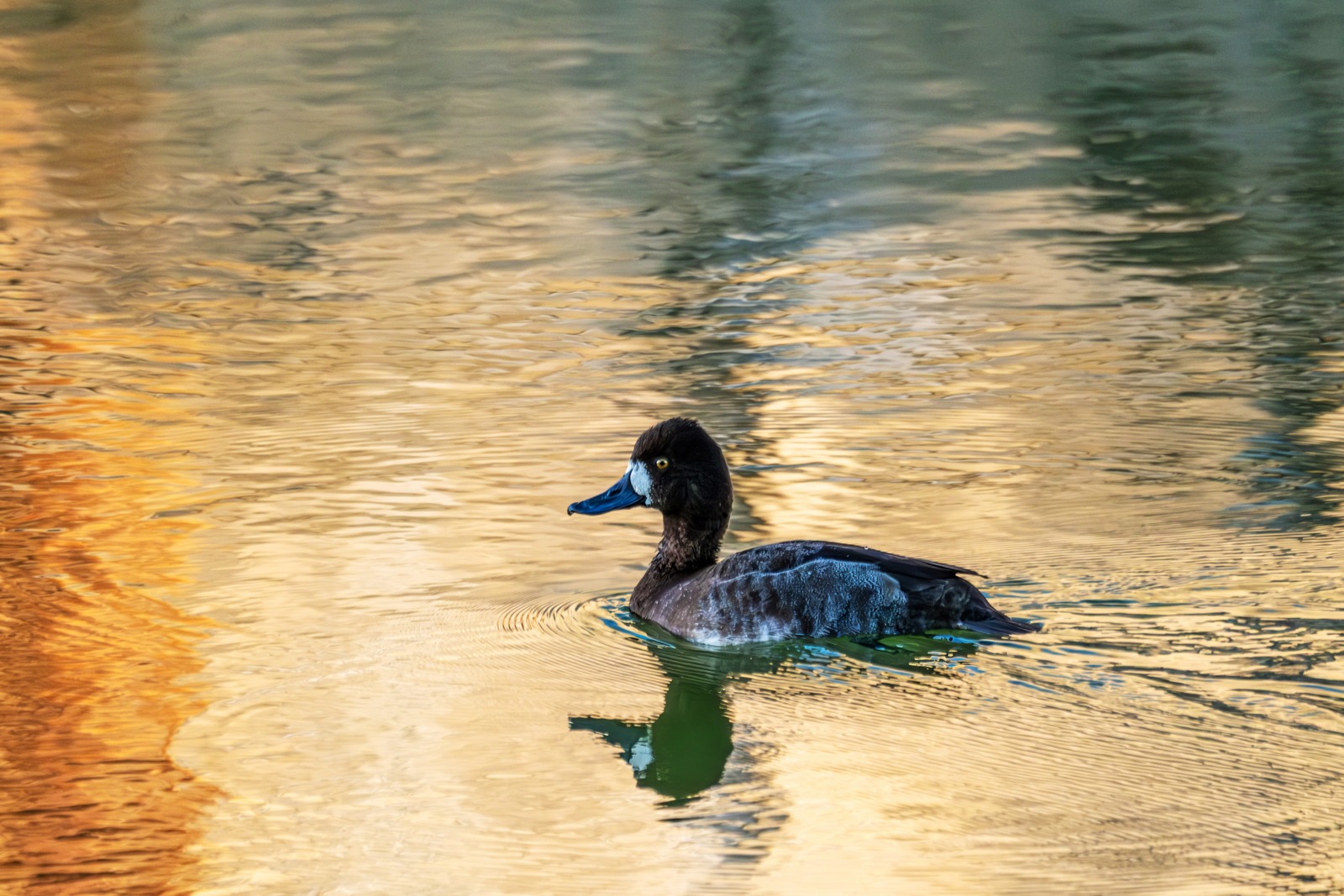
I wasn’t far down the moat path when I saw some movement. A duck swam out from under the mangroves to the middle of the water, the place of greatest safety. Avoiding humans seemed to me like the first sign of a bird no longer influenced by its captivity.
It had a longish bill, for a duck, a broad uneven white band across the bridge of it, and a dark head, chocolaty, russet, verging on the deepest burgundy. It was reminiscent of the dark velvet curtains of certain Italian restaurants in the 1970s, though in the proper scheme of things the curtains should have been reminiscent of the scaup.
All this made it a female.
She watched me with her amber eye, wary but unpanicked as she paddled slowly along the moat, propelled by her two unseen webfeet, which made it seem more like she was propelled by some kind of mystical force.
I walked along with her at a pace as she moved through the coppery sheen of the water, raising my camera occasionally, trying to get a shot of her through the branches.
That bird knew what she was about. She could be checked off any bird list you like. If you were into that sort of thing.