






I don’t usually have anxiety dreams about birding. I usually have them about cameras, social faux pas or software. Actually, it’s software more than anything. Passwords I keep typing in wrong. Dropdown menus that won’t stay dropped down. Cursors gone rogue.
But I had anxiety dreams about birdwatching a few nights before this year’s Christmas Bird Count. Two of them. In the first dream, I pulled back a couple branches in a park and caught sight of a pair of breeding smooth-billed anis and a blue jay. Anis pretty much disappeared from the South Florida landscape 15 or so years ago, but they’ve been making something of a comeback. But the blue jay, one of the most common birds in America, was the anomaly. We don’t get them much south of Islamorada.
In the second dream I was in my living room, which somehow had an A-frame ceiling. And a green heron flew across the room like an arcing dart and stabbed me in the forehead, leaving a perfectly round cut and giving me one of those what-you-going-to-do-about-it stares as it sat on the arm of our sofa.
And, oh yeah, there was a whole third one where I kept writing down numbers on the Christmas Bird Count tally sheet, and then they would change or disappear or move themselves to a different part of the sheet. Or maybe that was interspersed throughout the first two dreams.
The Christmas Bird Count is a (stops to look it up) 126-year-old tradition. The first one was held in 1900 with the intention of replacing the Christmas Bird Hunt, where hunters would shoot every bird out of the sky, and whoever had the biggest heap of dead birds at the end won. Oddly enough, it worked. That first year there were about 25 Christmas Bird Count circles. This year there are close to 2,700 count circles in North America, as well as a good number in Central America and parts of South America.
While it is a good substitute activity, the counts over the last 125 years have also created a massive data set – an annual census of what species are where in the days surrounding Christmas and the New Year.
The Key West CBC is the southernmost count in North America, as long as you define North America as stopping at the Mexican border, which most bird books do. There were 10 of us this year, which is more than we’ve had since the beginning of the pandemic. Ellen Westbrook and I, stalwarts of the Florida Keys Audubon Society, along with nomadic birding superstar power couple Luis Gles and Mariah Hryniewich, were the Old Town crew. We traveled by bike, gear in baskets and backpacks.
It was pretty much a perfect day – low 70s, light winds. The sky was a big, glacial blue pool, empty of clouds and, so far, birds.
We had our first raptor of the day in the park across from Higgs Beach, a female American kestrel (no blue in the wings) sitting on top of an old utility pole. Riding by the Casa Marina we had our first turkey vulture of the day, flying low, the featherless red of its head complimenting the blue of the sky.
When we stopped, Ellen recorded both species, and several others we’d seen, on the data sheet. The turkey vulture was most likely going to be statistically insignificant, but you never know.
The point of the Christmas Bird Count is to tally everything you see – shorebirds, gulls, terns, warblers, pigeons, pelicans, mockingbirds. We even count chickens. Every damn one.
But certain themes start to develop, affinities, through lines. Certain things rang the bell of enthusiasm more than others. In this case, it was raptors. When we spotted a red-shouldered hawk on a street light over JIATF, it seemed like it was going to be a good day for them. The merlin in a tree soon after bolstered that idea.
A while back, we’d all spent multiple hours looking for a golden eagle that had been spotted at Fort Zach. A month later we all still held on to the slight chance it could make a reappearance. The only birds you could possibly mistake it for were turkey vultures or bald eagles. So we had to pay attention to each one.
We’d been seeing turkey vultures in dribs and drabs since that first one. Three here, five there, all of their number duly recorded.
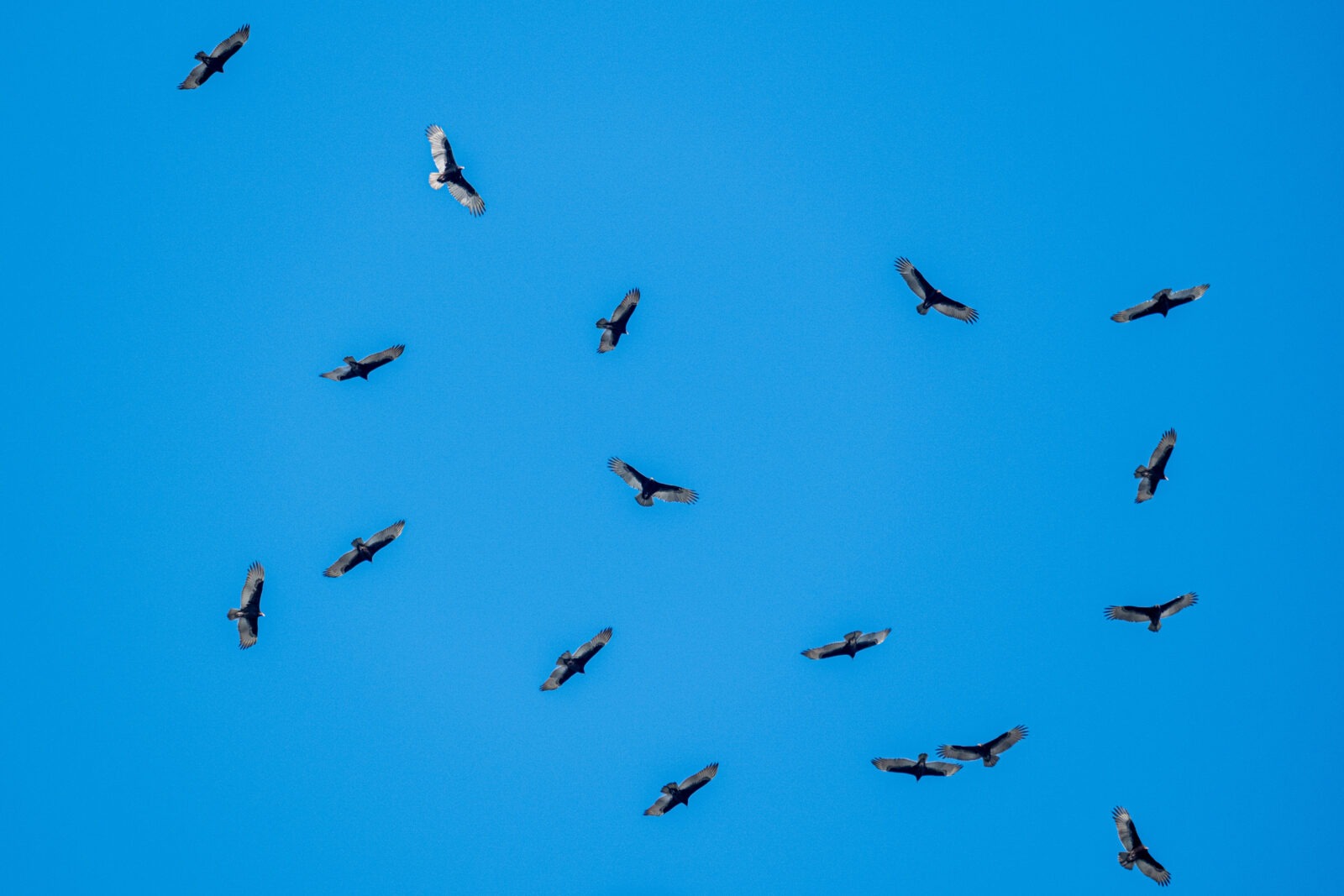
At the far end of Truman Annex we watched as a Würdemann’s heron flew in and landed on some jet skis. Then we looked up and saw our first kettle of the day – 50 or so TVs swirling on the thermals, all ashy wings and dihedrals. As we rode our bikes towards the fort we spotted two Cooper’s hawks, then a second kettle of 50 or so TVs. Then the two kettles merged, and continued to grow in number as birds kept flying in from all directions, like some kind of reverse avian version of the Big Bang. Ultimately it grew to about 250 birds.
We stopped and gawked for a while at the spiraling mass, trying to clock every bird, trying to see if we could find anything different.
Eventually Mariah and Luis pulled a couple of broad-winged hawks out of the spiraling mass, then a light morph Swainson’s hawk, a dark morph Swainson’s hawk, and another light morph.
The broad-wing was expected. We had a little under 4,000 fly by the Florida Keys Hawkwatch site (staffed by Mariah) in Marathon this fall. And a good number of them usually overwinter in Key West.
The Swainson’s had longer, lankier wings than the broad-wings, marked by dark commas out toward the end. And they had a certain heft to them, a bulkiness. Like the blue jay in my dream, they were the anomaly. The hawkwatch has counted up to 341 in a season, though this year was just a little under the average, with 38 counted. Normally they were late October and early November migrants. But I can’t recall one, let alone three, this late in the season.
We had other cool birds that day, like the pair of low Cooper’s hawks we saw when we started pedaling again, the former accipiters no doubt up to no good. At Fort Zach we watched an immature bald eagle work his way into the kettle and join the hurley burley for a while.
In the Key West Cemetery we made our traditional stop to say hi at the graves of Fran and Bill Ford. It took us a few minutes to notice all the mourning doves and white-winged doves snoozing on the branches of the nearby plumeria tree. And then the short-tailed hawk that came from the direction of the Harris School and drifted overhead.
We counted everything, and Ellen wrote it all down. At some point I’m going to have to type it all into an online form.
Later, though, when I closed my eyes, it wasn’t the numbers I remembered. It was that kettle, all those eddying birds watching the world from up there at the edge of our perception.