










The front came in fast on Sunday, like a bad mood. I was driving home on North Roosevelt and suddenly everything was divided between the usual bright, Technicolor world of the Keys, and one leached of any chromatically dynamic color. Then the front pushed across the road, trailing its blanket of gray, leaching the brightness out of everything.
I wasn’t actually in a bad mood. I’m just so used to the visual vibrancy of our basic everyday landscape that when that vibrancy dims, I always initially feel like something has gone wrong. And then I think, oh yeah, weather.
Late Monday afternoon, the world was bright and clear again, if a bit under siege from all the wind. The air was crisp, the way an early autumn day would feel up north, even if it was the middle of January. It was actually blowing a little too strongly to be a great day to see birds, but I decided to drive up to Boca Chica Beach just in case.
The beach was mostly empty, but I could see three or four people up beyond the concrete barriers, one walking a small puffball of a dog. Despite all the wind, the water was dead calm. No whitecaps anywhere.
The go-to spot there, the best place to look for birds, is at the edges of the puddles at the end of the runway, on the other side of the green fence. I can list 20 or 30 species I’ve seen there. But on Monday it was empty.
The tide was pretty low and most of the beach was covered with strips of tobacco brown sargasso weed that stretched for yards and yards. Past the runway ponds, climbing over the mounds of sargassum like Alpine explorers, I caught sight of a pair of ruddy turnstones. Further down, a trio of sanderlings.
Turning around at the end of what’s left of the road, just before the sign that says, GOVERNMENT PROPERTY/NO TRESPASSING that went up a few years ago, the light was gorgeous, that golden hue that infuses everything and makes you think nice things about the world. The old asphalt, the chainlink, the ocean, the sargassum-covered beach – everything looked resplendent.
I caught sight of a palm warbler, brown and tannish this time of year, probably the most common species in these parts in the winter. Bathed in those honeyed rays I was all, well, look at you, gorgeous.
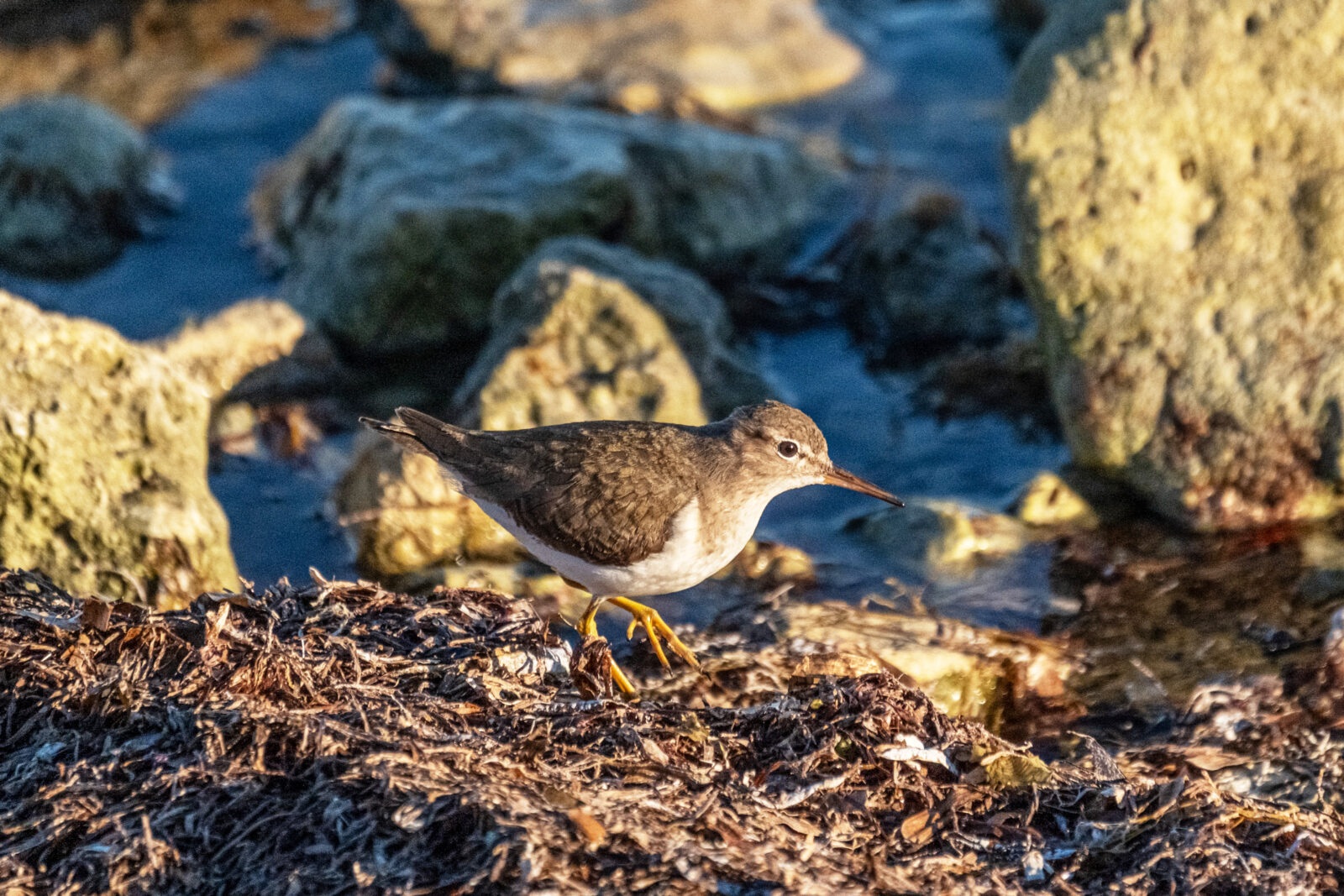
A little farther down the road I saw the bird that made the drive and the walk worth it (not that just getting out and moving around in the fresh air isn’t worth it). It was a spotted sandpiper.
I have a great, though no doubt unrequited, fondness for spotted sandpipers and all their assorted weirdnesses.
Spotted sandpipers aren’t rare in the Keys. Or anywhere in North America. As long as there’s some water nearby, you have a solid chance of spotting a spotted sandpiper or two.
I see them year-round, even though they typically only winter here. But a few stragglers and non-breeders always hang around. You generally find them alone, out on the edge of things.
Spotted sandpipers are sexually monomorphic – androgynous in human terms. The spotted part of their name comes from the Dalmatian-like dark spots they acquire in the belly in breeding season, which is not something we get to see as they don’t breed down here.
I’d never really thought of them as well camouflaged, but the one on the beach at Boca Chica alternated between easy to see and difficult to see, the brown on its upper half matching the sargassum and the white of its belly merging with the sand.
What gave the bird away was all the rump shaking.
Some of the older common names for the spotted sandpiper are teeter-tail, tip-up, jerk bird, twitchet, teeter-bob, teeter-snipe and tip-tail. If the species had been named in modern times, I’d assume the names twerk-snipe or Elvis Presley-on-the-Milton-Berle-Show Bird would have been on the table.
Spotted sandpipers basically bounce their rears on a near constant basis. I doubt there will ever be a fully satisfying scientific answer for why they do this. It has been posited that they do it to mimic the motion of water, which they are almost always near. But whenever I see them, they are always out of sync with the water, making them more obvious.
There has to be some kind of evolutionary advantage there, but it’s possible we’ll never definitively know what it is.
The one common species you could confuse the spotted sandpiper with is the solitary sandpiper, which confusingly does have spots most of the year, but they are white spots. The solitary also bobs, but from the front half of its body, its head rapidly pitching up periodically. In the Keys, though, spotteds are much, much more common.
There are occasional sightings of common sandpipers, the closest relative to the spotted sandpiper, in North America, but they tend to be in Alaska and the northern parts of Canada. They, too, have undulating posteriors, though it is slower and seems more like polite undulating, more pre-rock-and-roll, than the bobbing of the spotted sandpiper.
Spotted sandpipers also have a unique flight pattern, at least on their short hops. While most birds move with full range flaps, spotteds flap three or four times, pause, then flap three or four times again, their wings generally pointed downward, never seeming to rise above their shoulders.
Spotted sandpipers are also uncommon in the bird world due to their largely reversed gender roles. In the spotted sandpipers’ world, the females return to their nesting territories first, where they choose the nesting site and try to attract a mate. They are more aggressive to interlopers than the males. The males do more of the parental care and raising of chicks. And while female spotted sandpipers are often in seasonally monogamous pairings, some will also mate with up to five different mates, leaving eggs in the nest with each one of them.
If the world of sandpipers were a teen movie, the spotted sandpiper would be the weird kid, but the weird kid who, by the end of the movie, proves to be cooler and more sure of themselves than any of the other kids. Maybe even the hero.
Which might explain my fondness for them, in good light and bad.