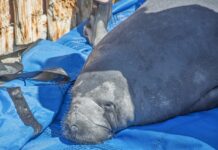








At Dolphin Research Center, we are the only licensed manatee rescue team in the entire Florida Keys. We work closely with our in-house veterinarian, Dr. Scott Gearhart, and the Florida Fish and Wildlife Conservation Commission (FWC) to assess when a manatee is in distress. If a rescue is needed, we locate and safely rescue the animal so it can be transported to a licensed rehabilitation facility – typically SeaWorld Orlando or another FWC-associated center. Once the manatee is healthy again, we help return the animal to the wild, which is extremely fulfilling.
But by May of this year, we had already responded to more manatee rescues than we did in all of 2024.
So far in 2025, we’ve had many successful rescues:
- A juvenile male exhibiting signs of gastrointestinal infection in Key Largo.
- A mother and calf after the mother had been struck by a boat in Islamorada.
- In Marathon, a mother named Stripes and her newborn calf, later named Argyle, when the mother was found with severe fishing line entanglement. The entanglement resulted in a necessary partial amputation of a flipper.
- An orphaned calf in Key Largo.
- Another mother and calf in Marathon when the mother was found with a severe fishing line entanglement.
- An adult, known as Cooley, that was found with severe fishing line entanglement in Key Largo.
- Another adult, known as Kanagroo, with severe fishing line entanglement in Key Largo.
- A 9-foot adult male, after being struck by a boat in Marathon.
In addition, we’ve had 10 rescue attempts that were not successful.
There are many difficulties that can create barriers when we attempt a rescue. Manatees are wild, large and strong animals. When we typically encounter them, they may be severely sick or injured and not behave like they typically would if they were healthy.
Some of these animals were able to evade rescue due to a variety of factors such as geographical challenges, other manatees and wildlife present, or vehicle and boat traffic. Some succumbed to their critical injuries en route to treatment and rehabilitation.
As hard as these outcomes are, they remind us that each rescue effort matters — because each manatee matters. Some rescues are fast, while others take hours of planning, tracking and adapting to the environment. No matter how difficult the situation is, we show up.

Why it matters
This work is one of the most meaningful things I’ve ever been part of. Even though I am already a practicing professional, I chose to get a job at the Dolphin Research Center simply knowing they are the licensed manatee rescue program in the Florida Keys.
Being part of the rescue team gives me a way to change the world in a real and direct way. These aren’t abstract efforts. When we save a manatee, that’s a living, breathing life still out there because we did something. I’ve stood in the water with manatees that barely moved. I’ve helped carry them into transport vehicles. I’ve waited in the shallows during a release and watched them swim back into the ocean.
Moments like this are unforgettable. It’s so amazing to know you are a part of a team of like-minded individuals sharing a common goal and purpose. You don’t forget moments like that. They stay with you. They remind you why we do this.
And for me, that’s everything.
What’s made this year even more inspiring is the support we’ve received from the local community. People have offered us their personal equipment — like kayaks and boats — for tracking manatees. Something as simple as lending a hat or sunscreen makes a real difference. Others have opened up their homes and private boat ramps to help us access hard-to-reach areas. Community members have even kept an eye on struggling manatees until we could arrive.
What’s more amazing is that this is true of the entirety of the Florida Keys: a real community that cares and supports one another, human and animal alike. That kind of support makes a real difference.

How you can help
Many of the cases we respond to are due to factors that are preventable. More importantly, the more awareness we build, the more injuries we can avoid. If you care about manatees and want to protect them, here’s how:
• Report sightings to FWC. If you see a manatee in distress, contact FWC at 1-888-404-FWCC (3922). STAY BY YOUR PHONE. Your communication can be vital in locating and rescuing a manatee in a timely manner.
• Dispose of fishing line and gear properly. Even a small tangle can cause serious damage.
• Slow down in manatee zones. These animals often rest just below the surface and may not be able to move out of the way.
• Don’t feed, water or touch wild manatees. It encourages dangerous behavior — like approaching boats and frequenting high-traffic areas, like marinas.
Every rescue we do is empowered by people like you — members, donors, neighbors and strangers who choose to care. If that’s you: Thank you, genuinely from the bottom of my heart.
You’re just as much a part of this as I am.
It’s already been a busy year, but we’re not done. We’ll keep showing up — because they still need us.
– Preston Surrage
Manatee rescue team and environmental services at Dolphin Research Center
Photos by DOLPHIN RESEARCH CENTER/Contributed