













Response to the stony coral tissue loss disease in May 2023 led several coral reef and environmental stakeholders to merge their efforts.
The Monroe County Extension Service co-leads Florida’s Coral Reef Resilience Program communications team, which collaborates on issues related to Florida’s coral reef. The communications team is one of 10 response teams in research, surveillance, intervention, rescue and propagation, restoration, data management, regulatory, water quality, Caribbean cooperation and communication. We work within a network of 80 partners from agencies, universities, nonprofit coral conservation groups and the private sector.
The communications team collaborates on media products focused on coral bleaching, stony coral tissue loss disease and pulse corals, a potential new invasive gorgonian species.
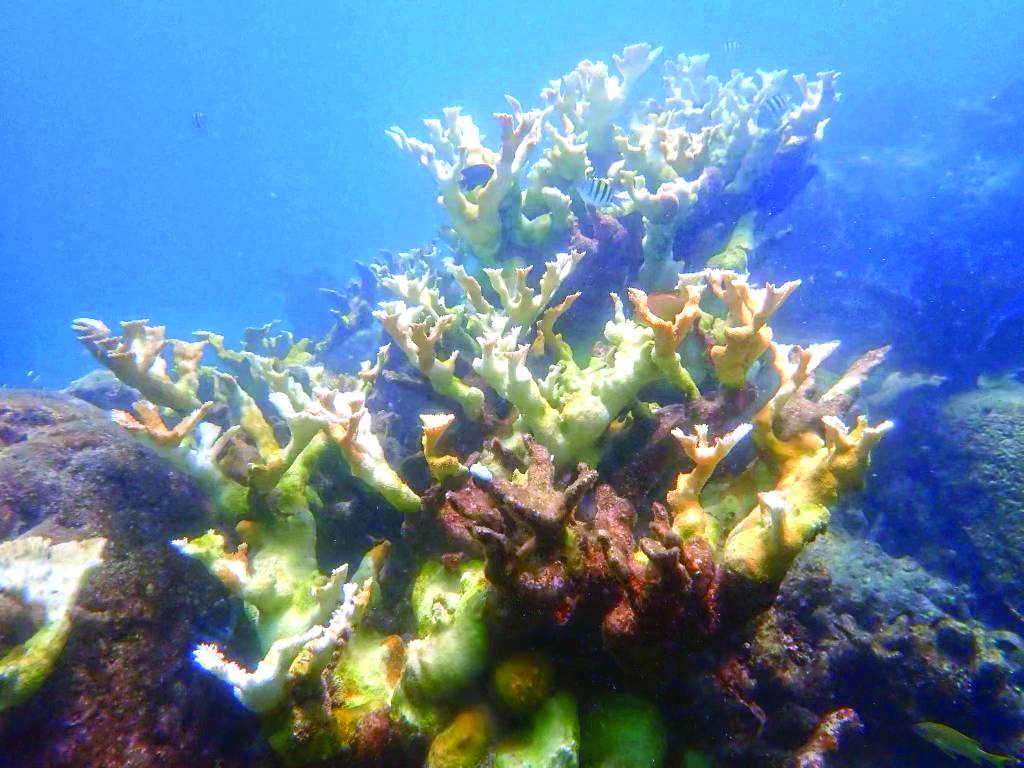
For three years, Florida’s Coral Reef Resilience Program communication team has focused on coral bleaching. Corals rely on microscopic algae called zooxanthellae, which live within their tissues, give corals their color and supply up to 90% of their nutrition. When heat stress forces corals to expel their algae, their white calcium carbonate skeletons become visible, a process called coral bleaching.
Coral bleaching results in the depletion of corals’ energy stores and makes them more susceptible to other stressors. When bleaching lasts for an extended period or consecutive years, corals may die from starvation and/or the heat stress alone, as seen in 2023.
During the 2023 marine heat wave — also part of the fourth global coral bleaching event — Florida’s coral reef experienced the most severe coral bleaching so far. Cumulative heat stress in the Florida Keys was nearly three times the previous records from 2015 to 2016. Surveys found severe bleaching prevalence in Biscayne National Park south to the Dry Tortugas.
A recently published article notes staghorn and elkhorn coral are no longer present on the majority of Florida’s coral reef. While Southeast Florida reefs were heavily affected, many coral reefs and patch reefs in the northern region fared well.
Bleaching is not a death sentence, and short-term coral paling and bleaching do not generally lead to coral mortality. But bleaching does signal coral stress, making monitoring vital for understanding reef health and Florida’s planning and restoration efforts. Integrating monitoring with targeted intervention also strengthens action plans, ensuring a more informed and effective response.
Since 2023, Florida has gathered insights and lessons from practitioners, managers and other partners on bleaching response strategies. Folks are learning and applying some of these strategies in preparation for, and response to, potential coral bleaching:
- Focusing restoration activities on more boulder coral species.
- Pausing planting and restoration activities during times of thermal stress.
- Monitoring coral conditions to better understand bleaching and patterns of resilience in the system and learning from corals that survive bleaching events.
- Using corals that have been shown to be more thermally tolerant for sexual reproduction.
- Testing the planting of thermally tolerant corals from other countries with coral from Florida.
- Monitoring real-time sea surface and bottom temperatures at key reef sites and coral nurseries.
- Preparing land-based facilities to accept corals from in-water nurseries, should evacuations be necessary to preserve genetic diversity.
- Using in-water nurseries at deeper depths for short periods, where impacts from temperature and light are less pronounced.
- Shading existing in-water nursery structures to reduce the effects of temperature and light.
How you can help:
Community scientists can report bleaching through the Florida Department of Environmental Protection’s seafan.net under “Report a Marine Incident.” Reports of no bleaching are just as important. There is an optional area to add photographs and a map to drop a pin on the site you were snorkeling or diving.