












I joke with my clients all the time that life is one big set of “wash, rinse, repeat.” But when it comes to our bodies, it’s really more like “rise, rest, repeat.” Every single day, your hormones are doing a carefully-choreographed dance, and whether you realize it or not, you’re following the beat.
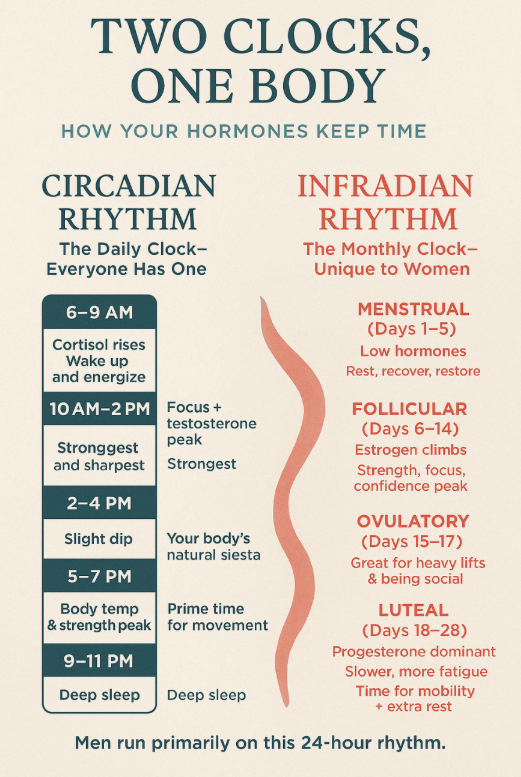
We all have a built-in 24-hour timer called the circadian rhythm — our body’s natural clock that manages when we wake, eat, move, think and sleep. This isn’t just woo-woo wellness talk; it’s hard-wired biology. The circadian rhythm is influenced by sunlight, temperature and behavior, and it helps regulate hormones like cortisol, melatonin, insulin and testosterone on a tight daily schedule.
Think of it like this: In the morning, cortisol rises to get you out of bed — not to stress you out, but to literally wake you up. Around midday, testosterone and alertness peak, making this the best time for productivity or a solid workout. In the evening, melatonin kicks in, signaling that it’s time to slow down and rest.
So yes, when you’re staring at a sunset, you’re actually participating in hormone therapy — the natural kind, complete with a side of salt air.
But here’s where it gets interesting. While everyone runs on this 24-hour clock, not everyone only runs on this clock.
Men’s hormonal patterns repeat every single day, rising and falling predictably within that circadian rhythm. Women, however, are operating under two clocks — the same 24-hour daily cycle, and a second one called the infradian rhythm, which spans roughly 28 days.
If the circadian rhythm is your body’s “daily schedule,” the infradian rhythm is the “monthly calendar” — and it’s the reason women can feel like completely different versions of themselves throughout the month. Hormones like estrogen and progesterone fluctuate in phases, influencing energy, metabolism, mood and, yes, strength.
Let’s talk about that, because this one hits home for a lot of women who think they’ve suddenly “lost progress.”
One day you are deadlifting 200 pounds. You are feeling unstoppable, on top of the world. Five to seven days later, you are lucky to be able to lift your toothbrush for the recommended full two minutes.
That’s not inconsistency — that’s biology. During the follicular phase (the first half of the cycle), estrogen is higher, driving energy, motivation and muscle strength. But once the luteal phase sets in, progesterone takes the wheel. You might feel heavier, slower or more fatigued — your body’s way of asking for recovery, not punishment.
It’s not weakness. It’s wisdom.
When you sync your workouts to these hormonal shifts, you stop fighting your physiology. That means scheduling your hardest workouts during your follicular and ovulatory phases and leaning into mobility, Pilates or gentle strength work during your luteal phase. The magic? Progress without burnout.
Men benefit from understanding their rhythm, too. Theirs just happens every single day. Knowing that testosterone and alertness peak mid-morning, for example, makes that the best window for lifting heavy or tackling mentally demanding tasks. By late afternoon, cortisol naturally declines — which is why caffeine at 4 p.m. is an uphill battle against your biology.
The more you understand your internal timing, the easier it is to support it. Morning sunlight exposure (yes, even through the Keys’ humidity), consistent meal timing, mindful movement and proper wind-down routines all help your circadian rhythm stay balanced. For women, respecting both clocks means learning when to push and when to rest — not as a sign of giving up, but of working smarter.
We’re taught to grind harder, sleep less and “push through.” But your hormones don’t care about hustle culture; they care about rhythm. And when you fight that rhythm, you end up tired, irritable and wondering why paradise feels more like pressure.
Living in the Keys gives us a front-row seat to nature’s timing — the rise and fall of tides, the consistent sunrises and sunsets, the unspoken rhythm that reminds us everything moves in cycles. Our bodies are no different.
So maybe the secret to health isn’t about doing more — it’s about syncing up. Rise with the sun. Rest when it sets. And repeat, knowing your body’s clock is doing the heavy lifting, toothbrush and all.