






Roughly 1,700 islands that make up the Florida Keys archipelago. Key Biscayne is not one of them.
However, historically, it is a significant piece of Monroe County real estate. The county is much smaller than it used to be. When Monroe County was established in 1823, it stretched from Key West north to Lake Okeechobee and west to Charlotte Harbor.
Key Biscayne is a 5-mile-long barrier island located just off the South Florida mainland, just minutes away from Miami. The island’s name is one of the oldest in South Florida. In 1675, it was charted as Caio de Biscainos. The Father Alana chart identified it as Biscaino in 1743. Bernard Romans called it Key Biscay on his 1773 chart. In John Williams’ 1837 work “The Territory of Florida,” he called it Kay Biscanyo.
The island is home to Cape Florida, and Cape Florida is home to the Cape Florida Lighthouse. The brick and coral-rock lighthouse stood 65 feet tall when it was first lit in 1825. On July 23, 1836, the lighthouse was destroyed in an attack during the second escalation of the Seminole War. Due to the continued Indian threat, it was not rebuilt until 1846. Less than a decade later, the conical tower was raised an additional 30 feet to a height of 95 feet.
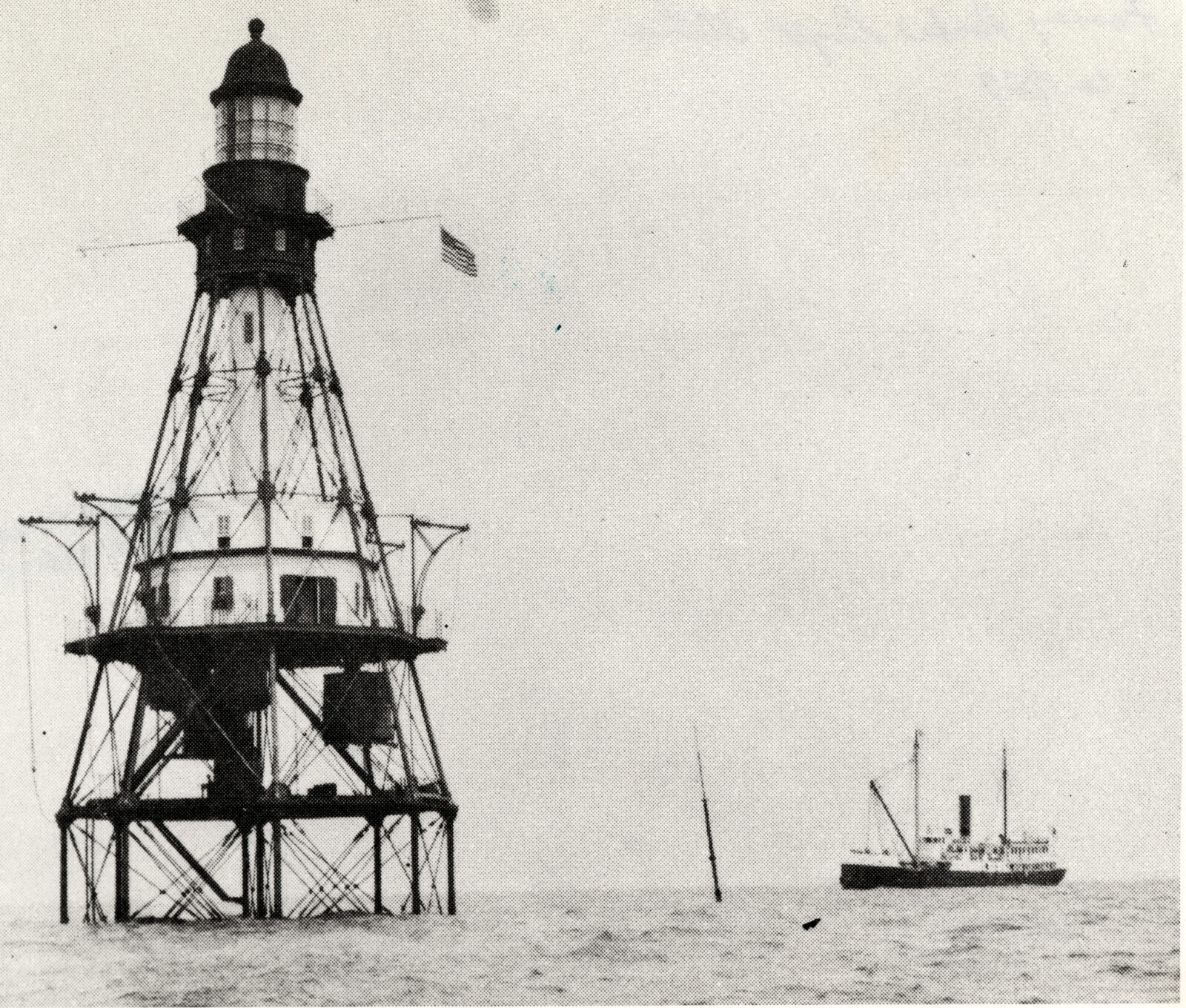
The Cape Florida Lighthouse remains standing and is the oldest structure in Miami-Dade County. The warning beam of light was extinguished when the better-situated Fowey Rock Light was established in 1878. Congress allocated $100,000 for its construction, as it was better situated to mark the navigational hazard that is the Florida Reef. It was enough money to get the project started, but not enough to complete the project, which required an additional $75,000.
Fowey Light was the second to last in a string of six iron lighthouses built to mark the Florida Reef. Carysfort Reef Lighthouse was the first (1852); the others were Sand Key Light (1853), Sombrero Key Light (1858), and Alligator Reef Light (1873). American Shoal Light was the last to be built and first cast its warning light across the water on July 15, 1880.
During the building of the Fowey Rocks Light, Soldier Key was used as a base of operations. Once the iron beams were driven down into the reef and the light’s skeleton was in place, the lighthouse’s platform was constructed. When the platform was finished, workers lived in a makeshift camp atop it to ensure that adverse conditions and rough water would not deter them from reaching the light during the construction period.
Twice, ships ran aground on the coral reef dangerously close to where workers were sleeping. One night, the men were startled from their sleep when the steamer Arakanapka hit the reef, ground through the limestone, and the bow of the ship came to a halt mere feet from the platform. The men undoubtedly watched with wide-open eyes as they considered their mortality. It was not the only time workers were nearly struck by a ship crashing on the reef. The Carondelet also wrecked on the reef, startling the workers building the light that would warn sailors of the imminent danger. Fortunately, the crew of the Carondelet was able to float free from their predicament when the incoming tide pushed enough water over the reef to set them free.
The Fowey Rocks Light was first lit on June 15, 1878. The light is 3 miles east of Soldier Key. It is a small island, about two football fields long and 100 yards wide, and is considered the archipelago’s first true key. The Florida Keys are composed of two types of limestone: Miami limestone and Key Largo limestone. The Upper and Middle keys are built atop a coralline foundation called Key Largo limestone. The islands of Florida Bay (and the Gulf of Mexico) and the Lower Keys are built on a Miami limestone foundation, built of oolite and bryozoans – colonizing invertebrates that build limestone exoskeletons.
Soldier Key is located about 5 miles south of Key Biscayne’s Cape Florida and 3 miles north of the Ragged Keys. On modern charts, it is identified as the singular Soldier Key. It has not always been the case, as the number, as well as the name, has varied over the years. Early Spanish charts identified the island as Parida. Interesting word, parida. In Spanish, it can refer to someone who has said something nonsensical or stupid. It can also refer to a mother who has recently given birth.
It is this second interpretation that is interesting. Juan de Liguera and Father Alana also identified the island as Parida on their 1742 and 1743 charts. In 1770, a chart created by O-Carrol named it La Parida y Su Hijo, a name that refers to a mother and her newborn son. In 1774, Captain Barton, in his Observations, identified the islands as the Soldier Keys. John Lee Williams, who wrote the 1837 work, Territory of Florida, identified two islands: “Soldier Keys are the small islands, in a row, six miles south of Biscayo.”
A Coast Survey chart from 1855 identified the islands as Soldier Key and Little Soldier Key. If there is one thing that mangrove islands like the Florida Keys do, it is grow. Over the last 150 years, Soldier Key and Little Soldier Key have merged and become the single island appearing on nautical charts today.
Soldier Key is the northernmost of the islands called the Northern Keys. It is one of nearly 50 islands before the largest of the islands in the archipelago, Key Largo, appears. For those driving down from the mainland, Key Largo serves as the gateway to the Florida Keys, connected to the mainland by both the Card Sound Bridge and the Jewfish Creek Bridge. It is easy to see why people assume it is the first island in the chain.