






The sky above the parking lot at the Key West Tropical Forest & Botanical Garden was an empty arena of blue, rimmed by tall trees. The tallest among them was a sausage tree – it had a helpful label, as well as a bunch of seed pods that look like sausages. Those got me thinking about South of the Border, that corny and culturally questionable roadside tourist trap in South Carolina, its incessant billboards punctuating I-95 for hundreds of miles, one of which implores you to stop because, “You never sausage a thing.”
I was at the garden to commit some science, not to revel in bad puns, but the puns persist when there aren’t any birds around.
I stood there for the allotted seven minutes, spinning around on a regular basis to cover all corners of the sky. Driving there I’d seen a number of turkey vultures in the area, and a small murder of fish crows, but from the parking lot, the allotted survey point, I saw nothing but a couple palm warblers and a late season white-crowned pigeon.
When the timer went off, I got into the car and drove on.
On Government Road, just behind the airport, the sky was also empty. On the runway, an American Airlines Airbus idled for a moment, until the pilot pushed the throttles forward and started the plane rolling down the runway.
I started the timer and as if on cue, a turkey vulture started circling overhead. Another one arrived a few minutes later, then a few more. None of the birds was part of my purview, but they made me wonder how many raptors had to assemble before they could be considered a kettle. I wasn’t sure if a half-dozen vultures counted.
But then another dark bird caught my eye. If you weren’t paying attention, you’d be forgiven for thinking it was just part of the vulture (near) kettle, but with a modicum of focus you’d see it was not.
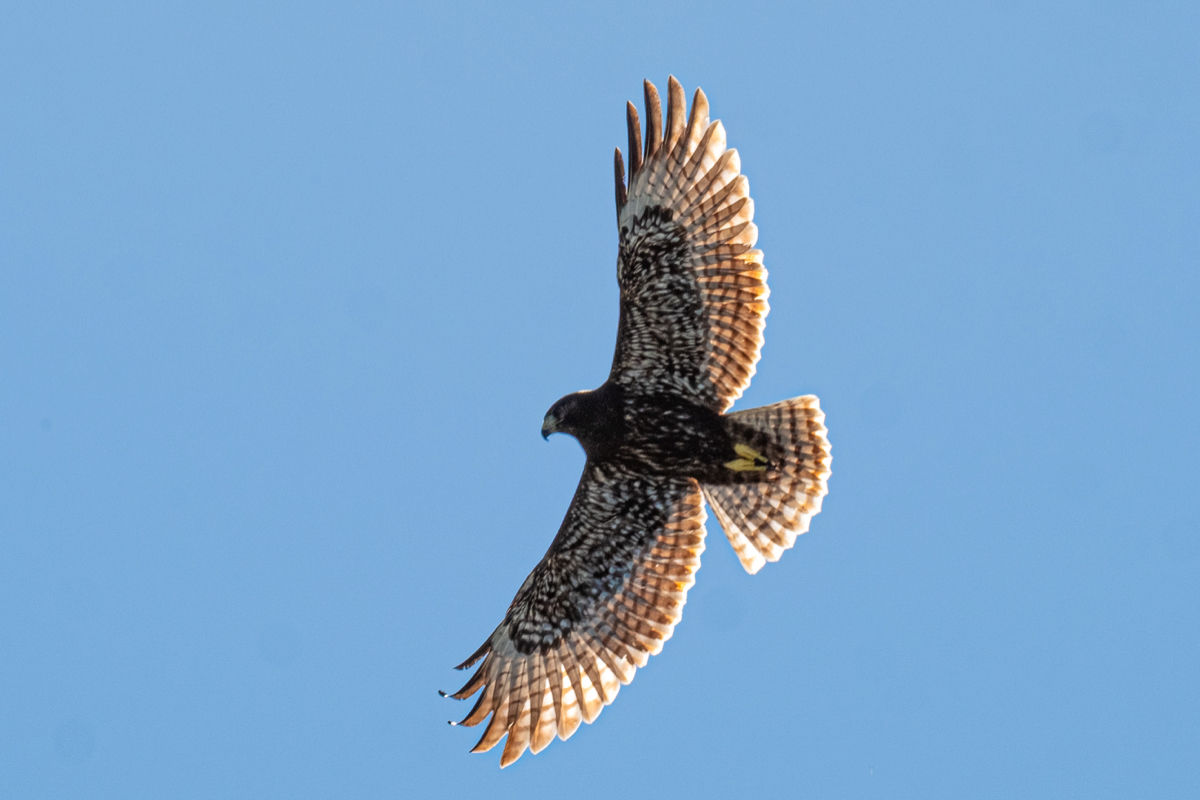
Vultures, to me, always look like they’re wearing a poorly fitted cheap suit. This may be a cultural judgment, but this bird was neat and trim, with some sporty, rounded wings that stretched about half the length of the turkey vultures’.
It was a bird I was looking for — a short-tailed hawk.
Short-tailed hawks are some of the rarest birds in the U.S. There are only an estimated 250 breeding pairs, all of them living in Florida. They live and breed in the top two-thirds of the state in the summer, then migrate to the bottom two-thirds of the state in the winter. (Short-tails are much more common in South America, but our population exists isolated from theirs.)
Florida Keys Hawkwatch volunteers count an average of 33 short-tails migrating into the Keys every fall, though those numbers seem to be climbing of late. They counted 65 last year and 105 so far this season.
Since the early 2000s, the folks at the Avian Research and Conservation Institute in Gainesville have also been monitoring short-tailed hawk populations in Florida. Unlike the Hawkwatch, in which counters stay at a single point for months at a time, recording every bird they see that goes by, the ARCI folks do a series of point counts at different locations, stopping at a spot and looking for short-tails for a prescribed window of time (in this case 7 minutes) before moving on to the next spot.
I’d met up with Gina Kent and Drew Fulton the afternoon before, as they were finishing a series of short-tail point counts for ARCI. I asked them how it was going and they said not great. It had been raining all day, and hawks hate to fly in the rain, so they’d been hitting spot after spot in the Keys and coming up with no data. They were thinking about trying again the next day, but weren’t sure they would be able to do the whole route, as they had to get back to Gainesville.
I told them that standing in a bunch of different spots around Key West, staring into the sky for 7 minutes at a time, might be in my wheelhouse. I told them I could do it and save them some time. Which is how I ended up on Government Road.
In theory, when doing such things, you are simply supposed to be an instrument, recording data. You saw a short-tailed hawk or two within a window of time, or you didn’t. But it’s difficult to not feel like a failure when you don’t find the things you’re looking for, so I was inordinately happy to see that short-tail flying 300 or 400 feet above Government Road.
I spent a long time following it with my binoculars, trying to see if there were any flecks in the dark plumage of its belly. When I realized there were not, I marked it on the data sheet as an adult dark morph short-tailed hawk.
I went over to Key West Cemetery, where I mostly saw oversized iguanas resting on the crypts, though one American kestrel was hunting in the grass for palmetto bugs. The last stop was Truman Waterfront Park, where I witnessed a sky unblemished by avifauna of almost any type. (There was one royal tern and a mockingbird.)
While packing up my binoculars, camera and clipboard, I was thinking I was glad to have at least seen the one short-tail.
I was also thinking: Science!