


Giddiness can sneak up on you. When it does, it often makes me think of that James Taylor line, “Ain’t it just like a friend of mine to hit me from behind,” even though I haven’t gone out of my way to listen to James Taylor in decades.
Taylor was talking/singing about going to an unspecified Carolina in his mind, but I’d just spent an hour in a dentist’s chair that was very specifically on Big Pine, getting my teeth worked over by various complicated cleaning implements, and getting told I was brushing my teeth too aggressively and maybe I should try brushing with my non-dominant hand. Which did not seem like a preamble to giddiness, or having a friend hit you from behind.
But giddiness was lurking out there somewhere.
I drove unsuspectingly around the island for a while after the appointment, my mouth still tasting like baking powder, paying my respects to the gators at the Blue Hole, checking out the salt ponds on Koehn Avenue and on Watson Boulevard. Then I drove over the No Name Key Bridge, which the Sunday before had been filled with hundreds of kids pulling tiny fish out of the water, measuring them, throwing them back, and generally having a great time during the Kids Fishing Tournament, put on by the Lower Keys Rotary and the Monroe County Sheriff’s Office. Five days later the bridge was populated by four or five men with fishing poles and five-gallon buckets, and a lone brown pelican watching over them like a bored security guard at the mall.
I parked and walked down to the end of the road. Historically, this was the landing for the car ferry from Lower Matecumbe, which ran from 1927 until 1938, when the Overseas Railroad was converted into the Overseas Highway. So for a decade or so it was a bustling place, not just with the 20 or so cars that disembarked twice a day, but also because of the No Name Lodge, which was right next to the landing, and which in historic photos looked to have about six or eight cabins, a main building with a restaurant, and a couple sizable fishing boats moored there.
The lodge apparently survived into the 1940s, according to the historian Jerry Wilkerson, but was abandoned by the 1960s. The shoreline near the ferry launch was restored by the Florida Department of Environmental Protection with the help of the Audubon Society in 1983. (It’s unclear if it was Florida Keys Audubon or Florida Audubon, but yay, Audubon. And FDEP.)
To get to the shoreline you need to weave between a couple of large chunks of limestone, no doubt put there to keep people from driving into the water. But when you reach the water’s edge, you would never know any of those things were there. And honestly, I didn’t know most of that until I’d done a little Googling.
It was a perfect Keys winter afternoon. Cloudless, cool, only a little windy. There wasn’t much going on out on the water — no boats, no pelicans, no cormorants flapping low over the waves. The world out there felt like a still life.
There’s a dock to the north of there that sometimes has some birds, and there were a couple royal terns standing on the pilings.
Then I looked down at the ribbon of sargassum hugging the shoreline, and it was going off. There were 80 or 100 birds in the midst of a quiet feeding riot.
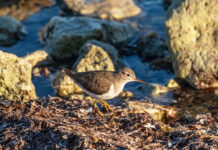
There were a couple of yellowlegs standing on the seaweed, which I usually think of as brown, but when I stared at it through my binoculars it contained a lot of green.
There are two species of yellowlegs in the world, greater yellowlegs and lesser yellowlegs. And they look insanely similar. If they call, they are easy to tell apart, as the lesser gives a double-note call and the greater gives a three-note call. But that’s usually when they are flying away. If they aren’t calling, one of the field marks is that the bill on the greater looks about one-and-a-half times the length of the skull, and the bill on the lesser looks about twice the length of the skull. Also, the bill on the greater appears ever so slightly upturned.
Size is a really tricky thing to determine. Human perception of large versus small can be highly variable. I don’t even trust myself trying to scale things. What makes it easier, though, is when the two species stand next to you and give you a straight-up size comparison. Which was what was happening out on the sargassum.
The most obvious thing to the south of me was a flock of white ibis, almost all adults, most with bills and legs that skewed toward the orange end of the color spectrum, but two or three with bills and legs hue-ing toward the reddish end of the color spectrum, meaning they were closer to being ready to breed.
On a dead snag lying low across the water were a half dozen ruddy turnstones. Ruddy turnstones are often described as Harlequin-esque in the field guides, but these were all in non-breeding plumage. They looked less wayward members of the commedia dell’arte than actors just after a show, freshly scrubbed of their makeup.
Oddly, the turnstones seemed to be avoiding the ground, huddling up on the branch as if they were playing The Floor Is Lava. Which for all I know they were.
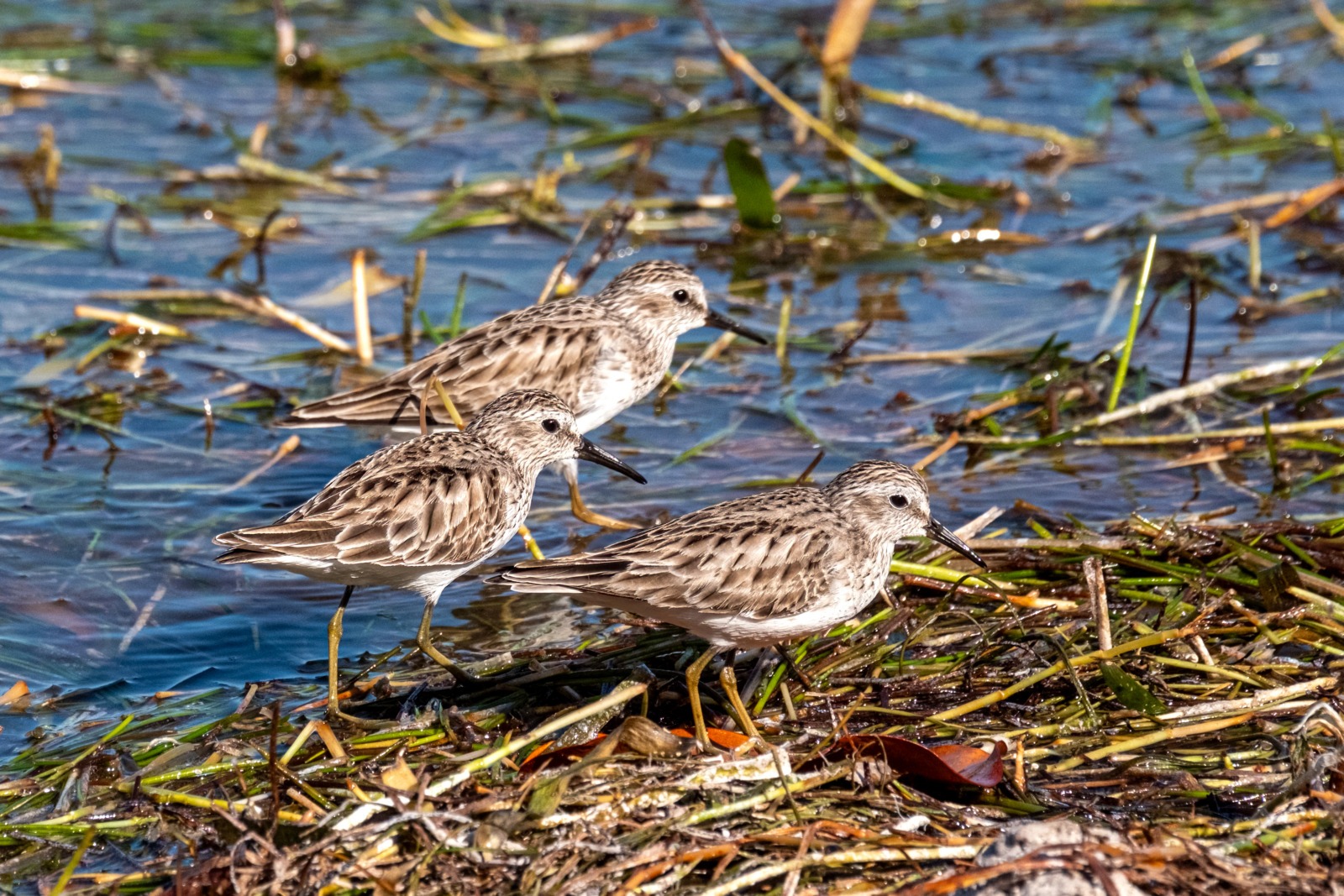
The birds that were slaying me, though, were the least sandpipers, the smallest shorebird species in the world. They’re about the size of a quartered lemon (cut horizontally) and weigh about the same as an AA battery. And this, along with a broad array of toes, gives them the ability to walk across the undulating landscape of sargassum and treat it like part playground and part smorgasbord.
I actually sat down on the ground to watch them, to take pictures, to follow them with my binoculars. To take in how they could casually move through a scaled-down landscape that few other creatures could. Which is when I noticed all the giddiness, ebullience, glee – whatever you want to call it – snuck in.
In an instant, this whole tableau exploded, disappeared itself, leaped up and sped off in multiple directions. Everyone but the ibis, that is.
And then I saw it, this brown comet skidding across the foreground, 10 feet above the water, trying to change direction on the fly. Literally.
It fanned out its long tail and flapped its shortish wings – the telltale traits of a Cooper’s hawk – and after a long moment it did manage to reverse the vector of its momentum, slowly at first, then quickly. Soon, it too was out of view.
The giddiness stuck with me for a while, though. Or maybe that was just the appreciation of my newly clean teeth.