











If you remember anything from the late ’90s, you might remember a little blonde boy telling Jerry Maguire that “the human head weighs 8 pounds.”
If you’re too young to remember that, you especially need to read this.
It is true that the average human head weighs around 8 to 12 pounds. What most people don’t know is that if that head shifts just millimeters forward, it exponentially increases the amount of weight your cervical spine has to support.
Here’s the actual science:
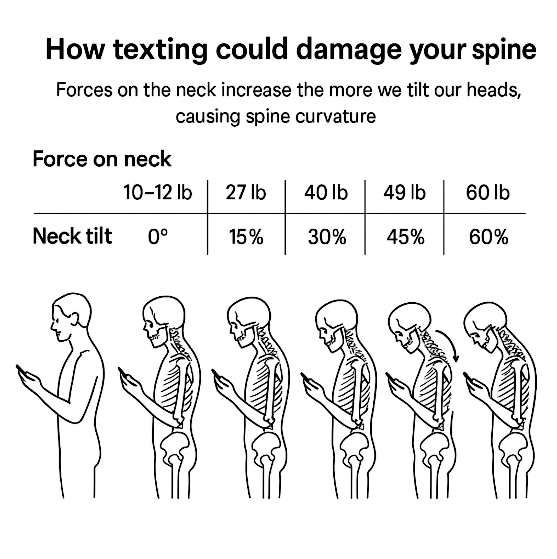
- At 15 degrees of forward head tilt, the effective weight of your head is about 27 pounds.
- At 30 degrees, your neck holds 40 pounds.
- At 45 degrees, that load jumps to 49 to 50 pounds.
- At 60 degrees, your neck feels like it’s supporting 60 to 70 pounds.
Those numbers come from research published in Surgical Technology International, and once you see them, you’ll never look down at your phone the same way again.
There have been several MRI-based studies showing that chronic forward-head posture — whether from your phone, tablet, driving position or working at a computer — literally changes the structure of the cervical spine over time. Some scans show up to a 1- to 1.5-centimeter reduction in cervical disc height, while others show early degenerative changes in people as young as their teens and 20s.
When I see these images, I immediately think of the cervical spine yelling out “Timber!” and then envision the head just collapsing forward. I have a vivid imagination.
But humor aside, tech neck is more than an annoying ache. It can contribute to headaches, shoulder tightness, jaw tension and TMJ, numbness or tingling down the arms, early arthritic changes, reduced lung capacity, fatigue and decreased concentration
Yes, you read that right: reduced lung capacity. One study in Applied Ergonomics found that forward-head posture can decrease respiratory efficiency by up to 30% because it restricts rib cage mobility. Another study in the Journal of Physical Therapy Science noted that people with chronic tech neck experience significantly more tension headaches due to overload on the suboccipital muscles at the base of the skull.
So when your neck feels tight by mid-afternoon, when your shoulders feel permanently raised, or when you can’t figure out why you feel “off,” it’s not just aging. It’s posture. And it’s extremely common.
The good news? You can fix this without giving up your phone, job or screen time. First, raise your screens. Bring devices up toward eye level instead of dropping your head toward them.
Next, follow the 90/10 rule: Every 90 minutes of tech use requires 10 minutes of movement or posture resetting.
Third, use chin tucks and proper alignment to strengthen your deep neck flexors, the tiny stabilizers that support upright posture.
Stretch what’s tight by opening the chest, lengthening the front of the neck and resetting shoulder mechanics.
Finally, fix your driving posture. The forward-leaning “turtle head” position is one of the biggest offenders.
We live in paradise, but even paradise cannot counteract hours a day of forward-head posture. The sooner you recognize and correct tech neck, the better your spine — and your head — will feel.
Small changes make a massive difference. Your cervical spine does a lot for you. The least you can do is meet it halfway.