







The sky was a giant blue bowl, inverted and empty. I couldn’t even find a turkey vulture. Where could they all possibly have gone? Maybe they needed an afternoon up the Keys, as we all do from time to time.
I pulled into the park behind the dog park at Higgs Beach and stopped by the pond, which, when it has water in it, usually holds a few surprises. But this late into the dry season it was a micro desert, parched and empty except for, for reasons unclear, a dozen rocks and a dozen roosters. Which I guess was also a surprise.
Nearby was the quarter-acre of land where the FAA tower used to stand, which can be a great place to see birds after recent rain. I’ve seen a dozen or so species there, usually wading birds like great egrets, great white herons, snowy egrets, and roseate spoonbills. It’s a great habitat largely because it is surrounded by an octagon of chainlink fencing and nobody spends much time grooming it.
There are rumors the county or city wants to turn it into pickleball courts, which seems a waste. There are quite a few pickleball courts a few yards away. (Besides, pickleball mania is relatively new. Wouldn’t it be wise to wait a couple years and make sure pickleball isn’t the roller disco or hacky sack of racket sports?)
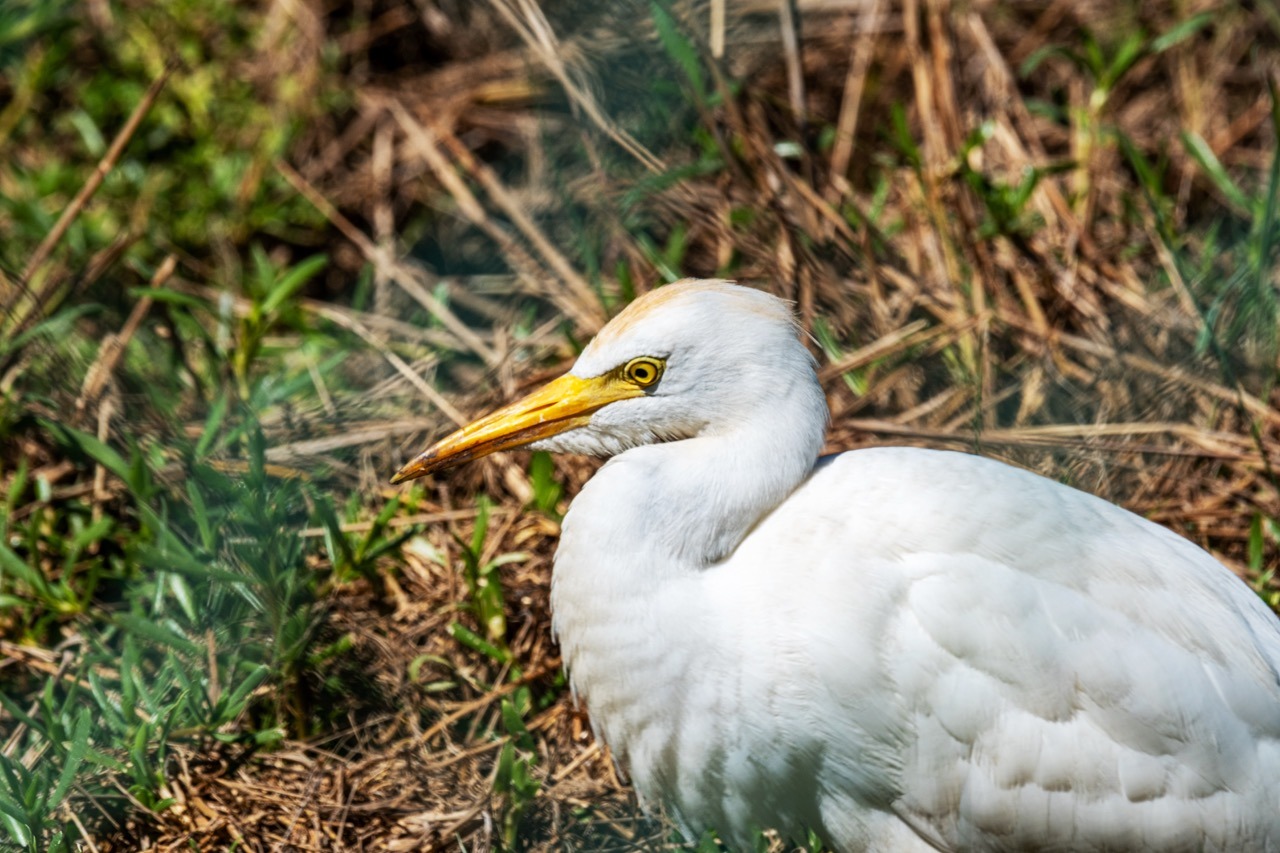
The only bird I could see on the other side of the green chainlink fence was a lone white ibis plunging its long decurved bill down into the ground. Only a white ibis tends to poke its bill up and down into the ground with the speed of a hepped-up oil derrick, and this one hadn’t yet lifted its head. When it did, its long decurved bill was missing, replaced with a modest wedge. It wasn’t a white ibis; it was a cattle egret.
The bird began to range around the dried grass of the octagon, bobbing its head most of the time, but occasionally speed waddling in a more upright, duck-like posture. Periodically it shoved its face down into the stubble of grass, no doubt trying to snatch up food.
Herons and egrets tend to catch things with the tips of their bills, then throw their heads backwards to fling whatever they caught toward their throats. Sometimes it happens in one go, sometimes they have to fling their head back multiple times to make it work.
The most dramatic version I ever saw was out near the bridge over Riviera Canal, when a great blue heron caught a small snake. The bird had the tail end of the snake down its throat, but the snake kept wrapping itself around its bill. The heron would shake it loose, manage to swallow another inch or two of the snake before it wrapped itself around the bird’s bill again. This happened over and over again. It took a long time to reach the inevitable conclusion.
It was hard to see in detail, but the cattle egret behind the green chainlink didn’t look to be doing a lot of head flinging. There was a lot of head stabbing, but no flinging. I hoped it was getting some kind of return on its efforts. Maybe some small bugs were tossed back so easily that we hardly noticed.
I decided to watch the bird for a while, largely because I never pay much attention to cattle egret, and because I wanted to see it catch something. I have photos of them with worms and bugs in their mouths, but I wanted to see what this bird might pull off. Also, while they are very common in most of the U.S., you don’t often see them in the Keys.
I pulled the car up near the fence to work as sort of a blind, and tried to get my camera to focus through the open diamonds of chainlink, which it did about a third of the time, leaving a soft crosshatching in the foreground.
I did see the bird throw its head back a few times, but not when I was holding up either binoculars or camera.
I think part of my neglect of cattle egrets is that they are the least dramatic members of the Ardea family, home of egrets and herons. Though in some ways they are outliers among their kind.
Like most herons and egrets, they are monomorphic, the sexes virtually indistinguishable, at least to the human eye. They are generally white, but during breeding season pick up some brown patches the color of weak tea. (This one had brown on the crown of its head.) Compared to their other family members, their bodies are a little thicker, their necks a little shorter, their legs a little stubbier.
While most Ardea tend to nest near bays or creeks or lakes, cattle egrets seem to be take it or leave it when it comes to water, sometimes nesting near it, sometimes choosing more upland habitats. As their name suggests, they are often associated with cattle, finding their prey in bovine footprints.
As of 85 years ago, no one had seen a cattle egret in North America, as they are an Old World species. They were first spotted in the Americas in Guyana in 1930. It was thought that some of the farm laborers who had emigrated from India, where they are common, had brought them as pets, but that theory was dismissed when it became known that the ones in Guyana were a different species than those from India.
The general belief is they got to South America on their own volition and spread from there.
The first cattle egrets in North America were seen near Lake Okeechobee by a biologist named Willard E. Dilley, who recalled seeing the birds sometime between January 1941, when he first moved to Clewiston, and the summer of 1943, when he joined the Navy during World War II. They were spotted on the shores of the lake again around 1946.
From there they spread out across the lower half of the U.S., appearing in New Jersey, Massachusetts, Virginia, Maine and Long Island, New York throughout the ’50s.
All this comes from a 1954 paper written by Sandy Sprunt Jr., who was head of the Audubon Tavernier Science Center for decades.
The report also has a fun note about the first time a group of cattle egrets was spotted in Key West. Four were reportedly seen on Nov. 8, 1953 by the late, great Frances Hames, who from the 1940s until the late 1970s was the go-to birdwatcher here. (There is a famous story about her once getting arrested while birding on Boca Chica because the MPs thought she was a spy.)
“I had not expected to see the cattle egret here because he is supposed to be a bird of ‘open cultivated country’ and not of the mangroves and mudflats along the coast,” she wrote.
The little patch of land where the FAA tower used to be is not open cultivated country, but it’s probably the closest we’ll get in Key West.