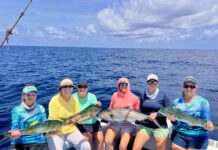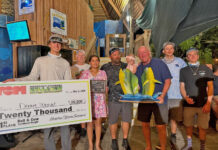








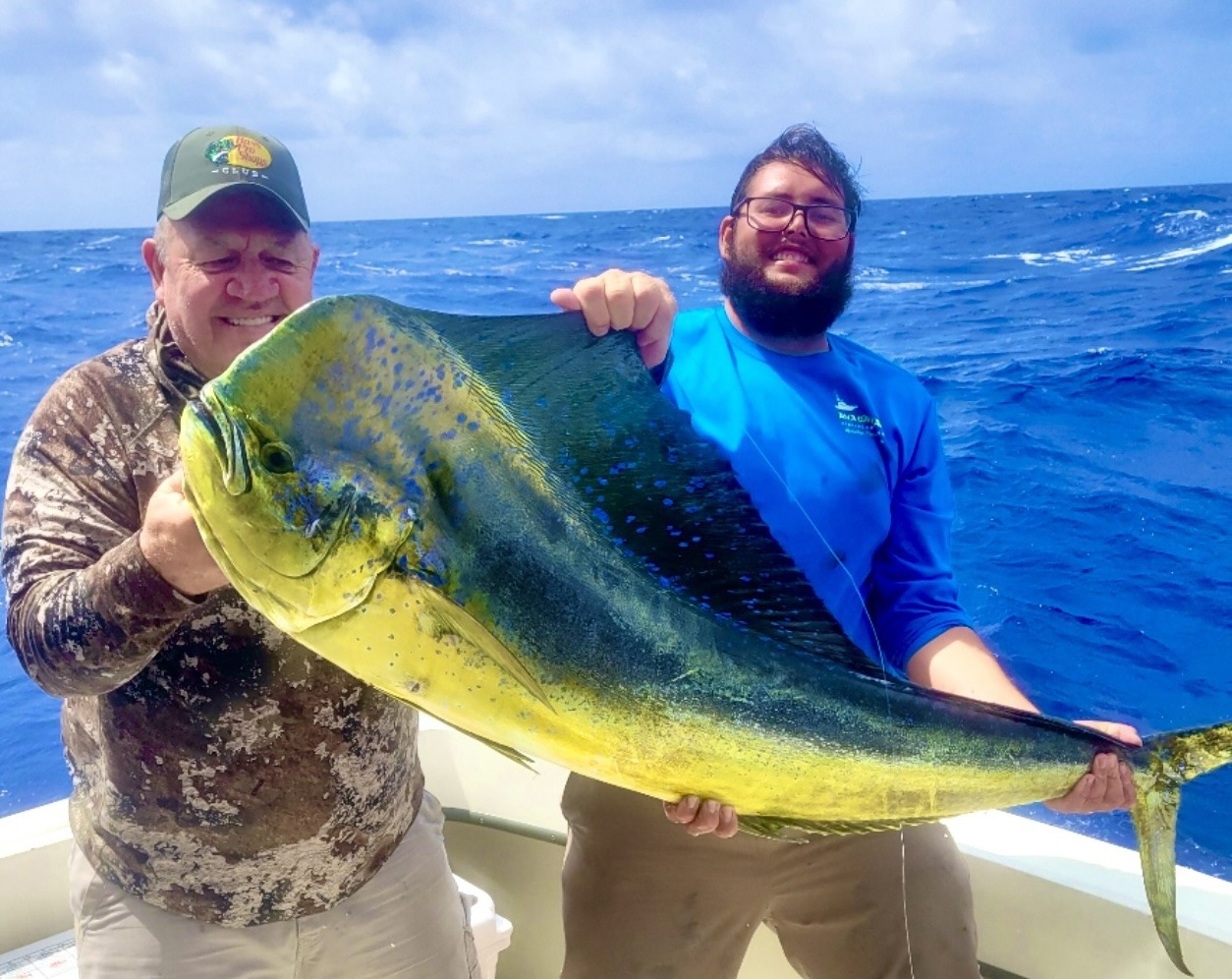
Mastering mahi can take a lifetime of successes and failures with a lot of research and development. By the time you read this article, we’ll be nearing what many consider the peak of mahi season. I’ve written several stories over the years about mahi fishing, but in this edition I will give you some tips I’ve learned that may help you during your mahi trip tomorrow.
One time I had my team on the boat at 5 a.m. for a mahi tournament and we ran out past the humps and all the way to the Bahamian border. We caught a few, but no tournament contenders. I came back to the dock and was complaining to a captain buddy of mine, Jamie Platt, about how bad the mahi bite was. He said, “A lot of good Mahi were caught today. Did you leave before the sun came up? You went out as far as you could go, didn’t you?”
He said the quality and quantity mahi have been hitting between 9 a.m. and noon in 350 to 500 feet of water. He said I left too early and went too far, and I ran right past the mahi in the dark.
That day taught me a couple valuable lessons:
Lesson 1: Do your research prior to going out mahi fishing , especially if you haven’t gone in the past few days. Look at online reports and call avid mahi anglers and ask them to give you a report. If I would have asked around and done my research, my tournament team could have slept in for a few extra hours, and we wouldn’t have traveled nearly as far to get to a contending mahi. We would have saved precious fishing time, had a much better chance at a slammer – and not to mention, saved a bunch of money.
Lesson 2: Understand hows and whys. Back in my corporate executive days we had a saying that “those who know how will always have a job, and those who know why will always be the boss.” Why were those mahi in so close and hitting so late in the morning? The moon had 98.3% illumination, the wind was blowing 15 knots into the west, the waves were four to five feet, the sky was overcast, the water was not clear, and the Gulf Stream was only 15 miles offshore. Mahi feed in the middle of the day on a full moon just like deer and other animals in the wild. When it’s windy and wavy, bait fish and flying fish get pushed in shallower, and game fish follow them in. Because the skies were overcast, the frigates and seabirds couldn’t feed on the flying fish because of the shade on the murky water. The Gulf Stream, with the direction of the wind and current, pushed the weed lines in closer.
Lesson 3: Another time I was out mahi fishing with another captain, Kavon Mehrani, who taught me how to look at birds. There’s a big difference between a sea bird and a seagull. He taught me how to read whether the birds are hunting like we are or swooping on bait while staying almost in the same spot pecking at the same area. If they’re doing the latter, they’re over mahi, whereas if they’re swooping but covering a lot of water quickly, they’re most likely over tuna. If a frigatebird is traveling slow down low, it means it’s most likely over a 30-plus-inch bull and cow. If the frigate’s moving fast and flying high, it’s either on the hunt or over tuna. Mehrani taught me to look for “birdnados,” when the birds get into a feeding frenzy and look like they’re flying in a tornado formation.
Lesson 4: Mehrani also taught me that when it comes to trolling, less is more. Some boats troll five lines, seven lines or more, but he taught me to troll one long line and one short. You might ask how two lines can be better than seven, but when you consider how often you have to clean the weeds off your trolling bait, you can get worn out tending to two lines, let alone seven. In case you didn’t know, mahi won’t hit a trolling bait with even a little piece of seaweed stuck to it. With one long and one short, you can dive in tight circles without getting your lines crossed, and if you get a slammer bull to hit your line, he’s less likely to get tangled on a bunch of other trolling lines.
Lesson 5: Another lesson was in a mahi tournament a few years ago in which we earned the Calcutta (side pot) for the largest bull and cow. We were in heavy waves in our 53-foot Hatteras. I had a four-person team and I decided to bring my 3-year-old grandson Atlas along. My grandson started getting seasick while we were trolling under three frigate birds. We hadn’t seen a weed line or any floaters all morning and I knew these frigates were our best shot at finding a tournament-winning bull and cow. I had to take my grandson into the cabin and put him to sleep, so I instructed my first mate (nicknamed Chicken Wing) to follow the frigates until I came back or until he found a floater. It took me an hour to put my grandson down and get him to sleep. After I got him to sleep I went back up and Chicken Wing was still traveling with the three frigatebirds. He informed me he had spotted a big bull and cow a few times in the past hour under the frigates. We eventually trolled past them and hooked a giant bull and cow simultaneously. The lesson I learned was “love the one you’re with.” If I hadn’t gone down to put my little guy to sleep, we probably wouldn’t have stuck with those frigates that long. I probably would have gotten impatient in half an hour or less, called the frigates “fake news birds” and traveled on for greener pastures. It’s hard to leave frigates, but always remember: A frigate is a hundred times better fisherman than any human being. As my late mother-in-law used to tell me, be patient.
See you next time, and thanks for reading.
To book a charter with Ana Banana, call or text Capt. Joel at 813-267-4401 or Capt. Jojo at 305-879-0564, or visit anabananafishing.com.