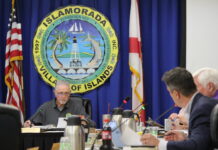














A majority on the Islamorada Village Council supported a contract extension with the lobbying firm Gray Robinson PA, despite some criticisms regarding broken communication lines over the village’s priorities for lawmakers in Tallahassee in recent years.
Islamorada has contracted with professional state lobbyists since 2013, when Capitol Insight began advocating for the village. Officials say their efforts at the state capital were critical in securing funding through the Florida Keys Stewardship Act, which set aside dollars for nearshore water quality projects like the installation of a wastewater system.
Capitol Insight eventually joined forces with Gray Robinson, a full-service law firm with 15 offices throughout the state. Village council members approved an agreement for professional services with Gray Robinson in September 2016. Contract extensions between the village and the lobbying firm have been approved on multiple occasions, with the most recent one on Oct. 7, by a 4-1 vote of the council.
As part of the agreement, Gray Robinson will look to bolster its advocacy efforts with the addition of Kate DeLoach, Tavernier resident and lobbyist who’s represented various Florida Keys entities in Tallahassee. The Keys native and eighth-generation Conch has been with the Southern Group since 2019. She’s represented clients on issues pertaining to insurance, appropriations, education, economic development and environmental policy.
The addition of DeLoach comes at no expense to the village, Manager Ron Saunders told council members. DeLoach will be a subcontractor for Gray Robinson and will remain a lobbyist with the Southern Group.
In addition, Saunders said the village will have more interaction with its lobbyists. Previous years have seen broken communication lines due to turnover in village hall.
Ryan Matthews, Gray Robinson lobbyist, said the firm has brought $1 million back to the village for various projects from the previous three legislative sessions.
“Our focus is providing a return on your investment and the investment of taxpayers,” he said.
Councilman Steve Friedman was the lone “no” vote in relation to the contract extension. He said the village should hire a lobbying firm that isn’t associated with Big Sugar and cause a potential conflict of interest. He also said he was disappointed the lobbyists didn’t alert village officials about the effects of Senate Bill 180, which was approved by lawmakers last session. Legislation established a new framework for emergency preparedness, but it also placed significant restrictions on local governments’ ability to regulate development, especially following a declared state of emergency. It led to lawsuits from 25 Florida municipalities against the state claiming it freezes the ability to adopt stronger land-use and development rules for years.
“I think those things a capable lobbying firm such as Gray Robinson could have alerted us to and did not – basically hearing ‘we didn’t know that was of interest to you.’ I think they should be aware of that,” he said.
While voting in favor of the contract extension, Vice Mayor Don Horton had strong words for the lobbying firm over its advocacy for the village. He said he was unimpressed with the results of Florida Keys Day last February, when lobbyists walked him through the doors of state Rep. Jim Mooney and state Sen. Ana Maria Rodriguez at the state Capitol. Horton acknowledged he already has communication lines open with the two legislators.
In addition, Horton said, his efforts to pursue changes to the way modular elevated homes are taxed in the state was met with a “defeatist” response from the lobbying firm. Per state statute, they’re treated as vehicles with an $88 per year registration fee instead of property taxes.
“I feel like I need you to advocate for us,” Horton said to Matthews, who appeared on Zoom.
Mayor Sharon Mahoney said past managers were never really engaged with the lobbying team to relay the village’s priorities for legislators in Tallahassee. But that’s changed with Saunders, a former state representative who served as minority leader in the Florida House for two years.
“I sat on the last council and I will fault the last council, myself as well; I didn’t know we had the ability to talk to him (Matthews),” Mahoney said. “Nobody did. It was just the way it was and it shouldn’t have been that way. We have to own up to shortcomings and mistakes.”
Matthews said previous sessions have been contentious between state and local governments. The 2026 session begins January with discussions likely over eliminating a revenue source for local government operations — property tax.
“(The legislature) got rid of business rent tax last year, and I think the communications services taxes and other revenues are at risk entering the 2026 legislative session,” Matthews added.