












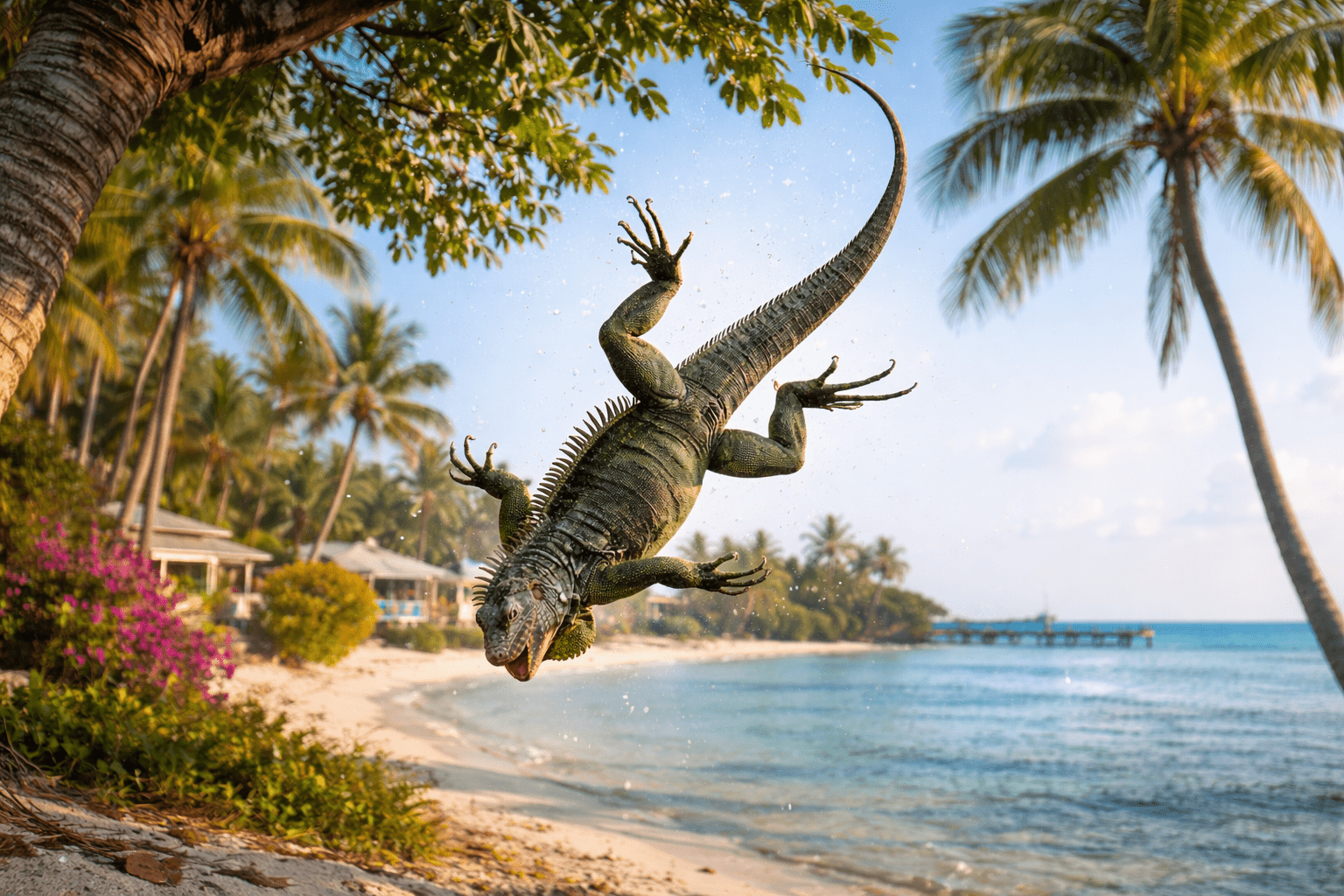
If iguanas start falling out of trees this weekend, you can bag them up – alive – and turn them in to FWC.
The special exception comes via FWC Executive Order 26-03, published as wind chill temperatures in the 30s and 40s are set to sweep across the Florida Keys this weekend.
Under Florida law, landowners are legally permitted to humanely kill the invasive green iguana on private property year-round. However, trapping and transporting live animals is ordinarily prohibited without special licenses.
Those protections will temporarily lift on Sunday, Feb. 1 and Monday, Feb. 2, as hundreds or thousands of cold-stunned animals are expected to be found partially immobilized by the low temperatures – making a “raining iguanas” scenario more realistic than comical. Cold-stunning is a form of paralysis that occurs when temperatures drop into the 40s or below, causing some animals to lose their grip on tree limbs and fall to the ground.
According to the executive order, the iguanas must be collected using legal and humane methods, and must be transported to approved FWC drop-off locations within 24 hours of capture – all before 4 p.m. on Monday. The animals must be kept in cloth sacks sealed shut, and must be placed inside locked transport containers labeled “Prohibited Reptiles” while being transported in a vehicle or vessel.
Collection on others’ private property is permitted, with the permission of the landowner.
FWC’s South Florida Regional Lab at 2796 Overseas Highway in Marathon is one of five approved drop-off locations, and the only location in the Keys. It will accept animals from 9 a.m. to noon on Sunday and 8 a.m. to 4 p.m. on Monday.
The cold temperatures may prove deadly for smaller iguanas, while larger animals may eventually recover from their temporary paralysis. It’s a potential helping hand for the ecosystem from Mother Nature, as the temperatures may also be deadly for invasive Burmese pythons in the Everglades.
To read the full executive order, click here.