


Fifty years ago, as America celebrated its bicentennial, Robert Reckwerdt leased a Lower Matecumbe Key marina from Ruth and Buck Starck. The Starcks had lived on the island for decades. They bought the property in 1946, and, in the summer, built two homes, one for their family and one for Buck’s father.
By Christmas, the Starcks were the island’s first recorded permanent residents.
It was not just homes they built. Ellis Shires, Ruth’s brother, helped build docks and a brick bait-and-tackle shop managed by Ruth. Sometimes, the boys, Walter and Terry, watched the shop, too. Considering Buck’s given name was Walter, as was his father’s, and both men were legendary charter boat captains, the little marina was called the Walter Starck Fishing Camp.
In 1976, Reckwerdt drove across the state from Naples and signed the lease. When it was executed, the era of the Walter Starck Fishing Camp ended, and the one celebrating what is now 50 years of Robbie’s Marina began.
It was Robbie, too, who rescued a tarpon struggling near the mangroves at the edge of the marina, scooped the fish up in a net, and discovered that its jaw was detached.
Robbie called a friend, Dr. Roach, who was not a veterinarian but a medical doctor.
He packed up a mattress, his wife’s knitting needles and thread, drove to Robbie’s, and performed some reconstructive facial surgery. More than an impromptu operation was involved; Doc Roach created a local legend.
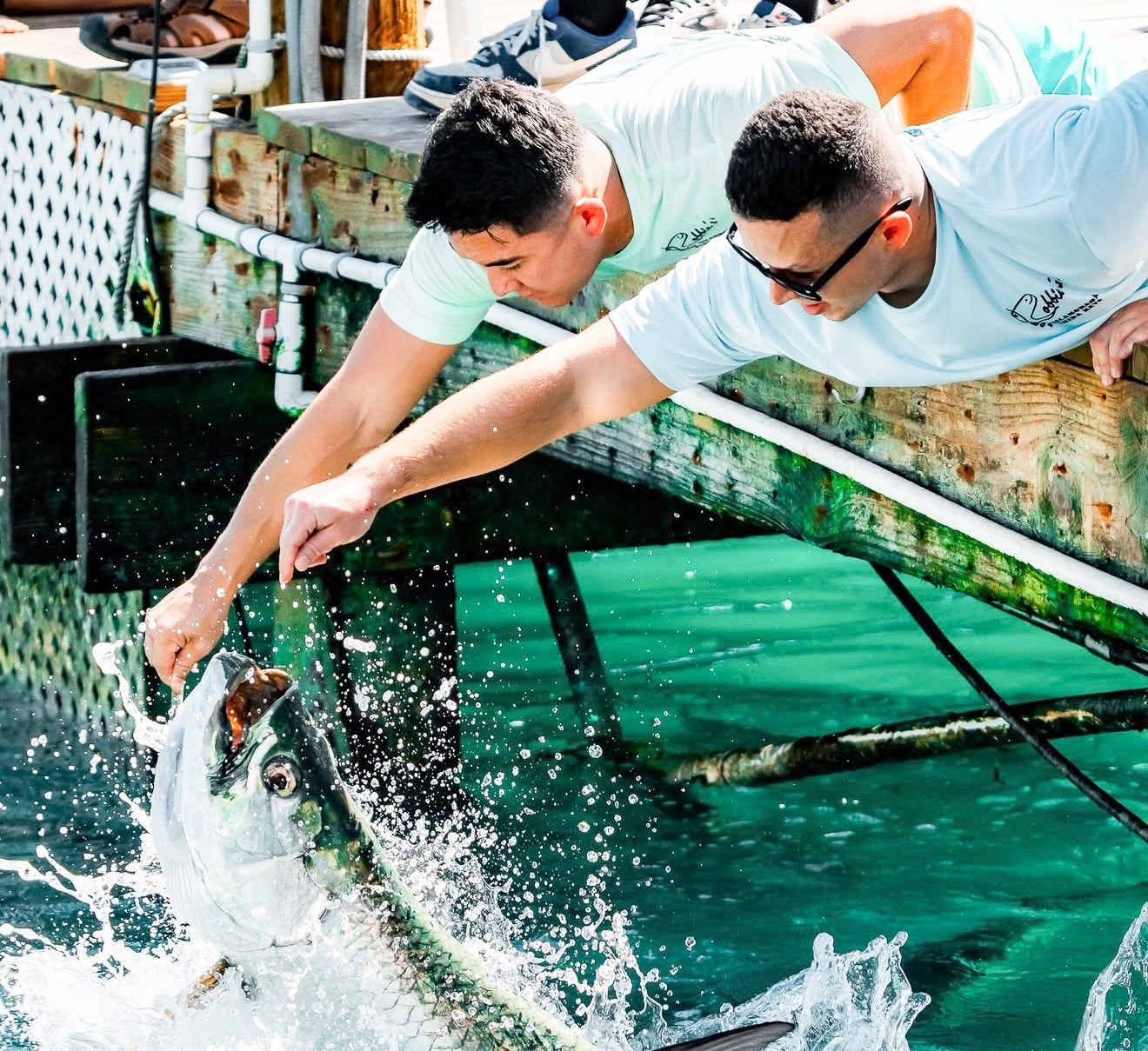
The fish, named Scarface, was placed in a bait tank to recuperate. For six months, the young tarpon healed. When they scooped the fish up and released it back into the marina, Scarface did not swim away. Perhaps accustomed to handouts, the fish stuck around for its next free meal. Clearly, the tarpon was not tight-lipped about the handouts, and it was not long before word spread beneath the surface, and other tarpon began schooling around the docks waiting for someone to feed them.
Hand-feeding tarpon at Robbie’s is a rite of passage in the Florida Keys, but only one of the reasons why the marina is one of the most visited spots in the islands. In addition to breakfast, lunch, dinner, cold drinks and the award-winning Trailer Trash Bloody Mary served at the Hungry Tarpon and the Beach Bar, there is shopping, backcountry and offshore fishing charters, snorkeling adventures, eco-tours, kayak and waverunner tours and Islamorada’s only glass-bottom boat, Transparensea.


The docks are a gateway to Florida Bay, coral reefs, Alligator Reef Lighthouse and three not-so-hidden cultural gems, Lignumvitae Key Botanical State Park, Indian Key Historic State Park, and the San Pedro Underwater Archaeological Preserve State Park. The docks and the property have changed over the years, but then nothing is like it used to be. The good news is that the Walter Starck Fishing Camp and Robbie’s Marina are still intertwined and will continue to be.
It can be easy to visit the property, look past the remnants of the old fishing camp, and just see Robbie’s. However, once you see them, the “remnants” stand out. The small concrete house in the middle of the parking lot might be the biggest one. It is the home the Starcks built for their family in 1946. Inside, the doorjambs are lined with ink marking the heights of the Starck boys, Walter and Terry, as they grew into young men.
While the boys moved away, Ruth and Buck lived in their Lower Matecumbe Key home for the rest of their lives. In 2010, they passed away, days apart. Their lives were celebrated on Nov. 29, which would have been their 73rd wedding anniversary.
It was 2012 when the Reckwerdts bought the property from the Starck family. For the last 50 years, the one constant has been the Reckwerdt family, who have worked to keep the spirit of the property and the Keys alive – the ramshackle, laidback vibe helps. After Robbie and his wife, Mona, moved to Lower Matecumbe Key, their children, Michael and Jodi, grew up on the property and around Ruth and Buck.
The Starcks became like a second family. After all, it is not just the heights of Walter and Terry marked on the doorjamb inside the family house; Michael and Jodi have their marks, too, as well as Michael’s five children and Aeris, the first granddaughter.
Also hidden in plain sight is the old bait-and-tackle shop. In the years since, the building transitioned into the Hungry Tarpon restaurant, where vinyl-covered booths once lined the wall facing the highway. As the restaurant grew, so did the kitchen’s needs, which now occupy what used to be the old bait shop.
Fifty years later, Michael is currently the head of operations for this family-run business.
He will not be the last Reckwerdt in that position. An increasingly rare sight these days, a new generation of the family has been learning the ins and outs of the property for years.
“This property is more than just a business enterprise. It’s home to myself and my children,” Michael said.
Will Robbie’s reach its 100th anniversary? The family’s next generation of caretakers are still in their 20s.


