


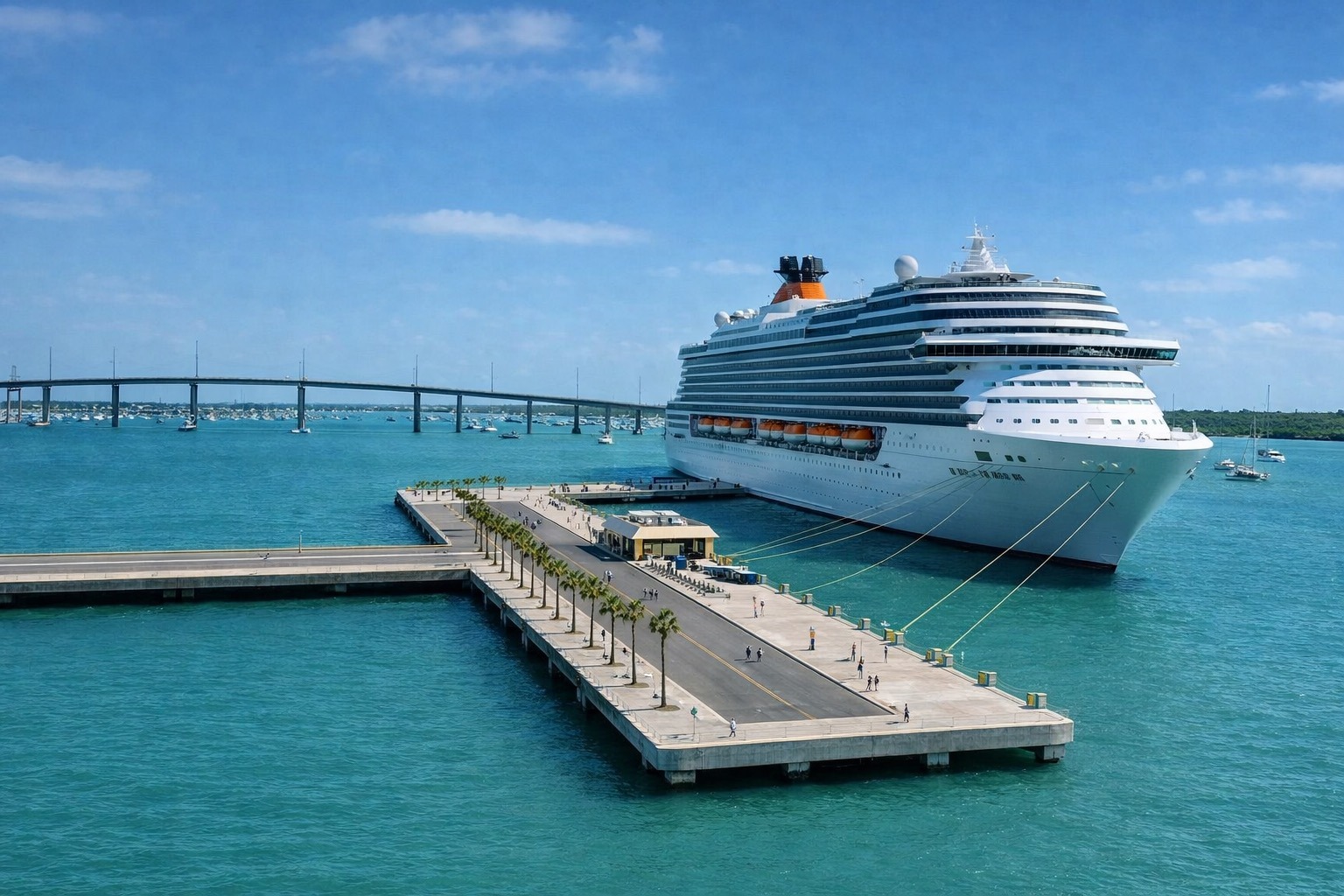
Forget Bimini, Cancun and the Virgin Islands. The next target destination of the Caribbean cruise industry is in the heart of the Florida Keys.
According to early renderings provided to the Keys Weekly, industry executives are eyeing a new mini-terminal at the west end of Boot Key Harbor, built on the now-vacant pier of the former oceanside Faro Blanco Marina.
“Florida Keys leaders have heavily invested in infrastructure and the tourist experience throughout the islands, and we felt that the stars finally aligned to make this happen,” one cruise executive told the Weekly, speaking on condition of anonymity as plans have not been officially announced.
Recent and ongoing infrastructure upgrades in Marathon, he said, paved the way for the new terminal and eased shareholders’ concerns about the feasibility of the project.
A runway move at the Marathon International Airport should see commercial air service return to the Middle Keys, with first flights bringing potential passengers on routes from Miami, Atlanta and Washington Dulles. And a new deep wastewater injection well, scheduled for completion by 2028, should aid in proper disposal of roughly 30,000 gallons per day of sewage (blackwater) and 150,000 gallons of greywater, on average, generated by ships each day.
“These weren’t just upgrades to bring Marathon in line with the times – they were investments in the future of Florida Keys tourism,” the executive said. “They’re not even complete, and they’re already paying dividends.”
Revenues from the terminal, Marathon Ports Director Sean Cannon may have said, should offset costs that may be otherwise borne by Marathon residents for projects like the $80 million deep well. With significant traffic, even small terminals can generate seven-figure revenues annually, with larger terminals like Port Canaveral totaling a projected $200 million for 2025-26.
“We’ve always had issues with derelict vessels in that end of the harbor,” he added. “Hopefully, a cleaner presence will help bring even more awareness to the issue. Quite frankly, prop wash from larger ships might just blow them straight into the mangroves.”
Matching the terminal project is a reimagining of Pigeon Key, set for redevelopment as an offshore amusement park for cruisers similar to models already followed by the Royal Caribbean Group’s Coco Cay in the Bahamas’ Berry Islands.
“First I’ve heard of it,” said the Pigeon Key Foundation’s executive director, Kelly McKinnon, when contacted for comment, remaining tight-lipped on any early negotiations.
Locals react
While some area businesses asked about the prospect of the terminal were cautiously optimistic, others immediately pointed to environmental concerns tied to bringing large ships through a notoriously shallow channel.
“I think it’s fantastic,” said Castaway Waterfront Restaurant owner John Mirabella, whose eatery lies mere yards from the soon-to-be-rebuilt pier. “My only question is, how am I going to source enough lionfish for all the King of the Jungle rolls we need to sell? Thousands of passengers disembarking daily means more chances to put meals on plates that educate them about our reefs.”
Numerous liveaboard boaters at Marathon City Marina pointed to clear dredging needs in Boot Key’s western approach channel – operations that are likely to disturb wildlife, seagrass beds and critical mangrove shorelines.
“If we run aground, FWC will fine us thousands of dollars, but we can just ignore that to make way for cruise ships?” one boater asked. “They told us all these upgrades in town were necessary – is this why George Garrett was … ‘retired?’”
“It’s an unfortunate consequence, but we can’t stop the future vision for Marathon because of some seagrass,” the cruise line executive told the Weekly. “Plus, let’s be honest – most of the ‘bay bottom’ we’re disturbing is a fancy word for mud.”
“We want to do this the right way – it’s not going to become a community war like what they have in Key West,” he added.
While the executive was unwilling to fully disclose which cruise lines may be the first to use the terminal, he said the grand opening for the upcoming project should match the completion of a new vessel, dubbed “Icon of the Keys” on or around April 1, 2030.


