


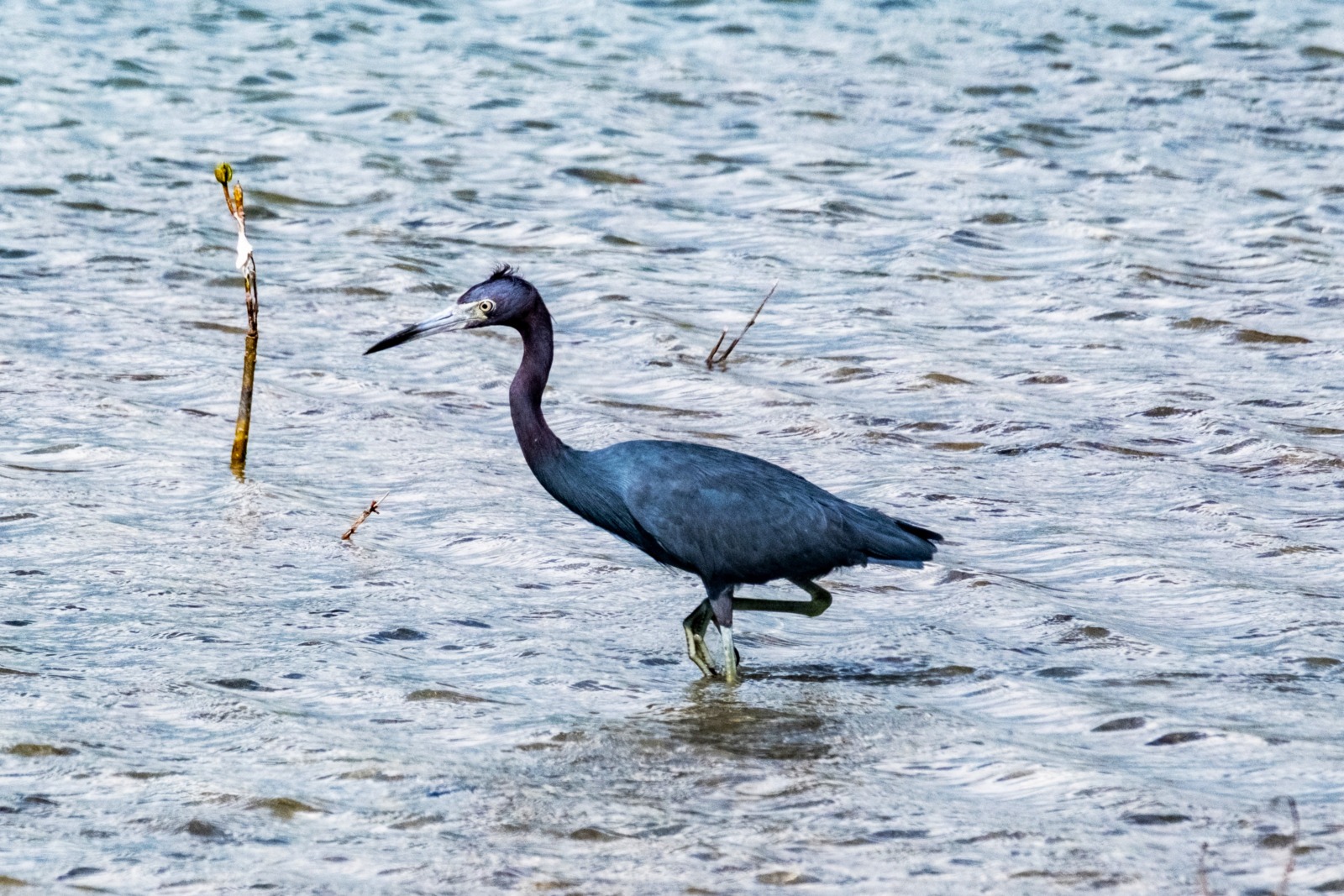
You tend to take little blue herons for granted. Not that they aren’t beautiful birds – there are no ugly herons or egrets, except maybe cattle egrets – but little blues can be a little undramatic.
As a species, they nearly live up to their name. They are little, sort of. They are blue, mostly. And they are herons. Still, it’s possible to get persnickety about the moniker.
When compared to a great blue heron, the title “little” fits. But little blues are not the smallest herons – that would be least bitterns and green herons. They are only slightly smaller than snowy egrets and tricolored herons, their two closest relatives, but it’s not the kind of difference you can detect without calipers and a scale. (All three species stand about 2 feet tall and weigh about three-quarters of a pound.)
While primarily blue, the head and necks of fully mature birds, especially in the right light, are purplish. But for the first year or so they are white, and as they reach maturity they become a mottle of blue and white and look somewhat reminiscent of calico bedspreads.
Little-ish bluish heron just sounds kind of indecisive, so probably best to stick to little blue.
As a species, I suppose they are notable for their lack of extremes. Where cousins snowy egrets and tricolored herons are famed for their aigrettes – the long, lacy nuptial plumage they develop during breeding season – little blues don’t really have them. Which makes them a little less dramatic, but also kept them from getting gunned down so often during the plume-hunting era.
Where waders like the reddish egret tend to put a lot of effort into their feeding, running around, leaping, doing body fakes, stabbing quickly at their prey, little blue herons are more low-key. They will occasionally stir things up with a foot, but they spend about three quarters of their hunting time slowly walking through shallow water, seeking fish.
They have mating rituals, but nothing too dramatic. The male does what is called a stretch display, walking around his territory with his bill pointing skyward. If the female is interested, she will approach in what is called the withdrawn crouch, moving toward him with her bill pointed downward. There may be some bill signaling involved, just in case you thought they were complete squares.
On average they will raise two to five chicks and stay together until the chicks are fledged. Odds are they would find new partners the next season.
As with people, I tend to think of birds in terms of their more dramatic behaviors. With little blues, I’ve been having a lot of trouble conceptualizing a personality for them. If they have secrets, they don’t give them away.
Surprisingly, one of the more interesting things I’ve been able to learn about them was in a paper from the late 1970s with the somewhat opaque title of “Commensalism in the Little Blue Heron” by noted Florida ornithologist James Kushlan.
Commensalism is essentially when two organisms have a relationship in which one of the organisms benefits without harming the other, a sort of non-reciprocal half-symbiosis, if that makes sense.
Kushlan spent several weeks watching over a mixed flock of wading birds made up, on average, of about 75 white ibises and 30 little blue herons. And what he noticed was that occasionally a little blue would trail behind a white ibis as they step-probed through the ponds. The herons looked to be following in a deliberate manner.
What he recorded was that the little blues that trailed the ibises had the same per-strike success rate as the herons off hunting away from the ibis, but that they consumed about twice the amount of fish, the increased abundance brought about by a more target-rich environment in the stirred water in the ibises’ wake. Thus commensalism allowed them to attain twice the calories for the same level of effort.
It’s fun to note that while the white ibis were not adversely affected by the little blues following them around, if one got too close, the ibises would apparently lunge at them with an open bill.
Little blue herons are pretty common throughout the eastern half of the U.S. We have them in the Keys, though seemingly in lower numbers than other wading bird species. If I drive down, say, Blimp Road on Cudjoe, or the road through Middle Torch and Big Torch, I tend to see small flocks of 10 to 30 snowy egrets and tricolored herons. Little blues I tend to see one or two at a time.
A couple months ago I realized I couldn’t remember the last time I had seen one. Which made me think maybe I wasn’t living my life right.
I didn’t go out specifically looking for one, but when I’ve been up the Keys I’ve made a point of keeping my eyes peeled. When I found myself on Big Pine a few weeks ago, I made a point to run down to the salt pond at the west end of Watson Boulevard.
I almost didn’t catch it at first. It was an adult, comet blue with a little aubergine tint to its head and neck.
The bird was walking at a slow and measured pace through about 10 inches of water, working a side to side pattern parallel to the road, neither hidden nor conspicuous. Occasionally it would stop and stab its two-toned bill down into the water, its head coming back so fast that it was hard to tell if the effort was successful or not.
Nice to see, even if I didn’t know quite what to say about it.


