


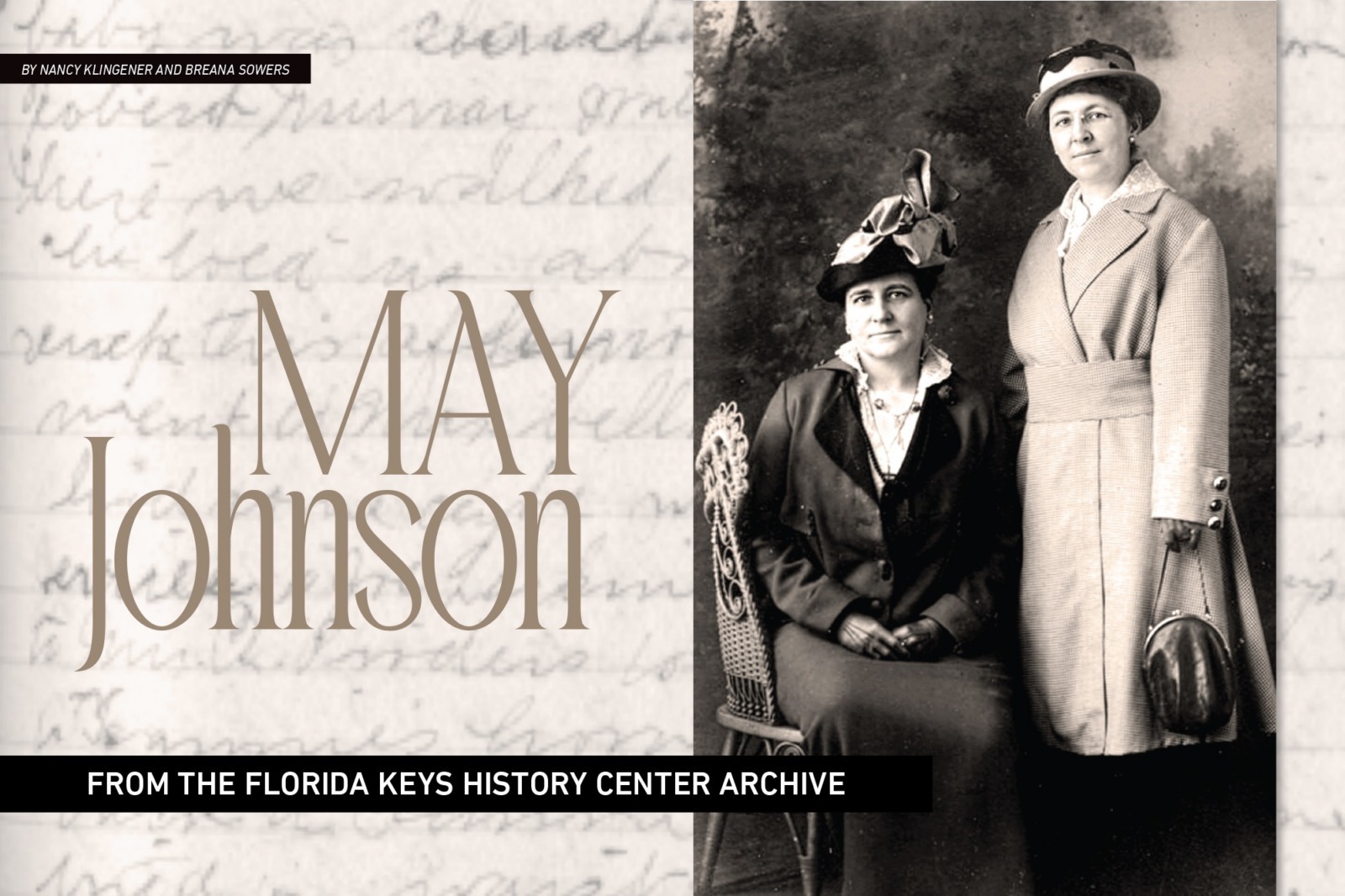
By Nancy Klingener and Breana Sowers
From January 2020 through February 2021, as the Florida Keys and the world were navigating the ever-changing and frequently terrifying conditions of the COVID pandemic, readers of the Today In Keys History column had a daily diversion: What was May Johnson up to now? Or rather, what had she been up to 124 years earlier?
Daily entries from Johnson’s diary written in 1896 and part of ’97 were printed in the column, produced by the Monroe County Public Library’s Florida Keys History Center. History buffs got a glimpse into what life was like on the island for a young woman at the turn of the last century. Readers got invested in Johnson’s romantic life. What happened with Miguel, of whom Johnson’s mother definitely disapproved. Would she wind up with Everest, her “dearest,” a young merchant from Miami?

The Florida Keys History Center had already had a big hit with the diary entries of William Hackley, from earlier in the 1800s. Hackley was an attorney who wrote about his daily habits of walking and bathing, about his children and their ailments, about his work and about his (usually unsuccessful) efforts at shooting birds. Forty years later, May Johnson’s Key West was very different. The island had gone through the Civil War. The cigar industry and political upheavals in Cuba had brought a huge influx of Cuban immigrants – about half the population by 1896. Electricity had arrived, though not yet at Johnson’s home on Division Street (now Truman Avenue). Another war was on the horizon, and technological innovations were everywhere.
May Johnson was part of a large and longstanding island family. Her mother was one of the seven daughters born to the Watlingtons at 322 Duval Street, now a museum known as the Oldest House. Mary Amanda Watlington married Charles Johnson, a pharmacist and physician from Nassau. They had five children, the fourth of whom was May, born in 1876. Her father died in 1887, at 42. By 1896, when this volume of her diary starts, she was 19 years old, living at home and working as a teacher.

A Day in the Life
In the diary, May recounts her days – when she woke, what she did, where she went – and most intriguingly, how she was feeling in an all-caps summary at the end of most entries. Her reactions range from “LOST,” “CUSSING” and “D—– MAD” to “OUT OF SIGHT” “GLORIOUS” and “GRAND.” One adjective that didn’t translate to modern times and especially intrigued readers was one of her favorites: “KICKING.” It ranks between “HA HA” and “KILLING” in the May Moodometer created by the library volunteer who transcribed the handwritten diary entries.
It looks like an unbelievably active life – here’s an example from Thursday, March 5, 1896:
“I arose at 7:40, dressed, did work, had breakfast, went to school, came home, had dinner, dressed, went to Church, from Church to Curry’s store, Corinne with me. (Lillie Cold’s baby was Christened this afternoon — Robert Murray Watlington). From there we walked up, met Earle. He told us about the shooting escape this afternoon. From there went to Mrs. Helling’s, then to Lillie’s, had some cake, went to Uncle Jerrie’s, to Joe Larkin’s, to Mrs. C. Albury’s, to Mrs. R. Pinder’s, took car, went to Corinne’s home, had tea, back to Fannie’s. Came home, tried on waist, came to bed.
“AS USUAL.”
(“Car” refers to the streetcar, pulled by mules until late 1898 when the line was electrified. The “waist” she tried on was a shirtwaist – a tailored blouse or dress.)

May did a lot of socializing – she was part of a large and prominent family – and a lot of cleaning and sewing, as well as writing letters and some reading. It seems impossible that she could fit so much into an average day, but this was before all the diversions and distractions that consume our time and attention – no telephones, radio, television or movies, much less internet and social media. To find out what was going on and how people were doing, you had to physically meet up with them, or get a letter and news delivered from the mainland by steamship.
Besides the entertainment value of following a young woman through a year in her life, May Johnson’s diary is an important and, so far, unique document in the history of Key West. Historical vernacular collections – such as diaries, letters and ephemera – capture everyday life as it was actually lived, not as it was summarized or filtered through secondary resources. May’s diary is a first-hand account of her daily life, relationships, routines and expressions as a 20-year-old, which do not exist in more institutionalized documentation. While other historical records can tell us what “happened,” diaries tell us how it felt to live through those moments. Diaries are typically not intended for sharing, so their contents are often more unfiltered. May was not creating a keepsake to explain herself – she was recording her inner life how she experienced it.
Most records in the archives are institutional – government documents, newspapers, etc. Official sources are essential in creating a general landscape of a time and place – what industries were present, who was living where, what events occurred, who was creating headlines, etc. Yet they often leave out ordinary/daily experiences, especially those of women or other marginalized communities. Vernacular records help fill in the gaps. May’s diary documents how young women moved through the Key West community, how she responded to courtship rituals and pressure, the daily routines of a schoolteacher, and social expectations.

May’s diary is a rare opportunity to view the world through the eyes of a person living at that time. Diaries were considered private and disposable; usually, the diaries that make it to an archive are of older women with exceptional social status. May was clearly looking for an outlet to express her emotional state, whether it was elation or despair. Emotions ARE historical evidence and meaningful data. In May’s diary, her emotions reflect relationships and courtships shaped by familial pressures regarding respectability, reputation and marriage in 1890s Key West. She expresses exasperation toward her mother, her sister, her love interests and her employer. You can feel her frustrations – probably the reason her diary was so popular with readers.
The diary shows us Key West on the cusp of the 20th century. May was meeting sailors from the USS Maine as it made regular port calls, just two years before its final, fatal voyage to Havana. The streetcar line had an entertainment emporium at the end, a motivation to buy tickets. New York’s version was Coney Island; in Key West they had La Brisa, an open-air entertainment complex at the ocean end of Simonton Street where people would gather to socialize, dance, picnic, conduct courtships and gossip.

And then what happened?
The diary in the collection of the Florida Keys History Center ends in February 1897. But we know the basic outlines of May’s life afterward, even if we don’t have her reactions in real time.
Everest, after visiting at Thanksgiving of 1896 and spending lots of time with May, did not work out. He became a prominent businessman in the early boom times of 1920s Miami, serving as head of the Chamber of Commerce and as mayor.
May’s older sister Lena, frequently mentioned in the diary, never married. She made candy and hosted the local Boy Scouts chapter on the family property. In 1927, she was the first woman elected to the Key West City Commission. Two years later, she was defeated in her re-election bid by 40 votes.
The Navy’s increased presence on the island during and after the Spanish-American War brought many young servicemen into the community – including a pharmacist’s mate named Stephen Douglass. He and May married in September 1901 at St. Paul’s Episcopal Church and were stationed all over the world. They had two children, but both died in the summer of 1909 in New York state, possibly of the all-too-common childhood diseases from that time. Douglass rose to lieutenant in the medical service corps and retired in 1930, after 40 years in the Navy. The couple returned to Key West and lived in May’s childhood home on Division Street where they threw themselves into civic life.

A newspaper story recounts the party they threw for their 40th wedding anniversary, where “the renowned tropical garden and the ancestral house rich with family heirlooms was the setting for this affair, as well as the scene of the wedding reception. … The hostess received her guests in her wedding dress and veil.” The house is still standing; the “tropical garden” is now land occupied by the Silver Palms Inn on Truman Avenue.
According to the story, “both the doctor and his wife have given generosity (sic) of their time in civic and club work as well as being social leaders in both navy and civilian life in Key West.” Stephen Douglass died two years later, in 1943. May died in 1951 on a trip to New York where she planned to visit the graves of her children and spend time with a grand-nephew who was a cadet at West Point. May and Stephen are buried together at the Key West Cemetery, not far from the plot dedicated to the sailors who died on the USS Maine.
Though May Johnson Douglass did not have surviving children, the Florida Keys History Center is hopeful more volumes of her diary may someday be discovered – or other diaries like it may come to light. For now, this account is a one-of-a-kind window into island life at that time in words written not for posterity, but from the heart.

Nancy Klingener is community affairs manager at the Monroe County Public Library. Breana Sowers is senior archivist at the library’s Florida Keys History Center, the foremost collection of documents and images from Keys history. You can learn more at keyslibraries.org/keyshistory.


