










Just a few miles offshore, the coral reefs of the Florida Keys National Marine Sanctuary support one of the most diverse marine ecosystems in North America. But for many who live in or visit the Florida Keys, those reefs remain largely unseen: Not everyone dives, and not everyone swims.
Still, protection of the reefs depends on people experiencing and connecting with the oceans. Islamorada nonprofit I.CARE (Islamorada Conservation and Restoration Education) had an idea: Give the public a way to dive onto the reef – through virtual reality (VR) – without having to get in the water.
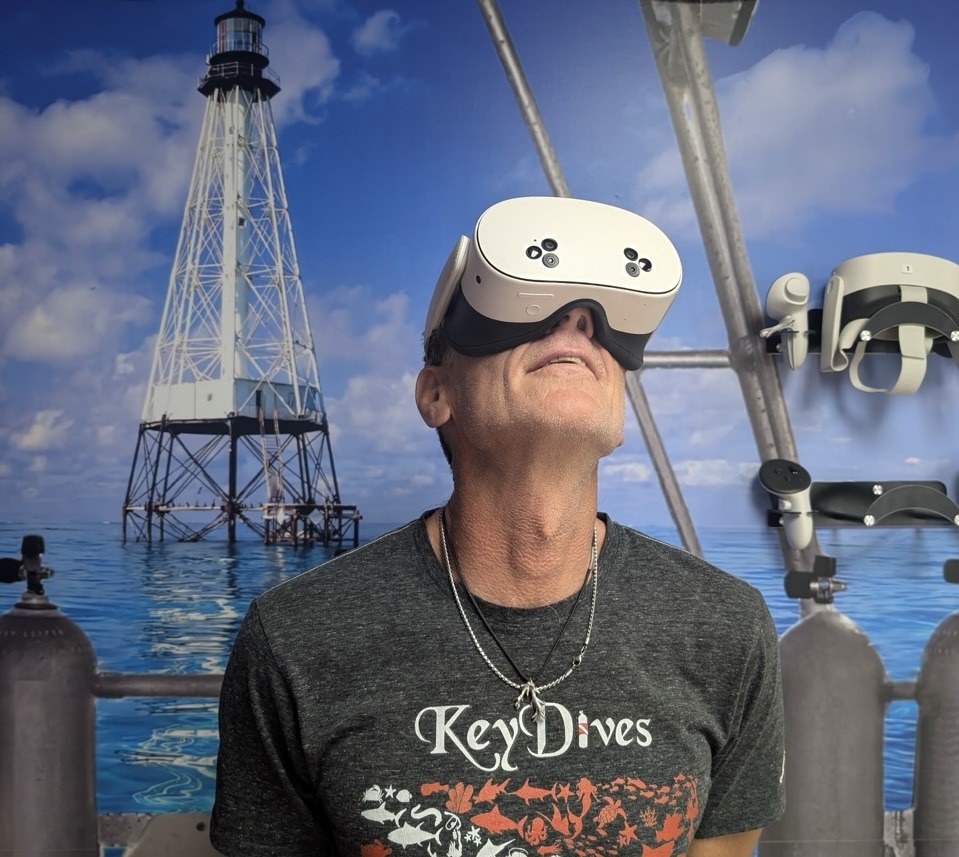
The VR experience is housed inside I.CARE’s new center in Islamorada, where visitors can learn about coral restoration efforts happening throughout the Upper Keys. Visitors are invited to put on a headset and dive immediately into a real Florida Keys reef, filmed in immersive 360 degrees. The footage places viewers in the middle of coral restoration dives, surrounded by reef fish and divers transplanting precious corals.
“I am so excited for this new way to share the coral transplanting experience with a wider audience,” said Kylie Smith, local coral expert and I.CARE’s co-founder. “This is such a great tool to show divers and non-divers alike the state of our coral reefs and how they can be a part of rebuilding them for our future. So far, the feedback has been amazing and people love seeing the underwater world.”
I.CARE’s mission relies on hands-on conservation, community empowerment and outreach to help recover critical underwater ecosystems. The VR experience creates a digital echo of those efforts, making their work more accessible.
The I.CARE experience was filmed on location by marine scientist and filmmaker Joseph Henry of Triton Society.
“I create underwater 360-degree videos that bring viewers as close as possible to the real underwater experience,” Henry said. “Three-hundred-sixty-degree videos offer the most immersive experience possible without physically being there.”


The distinction between 360-degree videos and traditional filming is important, he said, because 360-degree filming allows viewers to explore the scene themselves.
“Traditional filming limits viewers to a single, directed perspective,” Henry explained. “With 360-degree video, viewers can freely (look around and) explore their surroundings.”
From wherever the camera was placed, you have 360-degree freedom to explore. Look up, down, to either side and front and back to observe different parts of the same scene — just as if you were there right next to the camera underwater.
“VR provides an opportunity to connect people with places that remain out of reach for many,” Henry said. “This work makes ocean literacy accessible and engaging, which I hope will foster a greater connection to marine ecosystems and inspire conservation action.”
The potential was certainly clear to I.CARE co-founder Mike Goldberg the first time he tried a VR dive.
“At one point, a nurse shark swam right through my legs! I found myself pulling my legs up and grabbing for the walls because it felt so real,” he said.
Henry said reactions like Goldberg’s are common among first-time viewers.
“I love seeing the expressions on people’s faces the first time they’re virtually transported beneath the waves,” he said. “It reminds me of the awe I felt when I first experienced a coral reef as a child.”
The reaction surprised Goldberg, but also showed him how powerful this new technology could be.
“At that moment, I knew we could use this for education and outreach, especially here in the Keys,” Goldberg said.
While the Keys are surrounded by water, access to the ocean isn’t always an automatic guarantee. Some local kids grow up without learning to swim or snorkel, something that Goldberg and his co-founder, Kylie Smith, have encountered through their work with schools and community programs.
Through separate initiatives, they’re working to expand water safety and ocean skills among local youth. But those efforts take time, and not everyone is ready to get in the water.
The VR experience offers another entry point: a risk-free way to wade in. Visitors can sit on the benches, styled like the Key Dives’ dive boat “The Giant Stride,” and still see endangered corals being planted onto the reef. By turning their head with the headset on, viewers can follow fish across the reef or watch divers secure coral fragments into place, just as if they were underwater blowing bubbles too.
“Underwater 360-degree videos offer more than just engaging media,” Henry said. “They serve as a valuable tool for storytelling, research, education and conservation, ultimately helping to bridge the gap between people and our oceans.”