







A tiny piece of plastic broke in our CR-V’s brake pedal, which meant the brake lights didn’t shut off when we parked it at night, which meant the battery was dead in the morning.
I found a replacement tiny piece of plastic, which I learned was properly called a brake stop pad, at the NAPA on the Boulevard, and learned how to replace it from a couple of YouTube videos.
I ran into our neighbor Jack on the street when I’d finished the job and he said he’d seen the lights on and wondered briefly if there was just someone sitting in the car with their foot on the brake pedal.
The thing about jump-starting a car is that it is best to drive it around for a half hour or so afterwards to recharge the battery. That seemed kind of boring, and a poor use of time. So after managing not to shock myself when I unhooked the cables from the battery terminals, I decided to go birding by car.
It’s not a new phenomenon. The 1907 edition of the Auk includes an 18-page article by a man named Milton S. Bay entitled, “A-Birding In An Auto” in which the author describes a five-week, 1,100-mile road trip through California’s San Joaquin Valley in a 16-horsepower Wayne touring car, which in photos looks indistinguishable from every other old-timey car of the era. Along the way, Mr. Bay crossed rivers with no bridges, got stuck in quicksand, almost fell off a 1,000-foot cliff and twice had to wait a week for parts they needed to repair the car.
He said the car was actually quieter than the horse-drawn buggy they used to travel the route previously and named a lot of fun, antiquated bird names such as the Pasadena thrasher, the Anthony towhee, the Santa Cruz chickadee, and the California vulture, which is not to be confused with the California condor, which even then was incredibly scarce, though he did manage to see one. During the trip he saw 111 species.
Bay was a slyly good writer. Describing his and his brother’s efforts to seek shade one afternoon near the St. John’s River, he noted that “the thermometer has an awkward habit here of running up as high as 114 degrees Fahrenheit on summer days which we found destructive to ambition.”
I intend to throw the phrase “destructive to ambition” into conversation whenever possible from here on out.
Things have gotten more refined since Bay’s day. I’ve birded by car in places like Forsythe National Wildlife Refuge in New Jersey and Loop Road in the Everglades where you can often see most of the wildlife without even having to put the car in park.
Key West isn’t really set up for that kind of thing. For a small town we have a very high rate of bustle. But I put my binoculars and camera on the front seat because it would make driving around to charge up the battery feel a little less aimless. Also, the car had 99,978 miles on it, and I didn’t want it to roll over to 100,000 without my wife, because it is important to celebrate milestones in a marriage. So I needed to pay attention to how far I drove.
Summer is starting to kick in, and it was getting hot, but not quite destructive-to-ambition hot.
The first place I stopped was the area near where the FAA tower used to be at Higgs Beach. There’s a small pond in the back with some scraggly buttonwoods that can be surprisingly full of birds, though from the car all I could see were a rooster, a hen and a couple of cheeping chicks. I pished a little bit with no luck, though as I drove away I did hear through the open window a red-winged blackbird from somewhere in the cover.
As I pulled up to the fenced-off area a pair of Eurasian collared-doves flew by, then a white-crowned pigeon. Inside the fenced-off area something smaller than a dove hopped around. I lifted my binoculars to see a northern mockingbird leaping up every 10 seconds or so like someone in a kung fu movie, then throwing his wings out in a high-speed avian semaphore, flashing the white patches in a way thought to startle insects and make them easier to catch.
Two other northern mockingbirds showed up and the three chased each other around the green barbed wire, making buzzing noises. If one or two of them had been begging for food I would figure it was a parents/offspring thing. But no one did. So I have no idea what the relational dynamic was.
I stopped at the parking lot near Rest Beach hoping to see a magnificent frigatebird or a brown pelican, but both the sky and the water were empty of them. I put the car in park, rolled the window down, and got out to look for shorebirds in the shoreline sargassum, but it was empty, too.
At the foot of Smathers Beach I caught sight of a double-crested cormorant on one of the three remnant concrete supports that I always think of as the Three Sisters. But there was also something else. I pulled into the first spot I could, but it was still 50 yards back to where the bird was.
Car theft is probably the stupidest crime you can commit in the Keys, what with a 100-mile long two-lane road and the sheriff’s office a phone call away. But also, this is Florida, a 400-mile-long peninsula full of people who, let’s just say, don’t always think about consequences. Still, I rolled down the window, left the engine running and walked back to check the bird on the concrete support, which was, as expected, a least tern.
I glanced back periodically to make sure no one was going to jump into the car.
I took a quick glance below and caught sight of a black-bellied plover searching in the cracks of the concrete at the base of the seawall for the worms and crustaceans they thrive on.
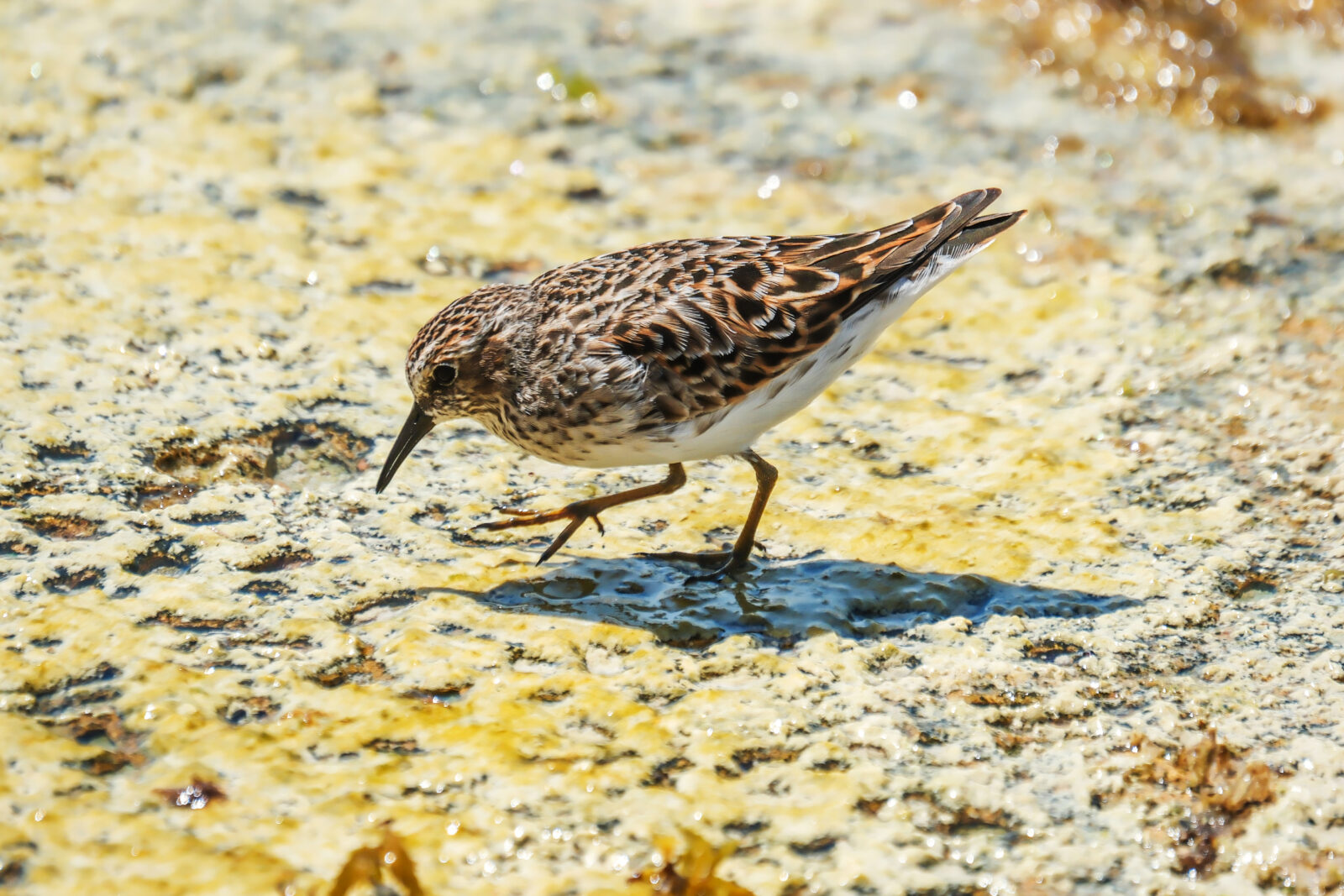
A little further along the wet concrete was a least sandpiper, a hint of ruddiness coming into its plumage, searching for its next meal.
I zigzagged around the island a bit after that – out past the airport, down Flagler, a quick out and back down Government Road, without seeing much else.
Pulling up in front of the house I realized I hadn’t paid much attention to how far I had driven, and for a moment I panicked. But the odometer read 99,992. There was still eight miles to go.