


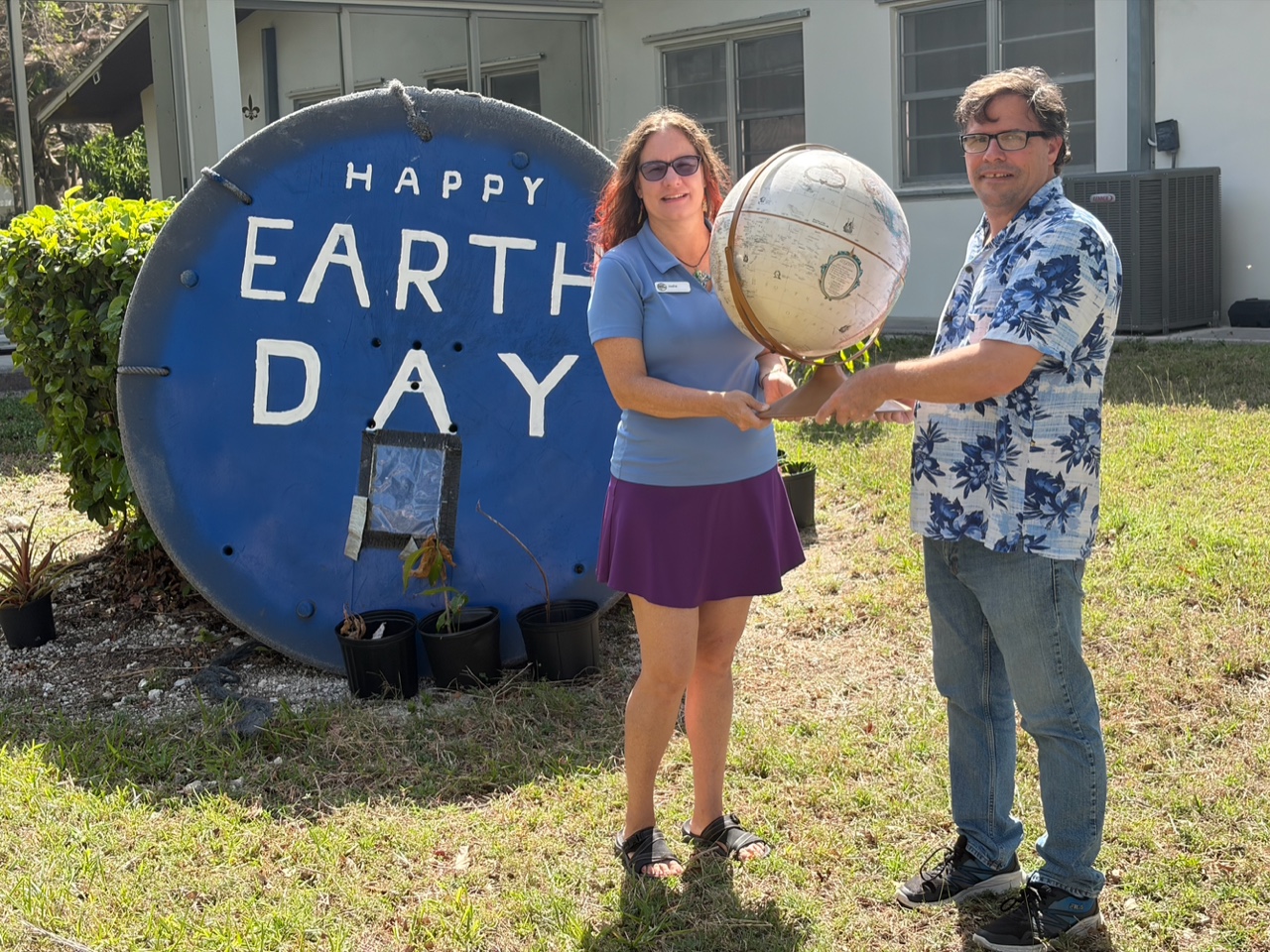
We have one planet, one shared home – and we’re all on it together.
In the Keys, life, survival and the challenges of living on a string of islands hanging off the coast of Florida require a bit of faith, a healthy heeding of science and a stalwart belief in community. So, it’s no wonder an Earth Day event can bring together seemingly-distant and opposing communities.
Now in its third year, the Upper Keys Earth Day Festival, co-hosted by Burton Memorial United Methodist Church and Coral Isles Church of Christ, will take place from noon to 4 p.m. on Saturday, April 18 at Coral Isles Church, 90001 Overseas Highway in Tavernier.
The premise is simple, but not common: bring faith communities, scientists and environmental groups into the same space — not to debate, but to collaborate. To find common ground and work towards a shared future.
“By holding the Earth Day celebration on church grounds, we are making the statement that faith and environmentalism do go together,” said David Charlton, Burton Memorial pastor. “I would like to add that faith and science also go together. Faith tells us that we have the responsibility to take care of the Earth, and science tells us how to take care of the Earth.”
That intersection anchors this year’s theme: Environmental Awareness: Educating and Empowering Our Community.
For Barbara Overton, the collaboration reflects something deeper than labels.
“People find their way into environmental work for all kinds of reasons,” said the Coral Isles chair of the Mission Committee. “But no matter the motivation, the shared goal is the same: reducing environmental harm and building a resilient, healthy planet for everyone.”
In a place like the Keys, that shared goal cuts across lines that might feel more rigid elsewhere.
“The Florida Keys are ground zero for the effects of climate change,” Overton said, pointing to coral decline, saltwater intrusion and shifting ecosystems. “Yet what stands out is the community’s response. Instead of giving in to frustration, residents, scientists, volunteers and local organizations are working toward real, lasting solutions.”
Much environmental work happens in silos, so bringing those efforts together in one place can spark new connections and momentum, Overton said.
“One of my favorite moments at the festival is watching the faces of environmental group representatives as they discover what other organizations are doing,” she said. “Their enthusiasm is contagious, and it’s exactly the kind of exchange we want to encourage.
“Our festival aims to bring all this work into one place and to help people discover how they can get involved. It’s an opportunity to see just how much is being done and to find a meaningful way to join in,” she continued.
Jack S. Grove has spent years advocating for this cross-pollination between organizations, disciplines and belief systems.


A longtime Key Largo resident, marine scientist and member of the Burton congregation, Grove sees the festival as a rare but necessary bridge. Whether described as biodiversity by scientists or stewardship by people of faith, he points out, the underlying message is the same: care for the living systems that sustain life.
In his view, the urgency of environmental challenges leaves little room for division. Debates about origins or ideology matter less than the immediate need to protect ecosystems and communities alike. The consequences of inaction, he said, extend far beyond the loss of species and directly affect human life.
That perspective has shaped his involvement in the event since its inception. While he won’t be giving a standalone lecture as in years past, Grove will still participate in the broader Earth Day programming, continuing a conversation he’s carried through decades of research, exploration and public outreach.
The festival is part of a much larger global moment. Since its founding in 1970, Earth Day has grown into the largest environmental movement in the world, with more than one billion people participating annually. Events like the one in Tavernier will be replicated across thousands of diverse communities this April, turning awareness into local action.
Attendees can expect booths from local nonprofits and environmental groups, alongside vendors, a plant sale, food, a silent auction and family-friendly activities like a bounce house.
Festival proceeds will continue to build between these two communities, helping both churches install solar panels and undertake other environmentally-focused projects.
For Charlton, the event truly makes sense. “We are… called to govern the earth as farmers, not tyrants,” he said.
And for Overton, the impact is amplifying. “Standing together creates a multiplier effect,” she said, “that can significantly boost the impact of local environmental efforts and inspire broader community action.”
It’s not a typical Earth Day event. And it’s not a typical church gathering.
But maybe that’s the point.
In the Keys, where the environment touches nearly every part of life, it may be less about sides – and more about simply showing up for the place we all call home.


