


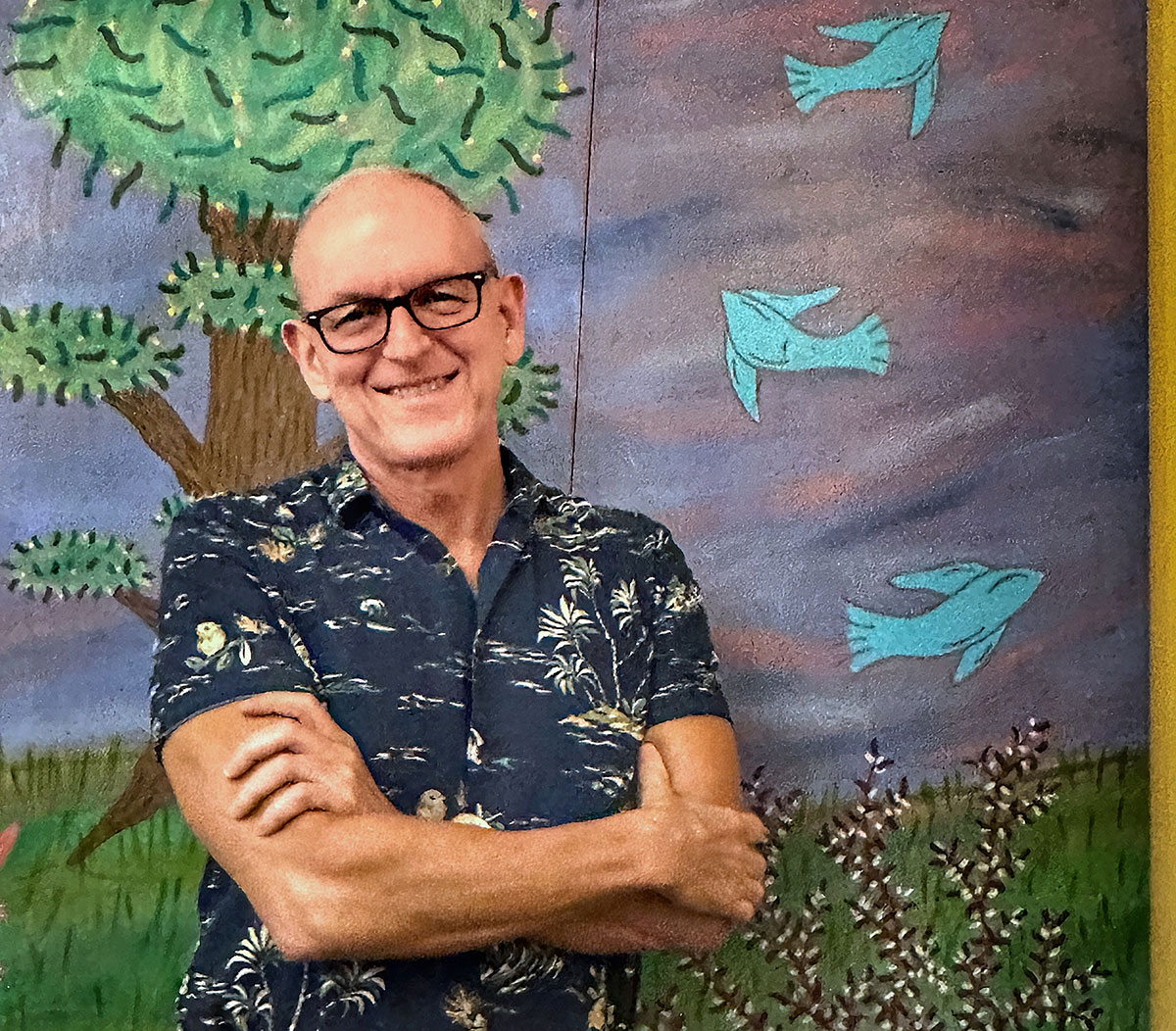
It’s hard not to notice the angels that hover behind Scott Pridgen’s head as he speaks — painted by local artist Lenny Addorisio. They’re a sort of metaphor for this man who has spent the last 35 years tirelessly advocating for those in need, and for health care and housing for those with HIV/AIDS in particular. Most of those years have been in Key West, where Pridgen is executive director of A.H. Monroe, where he’s worn just about every hat the agency has since he got involved, first as a volunteer in 1996.
“Just to see in someone’s face when you find them a place to live, whether it was a linear move or for those that are homeless or have been without housing for some time and were struggling,” he said of his 2006 housing case manager position. “To actually get them into that place and see them succeed, it was just so gratifying.”
The Key West housing crisis can be insurmountable for all people, but more so for those with health issues that cripple their finances and ability to work and function on a day-to-day basis. A.H. Monroe addresses this problem by recognizing that “housing IS care,” sensibly linking the two as a whole.
“We want an HIV-free generation; that is our goal. And the way we do that is through health, making sure people living with HIV are adherent to care,” he said. “Without housing, it is much more difficult to achieve any health goal, or any goal for that matter.”
If this citizen spotlight seems to shine more on the agency than the man, it’s probably because Pridgen is ever-humble and 100% dedicated to the AH mission. His pragmatism, calm demeanor and overall warmth align with the sense of safe haven he seeks to provide, something his predecessors established in 1989.
If you arrived on the island between the late ’80s and 2011, you might know that ‘AH’ was the acronym and parent name to AIDS Help Inc. and that its mission and services were geared entirely to it.
“There was and still is a lot of stigma associated with HIV and AIDS, but it was a prominent stigma where housing was refused if you had HIV or AIDS,” Pridgen said. “We want to think that we’ve always been One Human Family, but we have discrimination here, we have prejudice, we have racism, we have stigma, just like any other community.”
The original Marty’s Place on Bertha Street was the agency’s first hospice program.
“When people were literally dying of AIDS in Key West, a lot of hospitals and hospice wouldn’t accept them,” said Pridgen of the 16 original cottages on the agency-owned property. “We had a place to put them.”
This was thanks in part to the support of the Fantasy Fest Royal Campaigns, which started in 1989 during the height of the AIDS epidemic. Candidates work tirelessly to raise money in the eight weeks leading up to Fantasy Fest. The top two fundraisers are crowned king and queen of Fantasy Fest. (See page 4.)
“In the early days, that’s where the royal campaign money went — to give someone a place to die with dignity, because AIDS did equal death at that time.”
But as medicine and technology improved the lives of those with HIV/AIDS, AH was “still in the old playbook,” Pridgen said.
“Our entire roadmap and mission was HIV/AIDS-only. Anybody that walked through the door was immediately asked, ‘Do you have HIV/AIDS? Oh, you don’t? Sorry, we can’t help you. You’ll have to figure it out.’ Or ‘You have to have HIV/AIDS in order to live here. You have to be dying for us to help you.’ It was horrible.”
The year Pridgen became director in 2011, AH built Royal Poinciana, a 50-unit property that includes a gym. But only 25 clients moved in upon its opening. Management and the board scratched their heads and sent out a survey. They discovered that the No. 1 reason clients didn’t want to live there was that they didn’t want to be defined by their disease.
“We were actually adding just as much to the stigma as we were trying to take it away. It was such an eye-opener for us,” Pridgen said.
By broadening eligibility to those with low incomes, disabilities, the elderly, homeless and veterans, and by contacting other nonprofits to spread the word, AH quickly filled the space. The infusion of diversity resulted in less depression, more community engagement and greater participation in their own care for most of the HIV clients who lived there.
Now AH Monroe could mean AIDS Help, Accessible Health Care, or Affordable Housing, depending on the services that are sought and provided.
“Anybody who lives in one of our five properties, regardless of their HIV status, has access to medical case management, and all of the services that anyone living with HIV does,” Pridgen said.
Hurricane Irma was the impetus for yet another change within the agency with the addition of their Resource Identification program — case management for people who had no association with the agency. The program is still in place and particularly critical during crises like COVID and the recent Hurricane Ian, allowing multiple Monroe County nonprofits to collaborate and fill needs.
“It was such an eye opener of how close we all are to being one step away from homelessness, how we are just a microsecond away from losing everything — and being no different than the guy who’s been sleeping on the street corner all his life.”
It was also a cue to redirect the Fantasy Fest king and queen campaign funds so the next beneficiary — the nonprofit Florida Keys SPCA — can broaden its own initiatives.
“Every time a former royal or someone who worked on a campaign drives by one of our properties, they can say ‘I built that,’” Pridgen said of the 32 royal campaign years that raised a total of $5.3 million. “That’s their legacy.”
He’s also quick to acknowledge the community’s hand in the agency’s overall success. He recognizes the dedication of his staff and the power of collaboration with other nonprofits and supportive businesses.
“I’m proud of the agency and how far we’ve come and the fact that the community has built it. This agency – every single square inch of it – was built by the community. Now it’s our job as stewards of the community to provide the services that they need.”
When he’s not helping someone find a home, he’s out in the sun with his partner, paddleboarding, hiking and biking.
Cheer Pridgen on during his Nov. 18-19 SMART Ride, a two-day pedal from Miami to Key West’s AIDS Memorial that gives all funds raised to those infected, affected or at risk for HIV/AIDS in Florida.


